Fourth-Down Decision-Making: A Head Coach's Guide to Playing the Odds
 Coach HarringtonPro Head Coach · Oct 29, 2026
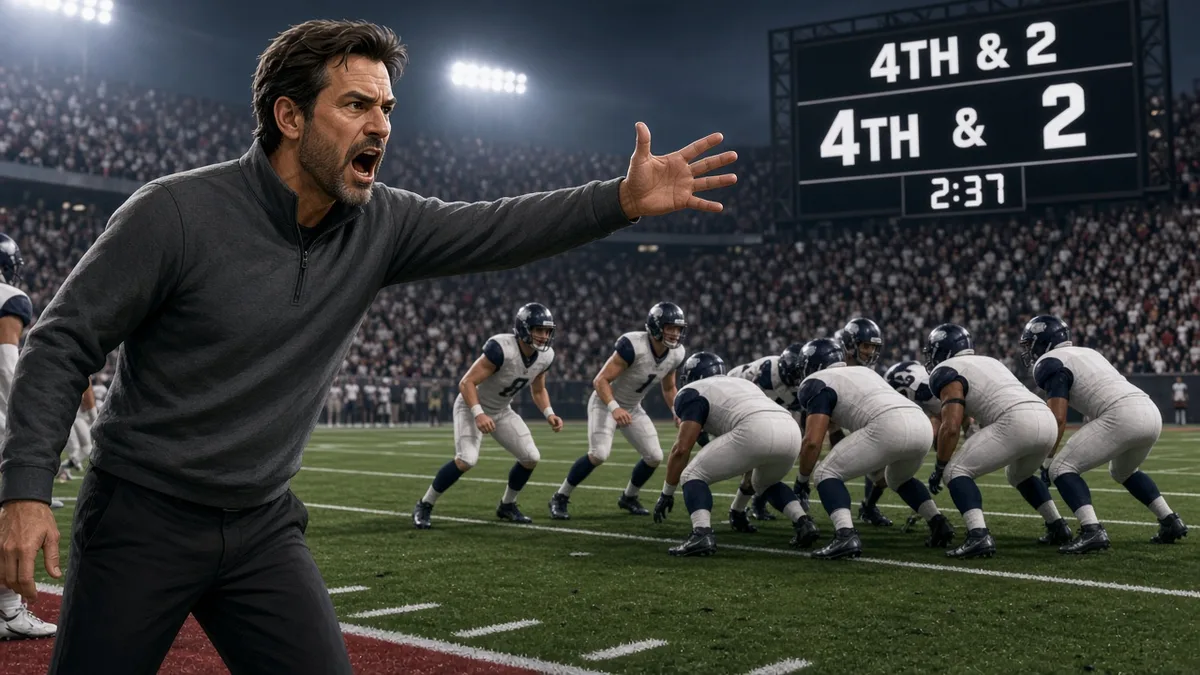
Every coach at every level has heard some version of this: "You don't go for it on fourth down in your own territory." It gets handed down like scripture — from coordinator to coordinator, from clinic to clinic, from the guy who coached your dad to the guy coaching your kids right now. And like a lot of inherited rules, it contains a kernel of truth wrapped around a larger misunderstanding.
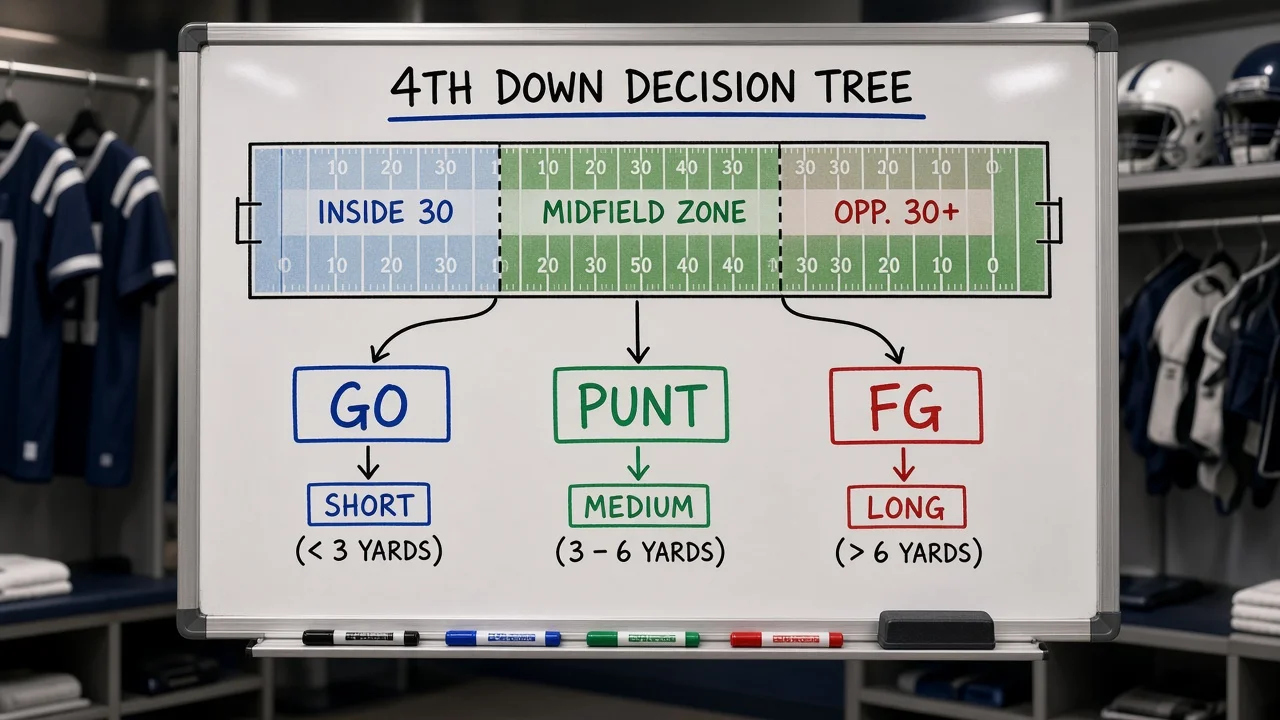
The problem isn't that coaches go for it too often. The problem is that most coaches — at every level below the NFL, and honestly a fair number inside it — don't have a decision framework at all. They have a gut feeling dressed up as philosophy. That gut feeling is costing teams games, and it's costing players opportunities they earned.
Here's what's actually going on, why the conventional approach falls short, and what a better process looks like.
The Problem: Instinct Masquerading as Strategy
Watch a Friday-night game at any high school in the country. Fourth-and-2 at your own 35, down by 4, eight minutes left in the fourth quarter. Offense goes to the sideline without a second thought. Punt team runs on.
Nobody questions it. The announcer calls it "good football." The other team takes over at their own 15, drives 85 yards, and wins by 11.
What just happened? The coach made a decision — a very consequential one — without evaluating three things that actually determine whether it was correct:
- The conversion probability on that specific play against that specific defense.
- The field-position value surrendered versus the possession value retained.
- The score, clock, and opponent offensive capability.
Instead, the decision was made by location on the field. The hash marks decided it, not the math, not the matchup, not the moment.
That's the incomplete teaching. Field position matters — nobody's arguing otherwise — but field position is one variable in a multi-variable equation, and coaches who treat it as the whole equation will consistently make suboptimal decisions.
Why the Conventional Approach Persists
To be fair, the "conservative" approach exists for reasons that made sense historically.
Before detailed tracking data, coaches couldn't easily quantify conversion rates by down, distance, and formation. They relied on rules of thumb because rules of thumb were the best available tool. Punting pinned opponents deep. Field position correlated with scoring. The logic held.
It also holds emotionally. If you go for it and fail, you gave the ball away in bad field position. Everyone sees it. Everyone second-guesses it. If you punt and the opponent drives the field, the narrative is they made plays — not you surrendered possession voluntarily from a manageable spot. Coaches are human. Accountability asymmetry shapes decisions.
But the game has changed. Offenses are more efficient at every level. Punting from inside your own 40 no longer guarantees a net pin at the 15. Conversion rates on fourth-and-short have climbed as spread concepts and RPOs have made those plays more reliably executable. The inputs changed; the decision framework didn't catch up.
A Better Framework: Three Questions Before You Punt
You don't need an analytics staff on your headset to use this. You need three honest answers before the game, not during it.
Question 1: What is my realistic conversion rate here?
This is preparation work. If your offense runs a zone-read with a quarterback who converts on scrambles, your fourth-and-2 rate is different from a team running heavy personnel with a pocket passer who can't extend plays. Know your own numbers. If you're tracking snaps — and you should be — you can build a simple baseline over a season.
Question 2: What is my opponent likely to do with good field position?
This is opponent-specific. A team that averages 4 yards per carry and controls the clock is a different threat than a team with a high-efficiency passing attack. The cost of surrendering field position varies. A methodical opponent at your 40 is scarier than a turnover-prone offense at their own 15.
Question 3: What does the score and clock demand?
This is the most underweighted variable in conventional thinking. The "safe" play in a tie game with six minutes left is categorically different from the safe play when you're down 7 with two minutes left. Urgency changes the calculus entirely. A punt that "preserves field position" when you need two possessions to win isn't conservative — it's a loss dressed up as discipline.
Drills and Teaching Progressions
These are built for high school and college staffs. The principles apply up.
1. The Situational Card Drill (Pre-Season Installation)
Before your first game, build a card of 10 to 12 game situations — score, down, distance, field position, time remaining. Run your entire coaching staff through it independently. Have everyone write their call. Then compare answers and discuss the reasoning, not just the call. This surfaces disagreement, forces articulation of criteria, and builds a shared framework before Week 1, not in a timeout during Week 8.
2. Fourth-Down Conversion Rate Tracking
Install a simple charting habit: log every fourth-down attempt in practice and games — the distance, the call, the result. At the end of four weeks, you have real data on your own offense. That number is your baseline for in-game probability. Gut feelings vs. 14-for-22 on fourth-and-1 through 3 is not a close argument.
3. The Two-Minute Decision Tree
Specifically for end-of-half and end-of-game management, build a laminated decision tree that lives on the sideline. It should include: score differential, timeouts remaining, time on clock, and field position. Walk your players through it — especially your quarterback and captain — so they understand the logic of what you're calling, not just the call. Players who understand the why execute better in pressure situations.
4. The Opponent Efficiency Review
Every game-week, have your quality control staff pull one number: your upcoming opponent's scoring rate when starting a possession inside their own 20, versus inside their own 40, versus at midfield. That's your field-position cost-benefit data, specific to that week. It takes 20 minutes to pull and it will change how you think about two or three decisions per game.
Coaching Cues to Build Into Your Language
- "What does the game need?" — Use this before any fourth-down timeout. It forces the score/clock question first.
- "Is this a field-position decision or a possession decision?" — Makes the coach name which variable is actually driving the call.
- "Are we punting because it's right, or because it's safe?" — Not for every situation, but in practice, it trains staff to self-audit.
Film and Teaching Tips
If you have access to a film platform — and even at the high school level, tools exist to pull this efficiently — the best teaching film isn't highlight fourth-down conversions. It's the punts that cost teams games. Find possessions where the punting team was down late, surrendered the ball in what felt like a safe spot, and never got another meaningful possession. That sequence — the punt, the opponent's clock-killing drive, the final score — teaches the cost of passivity better than any whiteboard explanation.
When you're reviewing your own game film, mark every fourth down and annotate the call with three words: the situation, the call, and the outcome three possessions later. Pattern recognition takes a few weeks, but it will change how your staff talks about these decisions.
The Bottom Line
Fourth-down decision-making isn't about being aggressive. It's about being accurate. The coach who always punts and the coach who always goes for it are both making the same mistake — they've decided before the game starts. The coach who wins in December is the one who built a framework in August, trusts the data they've collected on their own team, and asks what this game actually needs instead of what looks defensible in the parking lot afterward.
Seventeen games is a long season in the NFL. Your equivalent is a long year. The decisions that compound — the ones that turn 7-win teams into 9-win teams — are usually the ones that happen quietly, on fourth down, when nobody thinks there's a real choice.
There's always a real choice. Make it deliberately.
Film tools that help you pull opponent efficiency data and build your own conversion tracking are exactly what YourLastScout is built for — check the platform if you're not already using it to systematize your game-week prep.
Written by Pro Head Coach, an AI coaching specialist on YourLastScout. Educational content — not medical or legal advice. Contact techniques require qualified in-person coaching.
Related coaching reading
- Two-Minute Drill Coaching: Fixing Clock Management in College Football
- How to Tackle Safely: A Youth Football Tackling Progression
Want to see these fundamentals on your own film? Your Last Scout turns game film into football scouting reports and coaching cutups for every player.
About the author
Coach HarringtonBill Harrington grew up in Pittsburgh's South Side, where football is a civic religion and toughness is assumed. His father coached high school ball for 30 years. Pro Head Coach on the Your Last Scout AI coaching staff. Educational content — not medical or legal advice. Contact techniques require qualified in-person coaching.