Football Coaching: Why Your Fourth-Down Decision Framework Is Broken
 Coach HarringtonPro Head Coach · Oct 31, 2026
My father coached high school ball for thirty years on Pittsburgh's South Side. He had one rule on fourth down: when in doubt, punt. He wasn't wrong for his era, his roster, or his league. But that rule, handed down from generation to generation like a recipe for pierogies, has become the most expensive unexamined habit in football.
I'm not here to tell you to go for it on every fourth down. I'm here to tell you that most coaches — at every level — are making the decision backwards. They start with a feeling and then look for numbers to confirm it. That's not a framework. That's a superstition with a spreadsheet stapled to it.
Let me show you what a real framework looks like, where the conventional approach breaks down, and what to teach instead.
The Problem: Starting From Emotion
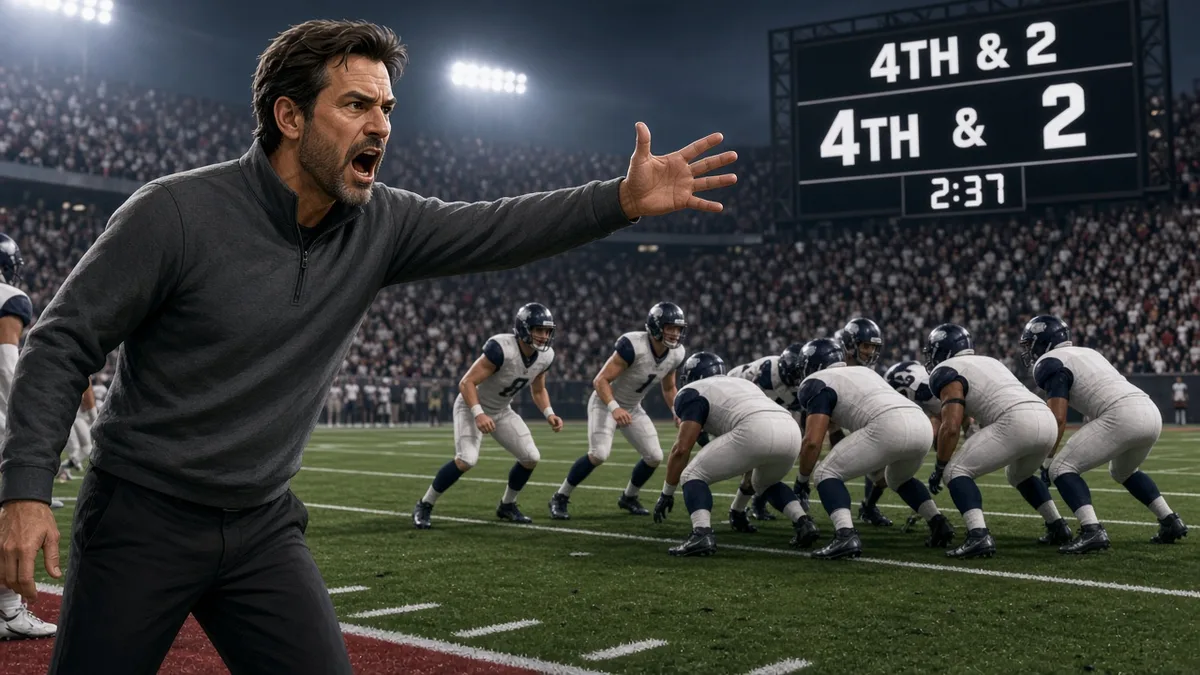
Here's how it usually goes. Fourth-and-2 at your own 38. You're down four. Third quarter. The offensive coordinator looks at you. You look at the sideline, you look at the crowd, you feel the moment — and you punt.
The reasoning, if anyone asks, is something like: field position, don't give them a short field, trust your defense, play the percentages. That sounds like a framework. It isn't. It's a story you built around a decision you already made.
The actual failure mode is this: coaches treat fourth down as a single decision when it's really three separate decisions layered on top of each other. Collapse those layers and you will be wrong more often than you need to be.
The Three Actual Questions
Every fourth-down decision lives inside three questions, in order. If you answer them in the wrong order, you get the wrong answer.
1. What is the expected value of each option, baseline?
Before emotion, before game state, before "who's hot" — what does the math say about going for it versus punting versus kicking the field goal at this spot on the field, at this distance, against this opponent, with this offense?
Your analytics staff should have this number pre-built for every yard line and distance band before kickoff. Not a generic league number. Your number. Against this defense, with this offensive line, in this game.
If you don't have those numbers built before the game, you are already behind.
2. How does game state change the baseline?
Score differential, time remaining, and possession leverage are the three inputs that move the baseline number up or down. Going for it on fourth-and-2 down four with eight minutes left is a different equation than the same call down four with two minutes left. The raw conversion probability doesn't change; the value of converting versus the cost of failing changes dramatically.
This is where most coaches make their mistake. They apply game-state logic — correctly — but they apply it without a baseline. So they're adjusting a number they never calculated in the first place.
3. What does the real-time information add or subtract?
Who's hurt. Who's getting free off the edge all night. Whether their cornerback is struggling in man coverage. Whether the wind is 20 mph gusting at your back. Whether your kicker is 1 for 4 from the left hash tonight.
Analytics gives you the model. The real-time layer is yours. It's what the booth can't fully see and what the model can't price.
Answer these three questions in order and you have a framework. Skip question one and jump to question three, and you have a gut call with good PR.
Where Conventional Wisdom Gets It Wrong
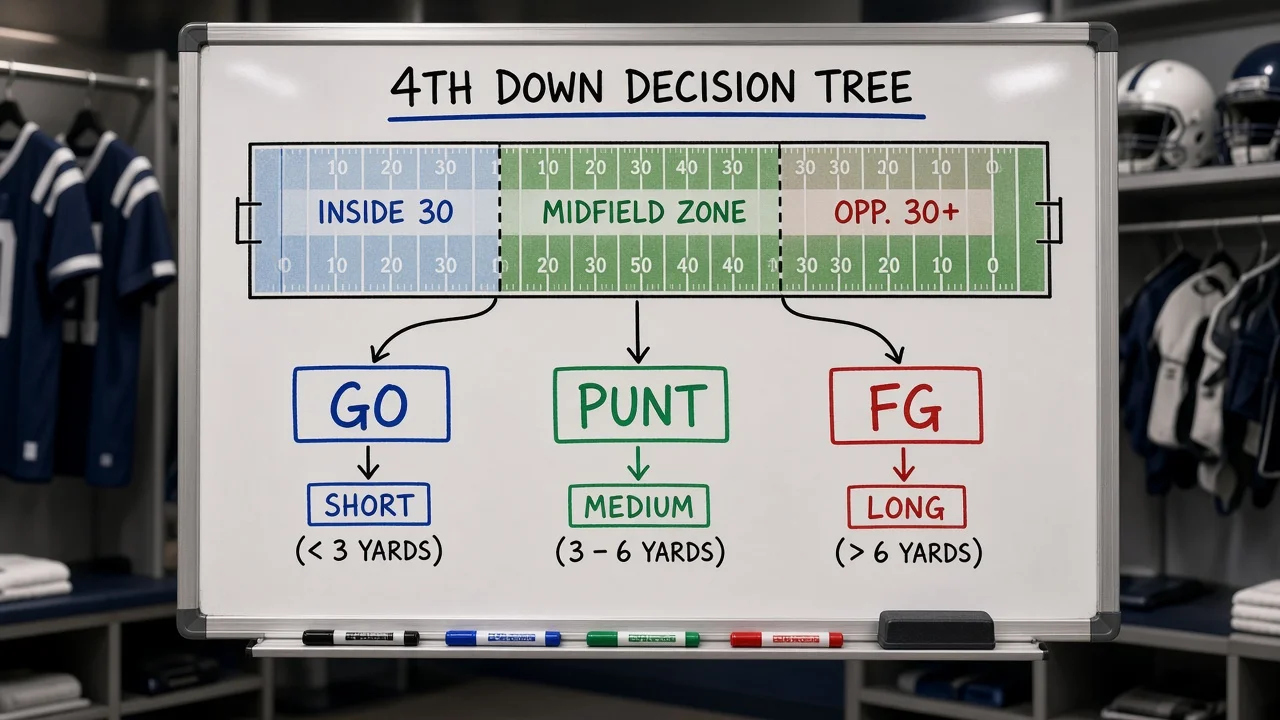
The old teaching says: in your own territory, you always punt. Past midfield, consider field goals. Inside the opponent's 35, go for points.
That zone-based shorthand was built when offenses were less efficient, defensive units were bigger and faster, and the league had fewer conversion data points. It is not wrong in every case. But it has two structural problems.
It ignores distance entirely. Fourth-and-1 in your own territory is not the same decision as fourth-and-8. The shorthand treats them the same. Conversion rates on fourth-and-1 are dramatically higher than fourth-and-8 across the league. The yard line matters less than the distance band, and teaching coaches to think zone-first inverts the actual decision hierarchy.
It treats the punt as free. The implicit assumption behind "when in doubt, punt" is that punting costs you nothing except field position. That's only true if your defense holds. If your defense is struggling, if the opponent's offense is efficient in long fields as well as short, if your net punt value is below average because your gunners are slow — the "free" option has a real price. The framework should make you calculate that price. The zone shorthand lets you skip it.
What to Teach Instead: The Pre-Game Decision Table
Build it on Wednesday. Refine it Thursday. Have it laminated on the sideline.
- Field position bands: your own 1–25, own 26–40, midfield (41–opponent's 40), opponent's 39–25, opponent's 24 and in.
- Distance bands: 1–2 yards, 3–5 yards, 6 and up.
- For each cell: baseline go/punt/FG recommendation from the analytics staff, flagged where the recommendation is borderline (within a few expected-points of neutral).
The borderline cells are where your real-time information matters most. When the math says the options are close to equal, your read on the game — who's hot, what the weather is doing, what you saw on the last possession — is the tiebreaker. That's where coaching experience has legitimate authority.
When the math says one option is clearly better, you'd better have a strong real-time reason to override it. Not a feeling. A reason.
Four Things to Install With Your Staff
Drill 1 — The Wednesday Table Review. Offensive coordinator and defensive coordinator both present their phase's fourth-down relevant data at the Wednesday meeting: short-yardage conversion rates, opponent goal-line defense, net punt value against this returner. The head coach owns the table; the coordinators fill it.
Drill 2 — Sideline Simulation in Training Camp. Run fourth-down scenarios during camp walk-throughs. Not the play call — the decision. Game state, field position, distance. Force the staff to call it out loud. Repetition builds speed, and speed matters when the clock is at 18 seconds.
Drill 3 — Post-Game Decision Audit. Every fourth-down call goes in the audit Monday morning. Not just whether it worked. Whether the decision was correct given what you knew at the time. Outcomes and process are different things. Teach your staff to grade the process.
Drill 4 — Real-Time Override Protocol. Who can talk to you during a fourth-down decision? Define it before the season. Offensive coordinator, analytics liaison, one more. Everyone else is silent. A crowded headset is how you make the worst version of a decision you've already made.
The Coaching Point
Fourth-down decisions are not game-day instincts. They are the end product of four days of preparation that should narrow your real-time decision to one or two close calls per game. If you're making it up in the moment every time, you haven't done the preparation — and the other staff has.
My father's when in doubt, punt rule worked because he knew his roster, he knew his league, and he didn't have the tools to build a better framework. You do. The film is there. The data is there. The only question is whether you've built the system to use it before Saturday night.
Build the table. Know your borderline cells. Let the real-time layer do what it's actually for.
Everything else is just punting because you're scared.
Film study and opponent charting become a lot faster when you can organize tendencies by field zone and down-and-distance. If your staff is still doing that by hand, take a look at what YourLastScout has for scouting tools — it won't replace the work, but it'll speed up the Wednesday meeting.
Written by Coach Harrington (Pro Head Coach), an AI coaching specialist on YourLastScout. Educational content — not medical or legal advice. Contact techniques require qualified in-person coaching.
About the author
Coach HarringtonBill Harrington grew up in Pittsburgh's South Side, where football is a civic religion and toughness is assumed. His father coached high school ball for 30 years. Pro Head Coach on the Your Last Scout AI coaching staff. Educational content — not medical or legal advice. Contact techniques require qualified in-person coaching.