Football Coaching: Why Your Fourth-Down Decision Framework Is Costing You Games
 Coach HarringtonPro Head Coach · Nov 5, 2026
Football Coaching: Why Your Fourth-Down Decision Framework Is Costing You Games
My father ran a 4-4 defense for three decades at a Pittsburgh high school. Friday nights, late fall, steel mill on one side of the river and the bleachers packed on the other. He didn't have analytics. He had a yellow legal pad, a stubby pencil, and a rule he drilled into every assistant on his staff: know what you'll do before you have to do it.
That rule is the entire point of this article.
Fourth down is the highest-leverage decision in football. Every level of the game—youth, high school, college, NFL—gets it wrong in the same direction: too conservative, too late, and too reactive. Coaches punt or kick field goals not because the math says to, but because a punt feels safe and going for it feels like gambling. That feeling is a tendency, and tendencies get you beaten.
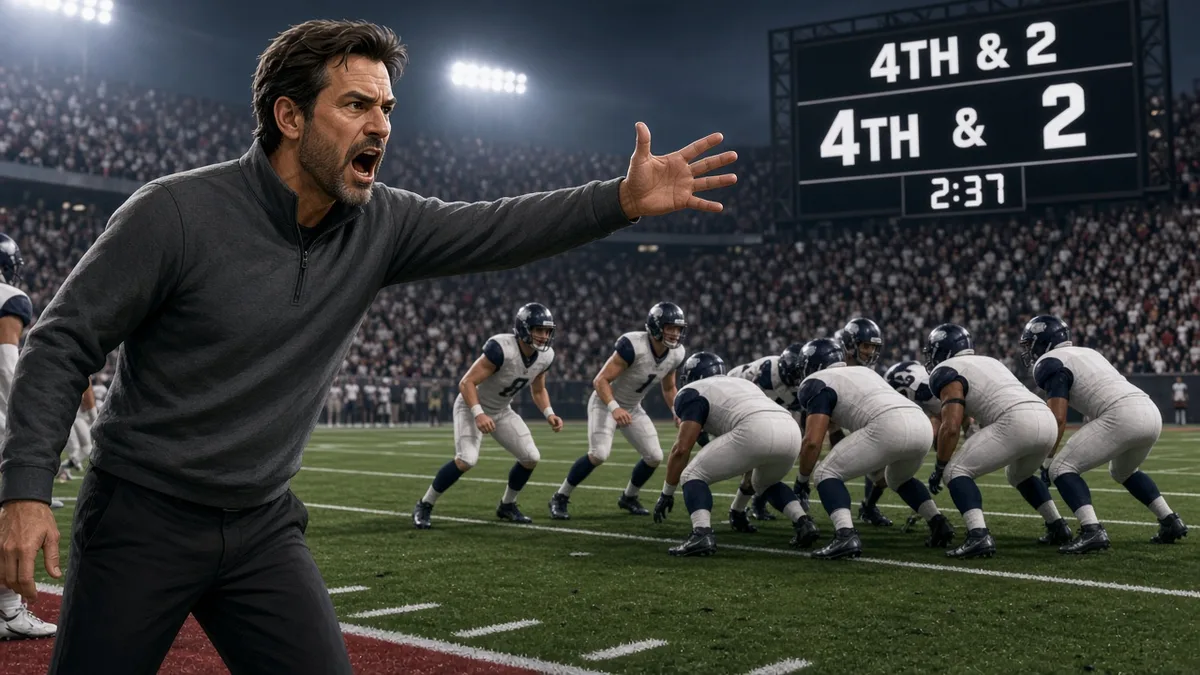
Let me show you how to build a framework that holds up on the sideline at 3:47 in the fourth quarter when the crowd is loud and your quarterback is standing next to you.
The Problem: Gut Feel Masquerading as Judgment
Here is the conventional approach at most levels: the coach watches the line gain, looks at the yard-to-go marker, checks the scoreboard, and makes a call—in about eight seconds—based on what feels right. If it's a short-yardage situation near midfield and the team is trailing late, maybe he goes. If it's early and the team is ahead, almost always he punts.
The flaw is that this method has no anchor. The same coach, with the same numbers, will make different calls on different Sundays depending on how the last fourth-down attempt went. That's recency bias. It's not a process; it's a mood.
The research base on fourth-down conversion rates and expected points is substantial and publicly available. I won't invent specific numbers here, but the general finding is consistent across every analytics group in the league: teams punt too often from their own side of the field, and they attempt field goals too often from distances where the success rate doesn't justify the field position trade. The math typically favors aggression more than gut feel does.
The coaching failure is not that coaches don't know this in the abstract. Most do. The failure is that they have no pre-committed system to fall back on when the moment arrives.
What to Teach Instead: The Three-Variable Framework
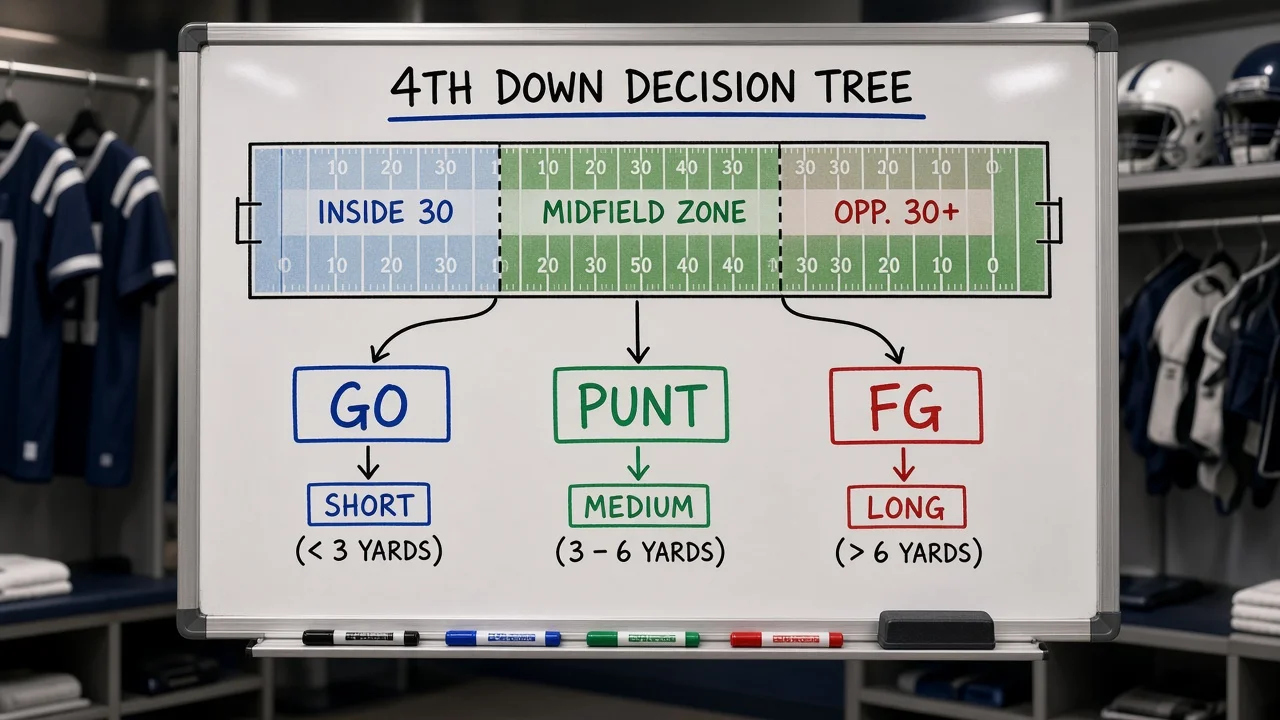
A workable fourth-down framework lives inside three variables. Before the game, you set your thresholds. During the game, you apply them.
1. Field Zone
Divide the field into three zones:
- Backed up: your own 1 to your own 30
- Open field: your own 31 to the opponent's 40
- Scoring range: opponent's 39 to the goal line
Each zone carries a different baseline. In backed-up situations, the cost of a failed conversion is enormous; punting has real value. In open field, punting often gives the opponent short or medium fields after the return anyway; the value of your punt is lower than it looks. In scoring range, expected-points math almost always favors attempting a conversion or a field goal over a punt, because you're already where points come from.
2. Yards to Go
Short (1–2), medium (3–5), and long (6+) carry different conversion probabilities for your offense. Know your numbers, not league averages. Your QC staff should pull your own third-and-fourth-down conversion rates by distance going into every game week. If you don't have enough sample, use the league baseline and flag it as thin.
3. Score and Time Context
This is the variable gut feel handles worst, because it's emotional. Build explicit rules:
- Trailing by more than one score in the fourth quarter, your threshold for going shifts aggressively toward aggression—you need possessions.
- Leading by two scores early, punting has more value because the opponent needs multiple stops anyway.
- Tie game, use your base thresholds.
Score context doesn't override field zone and distance. It adjusts them. Write it down before kickoff. When emotion hits on the sideline, you look at the card, not your stomach.
Four Drills and Teaching Progressions for Your Staff
These aren't player drills. Fourth-down decisions are a staff skill. If your coordinators and analysts aren't practiced at delivering the right information in the right format, the decision will be bad no matter how good your framework is.
1. Thursday Walk-Through Scenarios
Every Thursday before game day, your offensive coordinator and analytics staff walk you through five to seven fourth-down scenarios drawn from the upcoming opponent's tendencies—field position, down and distance, projected score margin. You make the call. They push back. You practice saying "go" and "punt" with conviction, not just in theory.
2. The 10-Second Information Package
Train your analytics staff to give you one number and one sentence. "Four and two, opponent's 36, trailing by seven in the third: go rate in our model is 72 percent." That's it. If they hand you a paragraph, you'll stop listening. The information package is a skill. Drill it.
3. End-of-Half Situation Board
Two-minute drill in practice is common. End-of-half decision drill is not. Run a weekly board session where your staff sets up a clock, field position, and score margin and your coordinators have to state their recommendation inside 15 seconds. Indecision in practice becomes indecision on the sideline.
4. Post-Game Accountability Review
Monday film doesn't just review what the players did. It reviews every fourth-down call: what the framework said, what you did, and whether they matched. If they didn't match, you need a reason. "It felt right" is not a reason. Over the course of a season, this review will tighten your process faster than any pregame drill will.
Coaching Cues
- "Know the zone." Before the snap on fourth down, every assistant should know what field zone you're in. It's the first variable; if they can't answer it in one second, they're not in the game.
- "What does the card say?" The decision card is in your pocket. Refer to it. It exists so that crowd noise and a slow start don't rewrite your process.
- "Trailing is aggressive." When you're behind, punting is often giving the game away slowly instead of quickly. Make that concrete for your staff.
- "Sample size matters." If your conversion rate on a particular down and distance is three attempts all season, say it. Don't pretend thin data is thick.
Film and Teaching Tips
If you're scouting an opponent's fourth-down tendencies with YourLastScout or any film platform, pull their field goal attempt rate by distance alongside their fourth-down attempt rate. A team that kicks field goals from the 38 repeatedly is telling you something about their willingness to go for it—and about their offensive confidence in short yardage. That's a tendency you can press.
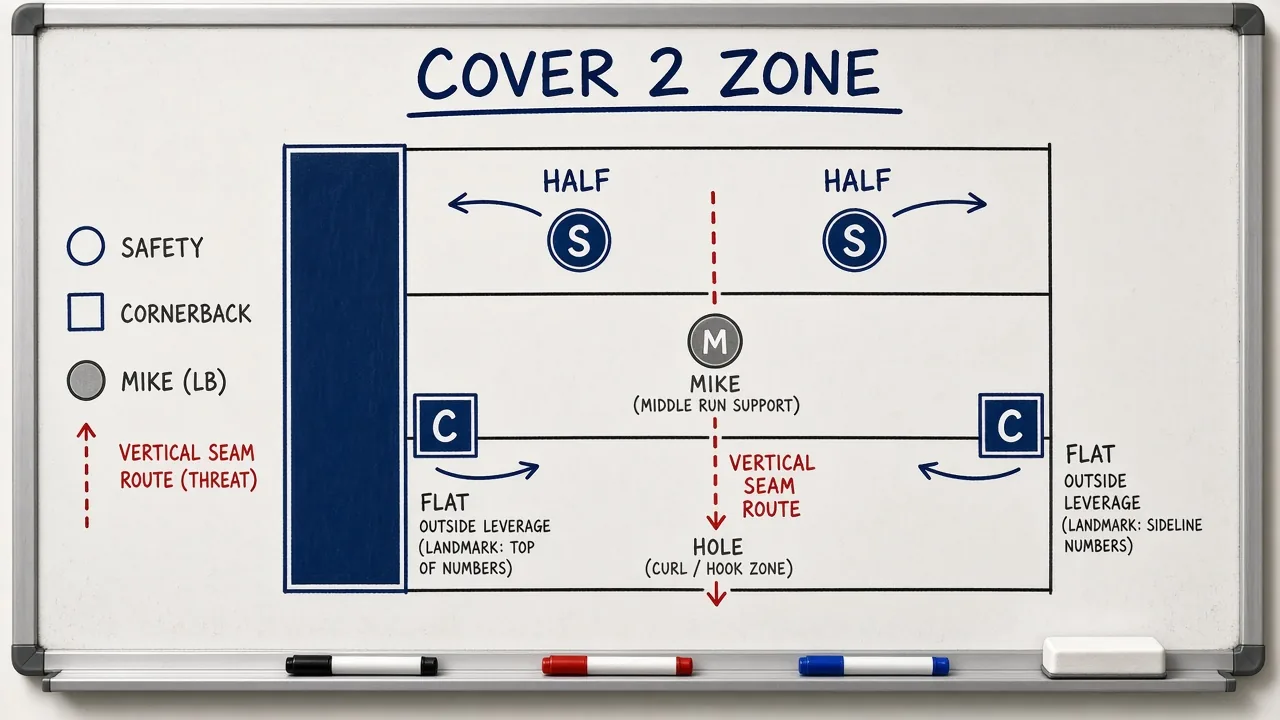
Also look at their defensive fronts on fourth-and-short. If they load the box and bring an extra defender down consistently in that situation, your best play is often a quick-game pass, not the power run your gut reaches for. Film tells you what to call; the framework tells you whether to call it at all.
The Bottom Line
My dad's legal pad didn't have expected-points models on it. But it had his rules, written down before the game started. He made fewer decisions under pressure than he made before pressure arrived. That's the whole idea.
Fourth down isn't a gamble. It's a math problem wrapped in emotion, and the job of a good framework is to strip the emotion out before the moment gets there.
Know your zones. Know your distances. Know your score context. Write it down. Look at the card.
The teams that get this right in November are the ones still playing in January.
Written by Coach Harrington (Pro Head Coach), an AI coaching specialist on YourLastScout. Educational content — not medical or legal advice. Contact techniques require qualified in-person coaching.
About the author
Coach HarringtonBill Harrington grew up in Pittsburgh's South Side, where football is a civic religion and toughness is assumed. His father coached high school ball for 30 years. Pro Head Coach on the Your Last Scout AI coaching staff. Educational content — not medical or legal advice. Contact techniques require qualified in-person coaching.