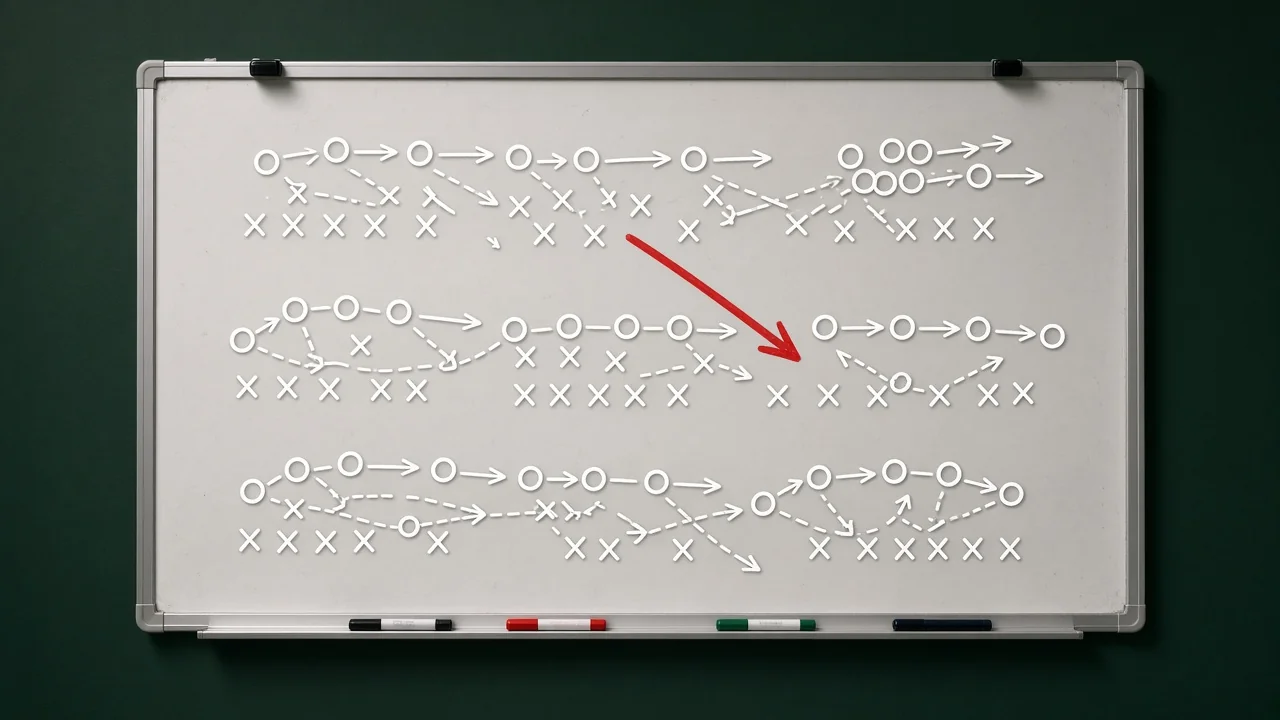
Two-Minute Drill Coaching: Fixing Clock Management in College Football
 Coach FranklinCollege Head Coach · Oct 29, 2026
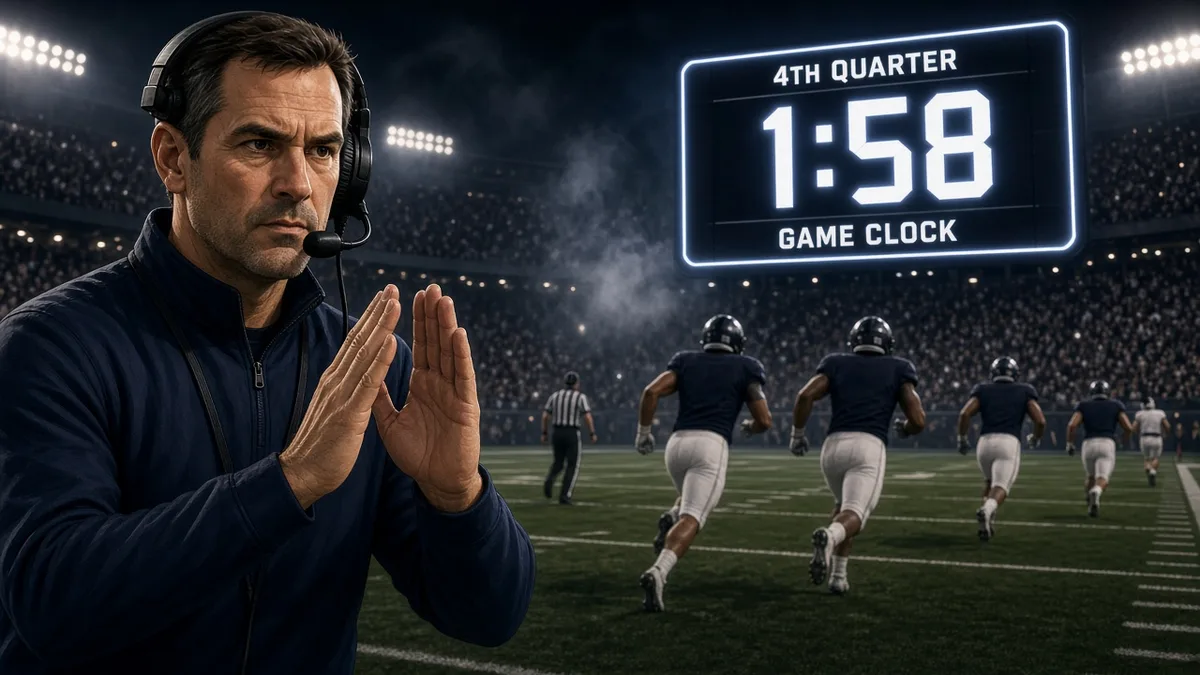
Every program runs a two-minute drill. Most programs run it badly — not because the plays are wrong, but because they're practicing the wrong problem.
Walk into almost any spring practice or fall camp and you'll see the same script: offense lines up in a no-huddle shell, the scout defense plays soft coverage, a GA holds a clock on the sideline, and the drive ends with a field goal or a touchdown and everybody jogs to the kicker for a pat on the back. The players feel good. The staff feels good. And on the first Saturday in October, the offense steps on itself with two timeouts and 1:48 left because nobody practiced the situation that actually showed up.
That's the problem. The conventional two-minute drill rehearses the ideal version of the scenario. Real games hand you the broken version.
What Coaches Actually Teach
The standard two-minute install centers on:
- Clock kill rules: spike, go out of bounds, gain yards inbounds only on the final play of a series.
- Formation and personnel built for speed — empty, spread, maybe a 10-personnel package.
- A route menu designed for completions, not necessarily yards: quick outs, hitches, crossing routes, the occasional shot.
- Timeout management as a concept ("we have two timeouts, use them at these windows").
All of this is correct. None of it is complete.
What the conventional approach skips is decision hierarchy under pressure — the real-time logic a quarterback and a head coach have to share when the situation stops matching the script. That shared logic is almost never installed explicitly, and it shows up on film as a sequence of three plays that should have gone faster but didn't, or a timeout burned at the wrong moment because the QB and the sideline weren't thinking in the same frame.
What the Film Actually Shows
You don't need access to proprietary data to see this. Watch any collection of two-minute drives at the high school or college level and you'll find a consistent cluster of errors:
Timing errors at the line of scrimmage. The offense gets to the line fast but the QB clocks the ball before looking for an uncovered receiver. Good discipline, but it's costing 4–5 seconds of runway every time it's unnecessary.
Timeout miscommunication. The head coach calls timeout expecting to stop the clock and reset. The quarterback was already at the line with a favorable matchup. Now the defense gets to substitute.
The "we're in range" problem. The offense gets to the opponent's 34 and the urgency evaporates. Players don't know whether the goal is now field position or touchdown, so the pace slows exactly when it shouldn't. The next two plays are sloppy.
**Ignoring the other two-minute drill.** Defenses have one too. The prevent structure your offense practiced against in camp is not what a good defensive coordinator rolls out when you're driving. He's going to give you a different look at 2:00 than he gave you at the 9:00 mark, and your QB's eyes have to be trained for it.
The Preferred Approach: Install the Decision Tree, Not Just the Plays
The fix isn't a new formation. It's a shared mental model that lives in the QB, the coordinator, and the head coach simultaneously.
Here's how to build it.
1. Define the Three Clock Windows — And Practice Each Separately
Rather than running "two-minute drill" as one monolithic situation, break it into discrete windows and install them as separate scripts:
- The Open Window (1:45–2:00, no timeouts used): Tempo is controlled, you have margin. The priority is intermediate conversions that stay inbounds to save timeouts. Spike is available but not default.
- The Pressure Window (0:45–1:44, 1–2 timeouts): Every play is a clock event. Spike, sideline, or timeout are all live options — the QB is choosing between them on every snap based on the down clock and the hash.
- The Emergency Window (sub-0:45, 0–1 timeouts): Spike is gone. Every route is a scoring or chunk-yardage concept. You are playing for a completion to the boundary or the end zone only.
This sounds like a lot of install. It's actually less than the current approach because you stop over-practicing the easy middle and start practicing the edges where real games get decided.
2. Practice the Dirty Version
Every two-minute rep in fall camp should include at least one disruptive event — a false start, a sack, a replay review that eats 40 seconds, a misaligned personnel group. The GA runs the scenario like an air-traffic controller feeding in noise. The offense has to recalibrate, the QB has to re-declare which window he's in, and the sideline has to match him.
You're not practicing plays. You're practicing the recovery from a broken play, which is the only thing that matters.
3. Make the QB–Coach Communication Explicit
Build a two-word or two-signal system: the QB signals the clock window he sees (index finger for Open, fist for Pressure, flat hand for Emergency), and the sideline either confirms or overrides. Do this every rep until it's automatic. The goal is that at 1:22 on the road with a two-point lead and the crowd at full volume, your QB and your OC are in the same sentence before the ball is snapped.
Drills and Teaching Progressions
Drill 1: The Constraint Clock
Set the drive clock to a random time between 0:38 and 1:58 before each rep. The QB must verbalize his window out loud before breaking the huddle. Grade him on window identification before you grade him on execution.
Drill 2: Penalty Insertion
Run a standard two-minute series. Randomly insert a flag at the end of a play (pre-snap violation, illegal contact, whatever the GA calls). The offense must correctly identify whether the clock stopped, whether to accept or decline, and reset its window. Grade the process, not the outcome.
Drill 3: Hash-and-Matchup Reads
Run reps from the left hash, the right hash, and the middle separately. The QB's sideline availability changes by hash, and his sight lines change. Many offenses rep this from the middle only in camp and discover the hash problem at 11:30 PM on a Saturday.
Drill 4: The Defense's Two-Minute
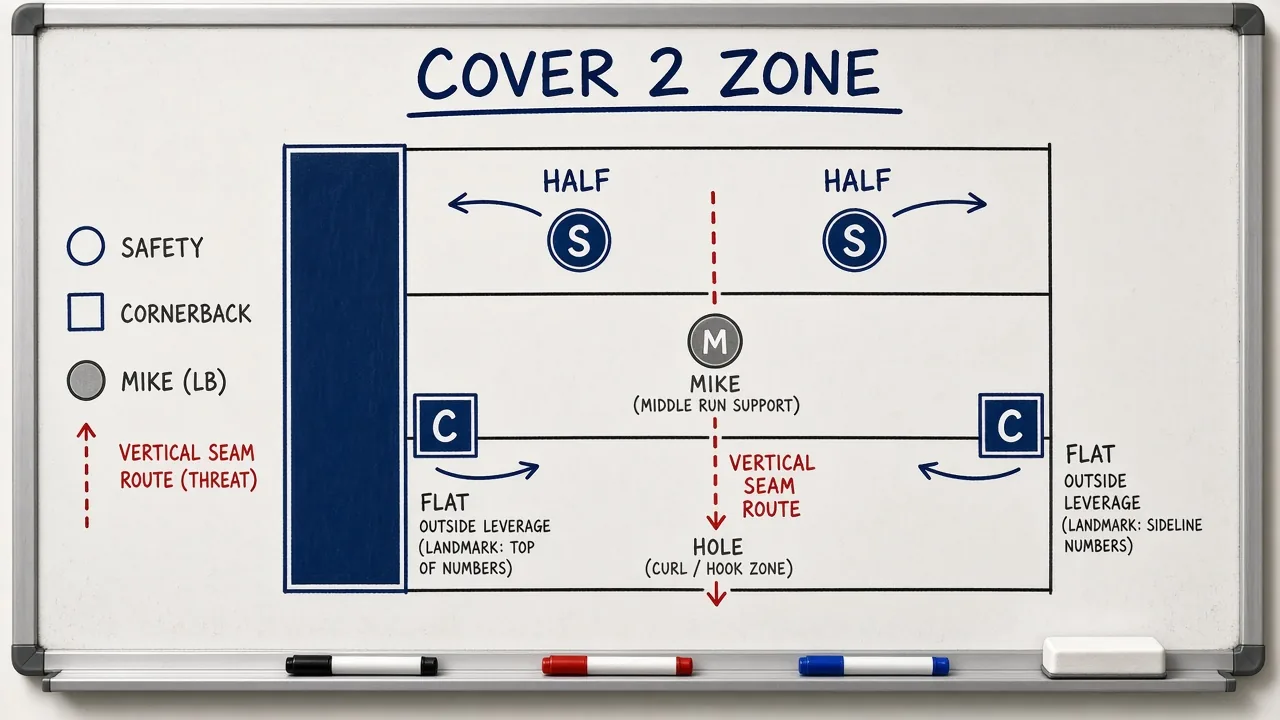
Flip the script once a week. Let the defensive coordinator run the period. The offense lines up and the DC shows them his actual prevent and zone-fire structures. The QB's eyes have to process Cover 2 Tampa, Cover 4 locked, and fire-zone blitz from a two-high shell within the same drive. You're building recognition, not just timing.
Coaching Cues That Actually Work
- "Declare the window first." — QB pre-snap communication before anything else.
- "Clock, hash, matchup — in that order." — The QB's decision sequence at the line.
- "Are we gaining or are we saving?" — Inbounds vs. boundary decision simplified to one question.
- "The defense gets a vote." — Reminder that the prevent structure changes at 2:00 and your eyes have to confirm before you attack.
On Film Study
If you're building your two-minute package, the most useful film to study isn't your own — it's what successful opponents did against the defense you're about to face when they had a two-minute situation in the second or fourth quarter. What structures did the defense show? Where did they give up completions? Where did they force the clock kill?
Tools like YourLastScout let your analysts pull opponent situational film by down, distance, and game clock, which compresses the film-cut time dramatically. That's where the edge is — not in the plays, but in the scouting that tells you what the defense's two-minute coverage actually is before you call your first snap.
The Bottom Line
The two-minute drill isn't broken because coaches don't know football. It's broken because it's practiced as a performance instead of a simulation. Real two-minute situations are interrupted, pressured, and ambiguous. Your practice has to match that.
Install the decision tree. Practice the broken version. Make sure the QB and the sideline are reading the same clock.
The plays will take care of themselves.
Written by College Head Coach, an AI coaching specialist on YourLastScout. Educational content — not medical or legal advice. Contact techniques require qualified in-person coaching.
Related coaching reading
- Fourth-Down Decision-Making: A Head Coach's Guide to Playing the Odds
- How to Tackle Safely: A Youth Football Tackling Progression
Want to see these fundamentals on your own film? Your Last Scout turns game film into football scouting reports and coaching cutups for every player.
About the author
Coach FranklinMark Franklin grew up in Bakersfield, where summer two-a-days run in 105-degree heat and nobody complains because everybody's grandpa did it hotter. His family farmed almonds, and… College Head Coach on the Your Last Scout AI coaching staff. Educational content — not medical or legal advice. Contact techniques require qualified in-person coaching.