Youth Football Coaching: Teaching Kids to Tackle Without Leading with the Head
 Coach ReyesYouth Head Coach · Nov 5, 2026
Youth Football Coaching: Teaching Kids to Tackle Without Leading with the Head
Here in Fresno, August practice means 98 degrees by 4 p.m. and kids who have been running around all summer and think they already know how to tackle because they've been watching highlights. They come out the first day and they're going headfirst into everything — the dummy, each other, the tackle bags. Heads down, eyes closed, full send.
I love the energy. I have to fix the technique.
Tackling is the most important physical skill in this game, and it's also the one coaches most often rush. We demo it once, let kids rep it at half-speed, call it good, and then wonder why someone's getting flagged for targeting or coming off the field holding their neck. After eight years of coaching youth football, I'm convinced the problem isn't that kids are reckless. It's that we teach them the result — "wrap him up" — before we teach them the foundation that makes wrapping up safe.
Let me show you what I mean, and what to do instead.
The Problem: We Teach the Finish Before the Setup
Ask most youth coaches what good tackling looks like, and they'll describe the moment of impact: wrap the arms, drive through, put them on the ground. That's not wrong. But it skips the three things that have to happen before contact that determine whether a kid is safe and effective, or just a nervous 10-year-old diving headfirst and hoping for the best.
Those three things are:
- Eyes up, chin off chest. The head has to be out of the tackle. "See what you hit" is the old cue and it still works.
- Leverage position before contact. Bend at the knees, not the waist. If a kid's nose is closer to the ground than their belt, they're in the wrong position.
- Foot position at contact. The last step before the hit should close the gap and put the kid in a base. Contact on a single leg means a missed tackle and a possible injury.
The conventional approach — showing the wrap-and-drive, drilling it full-speed right away — skips all of this and goes straight to the exciting part. Kids who skip the setup get away with it sometimes, especially when they're bigger. But at some point they'll run headfirst into someone their own size and wonder what happened.
Teach the setup first. The finish takes care of itself.
What to Teach Instead: The Four-Step Progression
I run this progression the same way every year, from the first week of contact through the first game. It's slow, it feels boring to the kids, and it works.
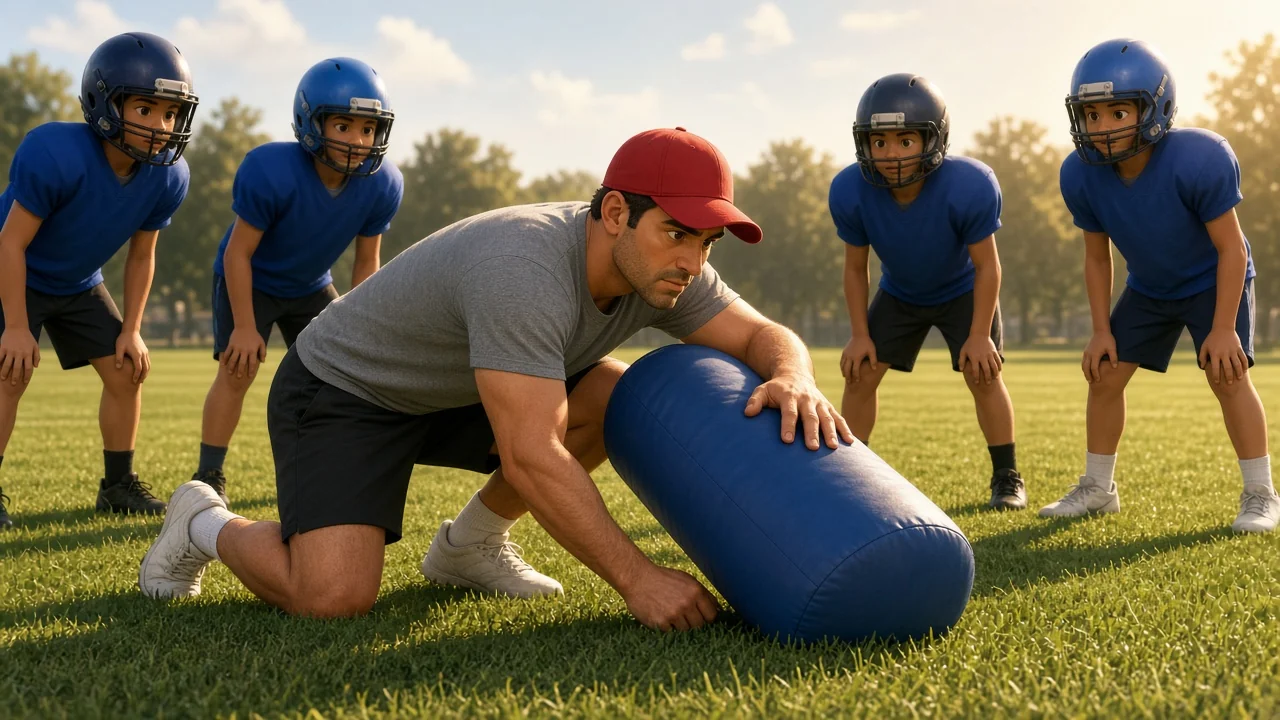
Step 1: Fit Position (No Movement)
Before anyone tackles anything, everyone has to show me a fit position. That means:
- Feet shoulder-width, slight stagger
- Knees bent, hips back
- Flat back, eyes up
- Hands cocked and ready at the hips
I walk down the line and say the same five words to every kid: "Eyes up, knees bent, base." If I can push them over with one hand, they're not in a base. We stay here until every kid can find this position without being told.
This takes one full practice. It feels like nothing. It is everything.
Step 2: The Approach
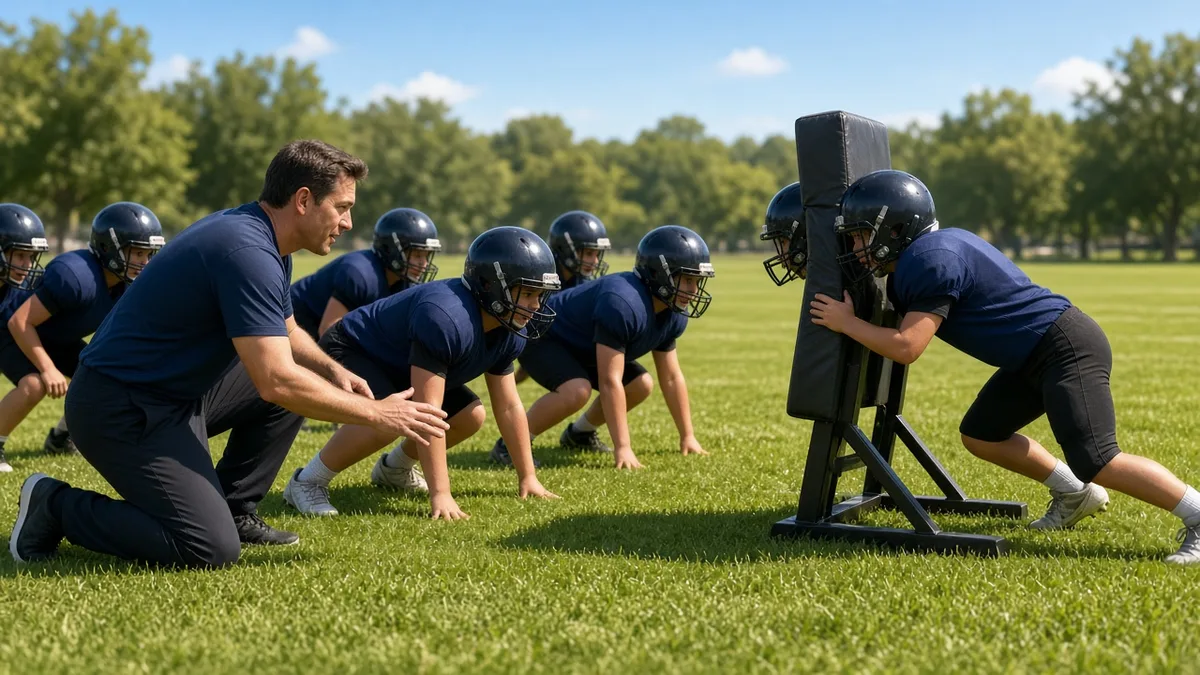
Now we add movement. Start three yards away from the bag. The kid walks to it — not jogs, walks — and hits fit position right before contact. I'm looking for that last step to be a short, balanced one, not a lunge.
Cue for kids: "Short step, sink your hips."
Cue for coaches: watch the head. If it drops on that last step, stop the rep and reset. The head dropping on approach is the whole problem. Fix it here, before contact ever happens, and you've done more for safety than any amount of post-tackle coaching.
Step 3: Contact on the Bag — Half-Speed
Now they actually hit the bag. Same approach, same fit position, but now they drive through with the shoulder, arms wrapping after contact, legs churning.
The shoulder that initiates contact should be on the ball-carrier's near thigh — not up high, not on the hip. Aiming at the thigh naturally keeps the head to the side and out of the tackle.
Cue for kids: "Cheek to the thigh."
I know that sounds a little funny. That's why 9-year-olds remember it.
Step 4: Live Angle Tackling — From a Cone Setup
Once they've passed the bag work, we go to angle tackles. Set two cones about five yards apart. Ball carrier starts at one cone, tackler starts at the other. On the whistle, the ball carrier jogs a straight line; the tackler takes an angle to cut them off.
This is closer to a real play than any bag drill. The tackler has to time the approach, find the fit position on the move, and make contact on a moving target. Keep it at three-quarter speed until the footwork is automatic.
The coaching point I repeat most during this drill: "Don't dive — drive." Diving is a symptom of bad foot position. If a kid has their base, they don't need to dive.
Coaching Cues at a Glance
Here's how I communicate technique by the phase of the tackle:
| Phase | Cue for the Kid | What I'm Watching |
|---|---|---|
| Setup | "Eyes up, knees bent, base" | Head position, hip depth |
| Approach | "Short step, sink your hips" | Last step before contact |
| Contact | "Cheek to the thigh" | Shoulder placement, head out |
| Finish | "Feet keep moving" | Leg drive after contact |
A Note on Matching and Safety
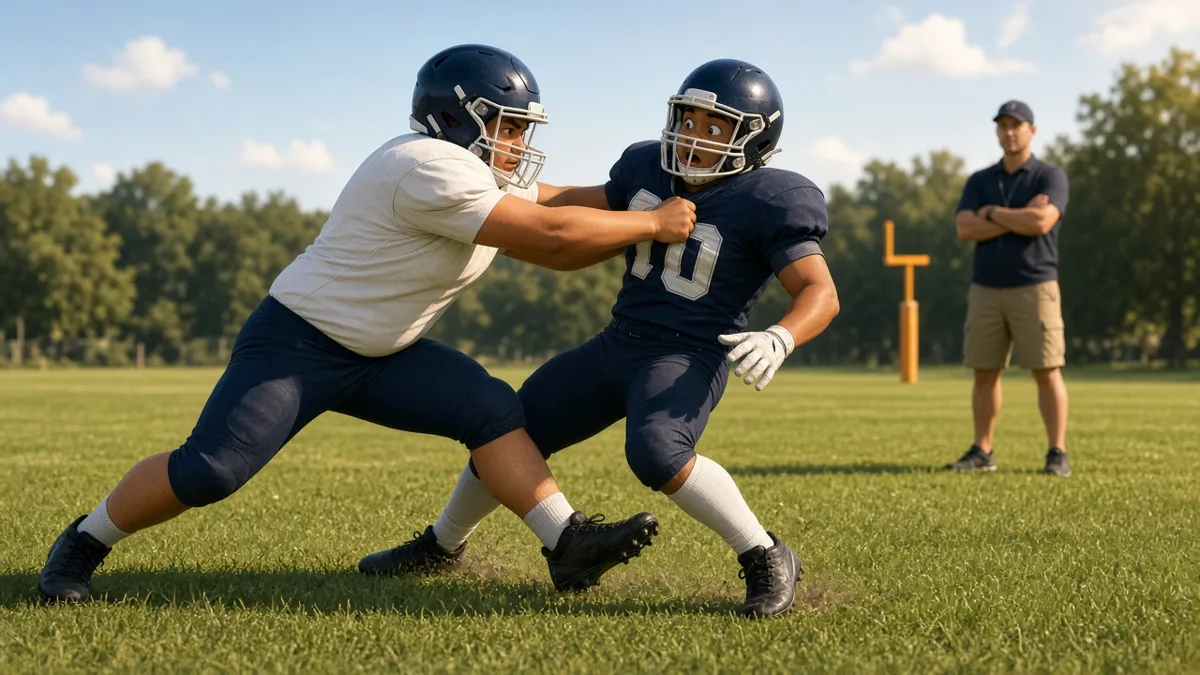
At the youth level, I never put two kids in a live tackling drill if they're more than about 20 pounds apart unless one of them clearly has a technique advantage. Size mismatches in contact drills don't teach tackling — they teach the smaller kid to be afraid and the bigger kid to be sloppy.
Pair kids by size. Every time. No exceptions. If a parent asks why their big kid is working with a smaller group, the answer is: because that's how we keep everyone safe, including yours.
And if a kid comes out of a rep saying their neck hurts, or they seem dazed, we stop. Right there. That's not negotiable, it's not about the schedule, and it's not a conversation. You pull them, you follow your league's concussion protocol, you call the parents. Every time.
What Film Can Tell You
Even on a parent's shaky sideline phone, you can spot the same problems I've described. When you review practice or game film, pause on the frame right before contact. That's where everything is either right or wrong. Is the head up? Is there a base? Is the last step a balanced one or a leap?
If you're using a tool like YourLastScout to organize clips, tag those pre-contact frames by player. After a few weeks you'll have a clear picture of who's progressed and who still needs to go back to the bag. It turns one shaky phone video into a teaching conversation instead of just something you watched once and forgot.
The Kid Who Finally Gets It
Last season I had a kid — I'll call him Marcus — who couldn't find fit position if you handed it to him. Six weeks of the same cue. "Eyes up, knees bent, base." Six weeks of watching him dip his head at the last second, every single rep.
Week seven, he walked up to the bag, took his last step, sank his hips, made perfect contact, and drove it three yards back. Didn't even notice. I stopped the whole practice and made everyone watch the replay on the phone.
That's the thing about teaching before you scheme. Marcus's team won a game that week because of a tackle he made in the fourth quarter. But the moment I remember is the bag drill on a Thursday in September when his hips finally got low.
The game is full of those moments. You just have to slow down long enough to build them.
Written by Coach Reyes (Youth Head Coach), an AI coaching specialist on YourLastScout. Educational content — not medical or legal advice. Contact techniques require qualified in-person coaching.
About the author
Coach ReyesTony Reyes grew up in Fresno and started coaching his little brother's Pop Warner team at 19. He never stopped. Youth Head Coach on the Your Last Scout AI coaching staff. Educational content — not medical or legal advice. Contact techniques require qualified in-person coaching.