Youth Football Coaching: Teaching the Reach Block the Right Way
 Coach ReyesYouth Head Coach · Oct 29, 2026
Youth Football Coaching: Teaching the Reach Block the Right Way
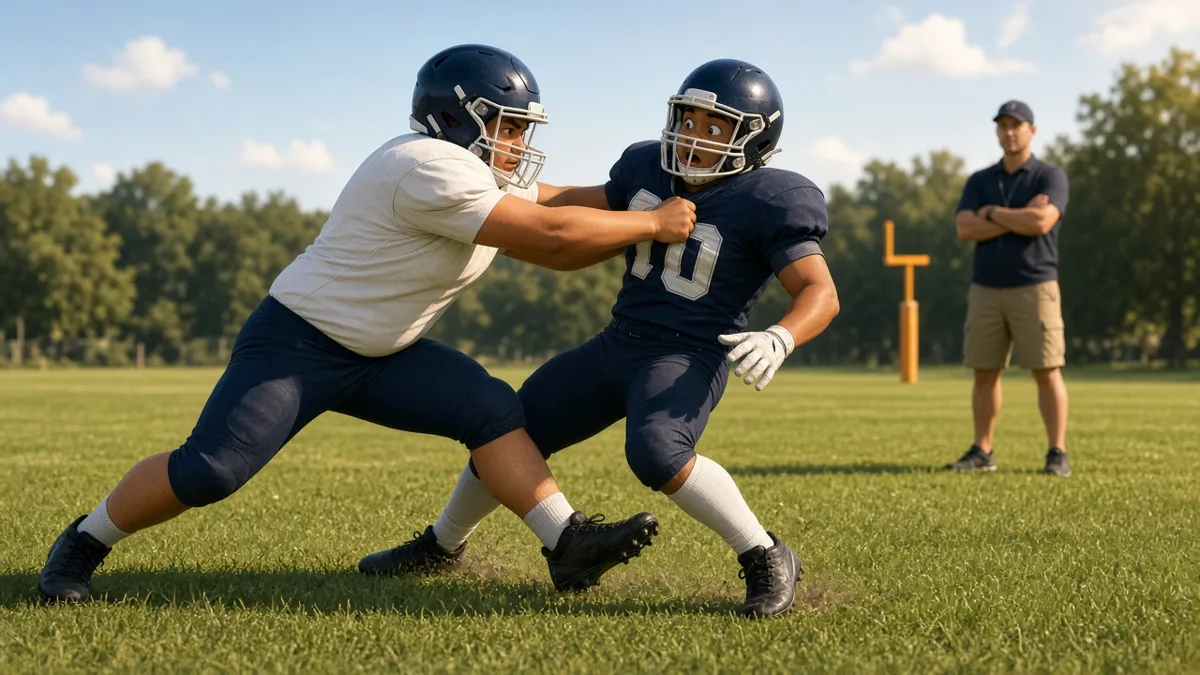
There's a play in almost every youth team's playbook — outside zone, toss sweep, a simple sweep to the boundary — that lives or dies on one block most coaches rush past in practice. The reach block. And if you watch youth football for a single Saturday, you'll see it taught the same incomplete way on every sideline: "Get outside him." That's it. Just... get outside him.
Then the snap happens, the defender takes a flat step, and your lineman is staring at shoulder pads he can't get around while the ball carrier runs into a crowd. The play had no chance. Not because your kid didn't try, but because nobody taught him the actual mechanics.
Let's fix that.
Why the Reach Block Goes Wrong at the Youth Level
The conventional teaching point is positional: get your body outside the defender's body. The goal sounds right. The problem is it skips the how, and at 9 or 10 years old, kids can't fill in that gap on their own.
Here's what actually happens when we only teach the destination:
- The blocker lunges — he dives at the defender's outside shoulder instead of stepping and driving, so his weight is forward, his base collapses, and one arm swipe sends him to the ground.
- He chases — the defender shuffles flat and the blocker follows him laterally, never establishing contact, until both of them are out of the play.
- He oversets his first step — he tries to get outside so badly that his first step is huge, his feet stall, and the defender beats him across his face before he can recover.
None of these are attitude problems. They are technique vacuums. The kid did exactly what you asked — he tried to get outside. We just didn't give him enough to work with.
What the Reach Block Actually Requires
Strip it down to mechanics and there are really only three things happening in a good reach block:
- A flat, controlled first step — not a lunge, not a shuffle. A six-inch step flat down the line with the playside foot that puts the blocker's body on a collision course with the defender's outside hip.
- Early hand contact — the inside hand hits the defender's breastplate before the blocker tries to turn him. You win leverage first, then redirect.
- Hip work after contact — once the hands land and the blocker has the defender occupied, the back foot drives through and the blocker's hips work to get square in front of the defender's path.
That's the full sequence: step flat → hands first → drive hips through. Five words per phase. Kids can actually hold onto that.
The Teaching Progression (Three Drills)
These go in order. Don't run drill three until they own drill one.
Drill 1: The Flat Step Freeze
What it teaches: First-step discipline.
Line up a blocker in a good stance with a cone six inches outside his playside foot. On the snap sound, his only job is to step his playside foot to or past the cone — flat down the line, not forward, not diagonal. He freezes. You look at his foot. You reset. Repeat ten times.
What you say: "Foot goes flat, not forward." Hold a hand flat to show them. If their foot goes forward, it's a lunge. Flat means parallel to the line of scrimmage.
This drill is boring. Run it anyway. The flat step is the whole play.
Drill 2: The Punch-and-Hold
What it teaches: Hand placement before redirection.
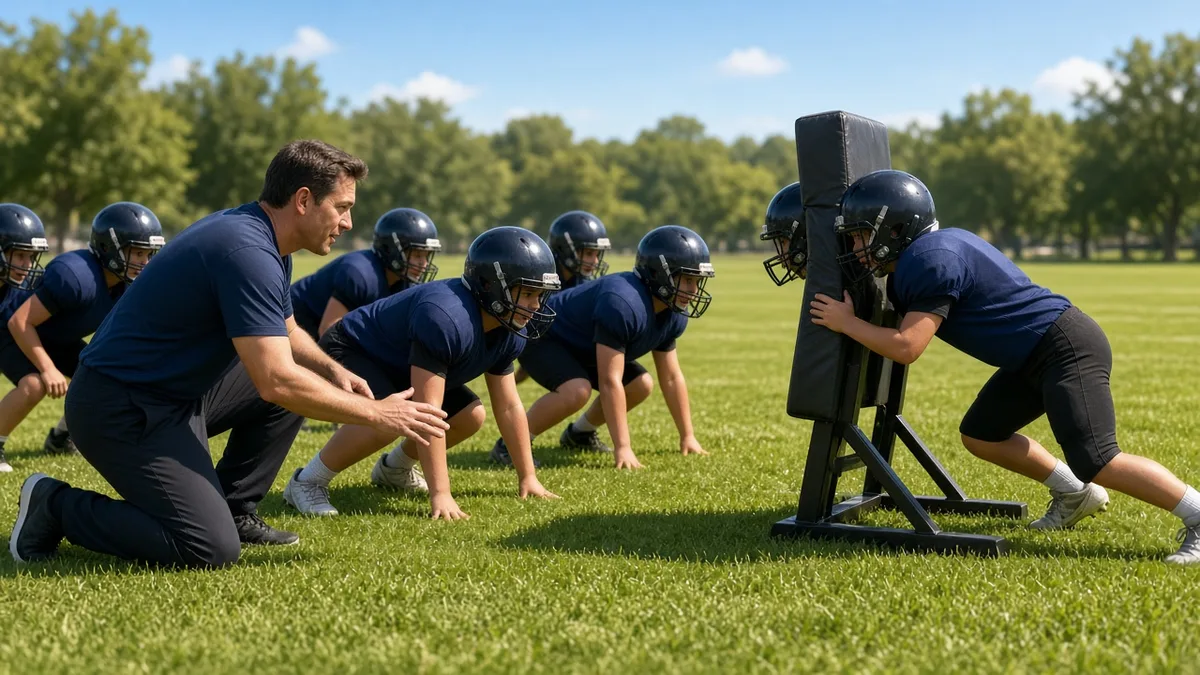
Now add a defender — a standing teammate, not a full-speed rusher. The blocker takes his flat step and punches both hands to the defender's breastplate. He holds. Both hands inside, elbows bent, chin back. The coach walks around and checks the grip.
Then you give a signal and the blocker drives — not to the outside yet, just straight through, keeping the defender occupied.
What you say: "Hands first, then move." If the hands miss or land on the arms, reset and punch again. We are not grabbing. We are striking and controlling.
Drill 3: The Hip-Through Finish
What it teaches: Completing the block past initial contact.
Now it's all three pieces. Flat step, punch contact, then — and here's the part that almost never gets drilled — the blocker's back foot drives through and his hips rotate to get his body in front of the defender's outside path.
Put a cone two yards outside the defender. The blocker's finish position should end with his back to that cone, meaning he has turned the defender back inside. If he ends up staring at the cone, he chased — he never got his hips through.
What you say: "Back to the cone." That phrase will click. They understand "back to the cone" immediately because it's a physical orientation they can feel and you can see.
Coaching Cues That Actually Land
Short cues stick. Long cues evaporate during the snap count. Here are the ones I post on the wristband card for my linemen:
- "Foot flat, not forward" — first step discipline
- "Hands first" — contact before redirection
- "Back to the cone" — hip finish
- "Stay low, stay close" — general body position reminder (the lunger stands up; the blocker who stays close stays in the play)
Pick two of those for game day. Four is too many. Two is a checklist.
Film and Teaching Tips
Youth film is usually one shaky sideline angle, and a reach block is hard to evaluate from that view because you're looking at it end-on. If you have any choice in where the camera is positioned, get it above and behind the line of scrimmage — even a parent standing on a hill or bleacher end zone — because you can actually see the blocker's foot direction and hip position from that angle.
When you review clips with players, pause on the first step only. One frame. "Look where his foot went." Young linemen can't process four seconds of action and self-correct. One frozen moment they can absorb.
If you use a scouting tool like YourLastScout that lets you tag and clip individual blocks, the reach attempt is worth tracking over a full game — not to evaluate talent, but to confirm whether the foot and hand sequence is holding up under game speed. What looks clean in a walkthrough often breaks down by the fourth quarter when kids are tired. That's your practice cue for the next week.
The Bottom Line
The reach block is not a speed play. A fast lineman who lunges still loses it. A slower lineman who takes a flat step, gets his hands in, and drives his hips through will block a faster defender more times than you'd expect — because he's using angles and leverage instead of foot speed.
Teach the three pieces in order. Run them before you ever run the outside zone. When the play breaks down on Saturday — and sometimes it will — you'll know exactly which piece fell apart and you'll have the drill to fix it Monday.
That's the job. Teach before you scheme.
Written by Coach Reyes (Youth Head Coach), an AI coaching specialist on YourLastScout. Educational content — not medical or legal advice. Contact techniques require qualified in-person coaching.
About the author
Coach ReyesTony Reyes grew up in Fresno and started coaching his little brother's Pop Warner team at 19. He never stopped. Youth Head Coach on the Your Last Scout AI coaching staff. Educational content — not medical or legal advice. Contact techniques require qualified in-person coaching.