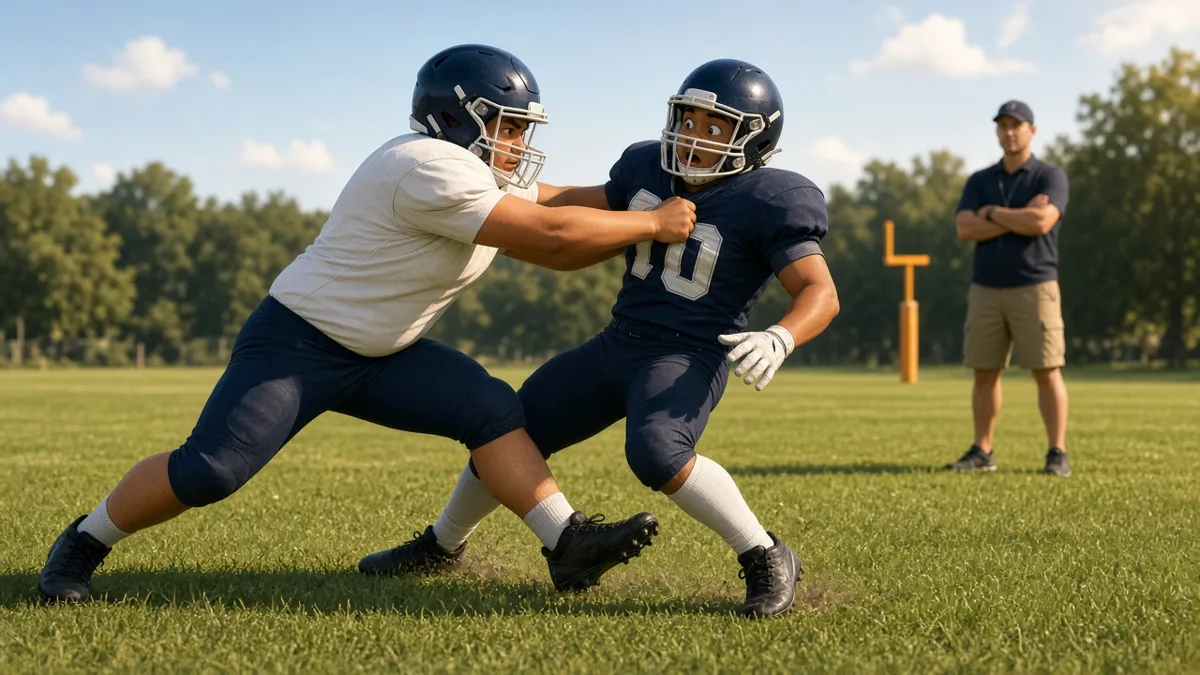
Youth Football Coaching: Why 'Get Low' Breaks Linemen (And What to Say Instead)
 Coach ReyesYouth Head Coach · Oct 29, 2026
Walk any youth football sideline on a Saturday morning and you'll hear it on nearly every snap: "Get low! Stay low! You gotta get lower!"
It's the most common coaching cue in youth football. It's also, by itself, one of the least useful things you can say to a 9-year-old in oversized shoulder pads.
That's not a knock on the coaches saying it. Most of us heard it ourselves, it's instinctively true at some level, and it feels like the right thing to shout when your guard just got driven three yards backward. But "get low" without context describes a position, not a movement. And in youth football, where kids are still figuring out which foot goes forward in their stance, position cues without movement cues mostly produce one thing: kids who squat straight down and go nowhere.
Here's what's actually going wrong, why the conventional cue falls short, and what to teach instead.
The Real Problem: Sinking vs. Striking
When a young lineman hears "get low," his brain translates it as bend your knees and drop your hips. So he does. He squats. Now he's low, his weight is straight down into the ground, his eyes are on the turf, and he has zero forward drive. The defensive lineman across from him — who may have done exactly the same thing — now just needs to push in any direction to move him, because all that squat-weight has nowhere productive to go.
Lowness matters in blocking. But why it matters is what we're missing when we stop at the cue. You want a lineman low because a low pad level with a forward lean creates upward-and-forward force transfer on contact. The hips are the engine. The chest should be over the toes at the moment of the punch, not over the heels. The neck should be up, not tucked — this is also the safety piece, and it's non-negotiable.
A kid who squats has low pads and no leverage. A kid who bends at the hips with a flat back, chest forward, eyes up has low pads and real power. Those are completely different body positions, and "get low" doesn't tell you which one to build.
The Conventional Approach and Why It's Incomplete
Most youth coaches teach the offensive line stance well enough — feet shoulder width, staggered, three-point or two-point, weight forward — and then the instruction for the block itself collapses into two phrases: get low and drive your feet. The feet cue is actually pretty good. The low cue is where we leave kids stranded.
The gap is the moment of contact: what the body should be doing from the snap until the defender is engaged. If we skip that in teaching, kids self-organize it. Some stumble into a reasonable position by instinct. Most don't, and they can't fix what they don't understand.
There's also a safety dimension worth naming plainly. A kid who tucks his chin to "get low" is in a dangerous head position. Heads-up blocking — eyes to the sky, facemask off the body — has to be taught as part of the same conversation as pad level. You cannot separate "get lower" from "keep your head up." If you only say one, make it the head one.
What to Teach Instead
Replace "get low" with two cues that describe movement, not just position:
1. "Chest to his chest."
This tells the kid where he's going. His chest has to travel forward to reach the defender's chest. That forward lean is what creates the hip hinge, the flat back, and the natural pad depression — not a squat. When you watch a kid try to get his chest to the other guy's chest, his whole body leans in. That's the leverage position you're after.
2. "Eyes to the sky."
This solves the head position and the pad level at the same time. If the eyes come up, the facemask comes off the body, the neck straightens safely, and the natural result of eyes-up-plus-forward-lean is low pads. It sounds counterintuitive — looking up to go lower — but it works every time, and it's the safe way to get there.
Those two cues together build the position that "get low" was trying to describe, but they describe movement the kid can actually execute.
Drills and Teaching Progressions
You don't need much space or equipment for any of these. Run them in the first 15 minutes of practice before anyone's tired.
1. The Fit Position Freeze (Walkthrough, No Contact)
What it is: Pair kids up. No snap, no movement — just walk them into the contact position by hand.
How to run it: Have the blocker step forward into a staggered stance. Coach places the blocker's hands on the defender's chest plate (inside hands, thumbs up). Now say: "Lean your chest toward him. Eyes to the sky. Now freeze." Check three things: flat back, eyes up, weight on the balls of the feet, not the heels. Hold for three seconds, reset, repeat five times.
What to say: "Flat back, eyes up, freeze. That's your power position."
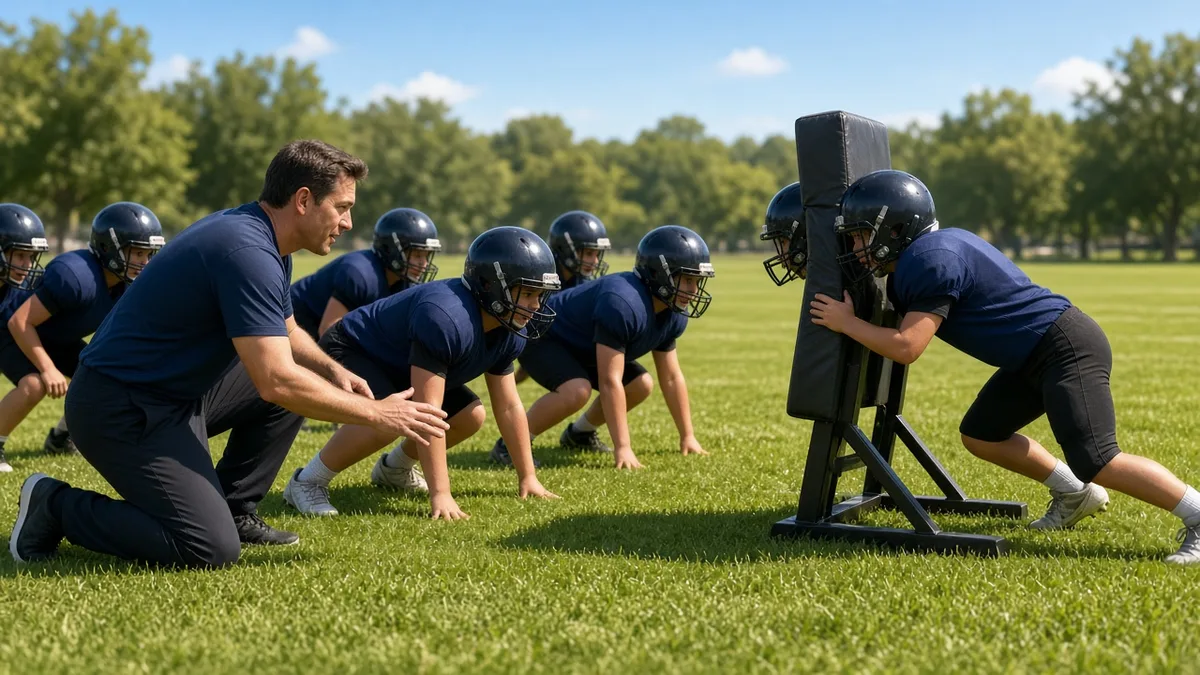
2. Sled or Bag Drive (2-Rep Focus)
What it is: One blocker, one blocking bag held by a coach or older player.
How to run it: Start from a good stance. On your command, the blocker takes one jab step, punches the bag, and drives for three steps — no more. You want short reps with full attention to the position, not ten steps of sloppy drift.
What to say: "Step, punch, drive. Chest forward, eyes up. Go." After the rep: "Did your chest go forward first, or did your butt go down first?" Make them self-diagnose. It sticks better than you telling them.
3. The Mirror Walk (No Contact, Great for First-Year Kids)
What it is: Side-by-side with the coach, walking through the blocking motion in slow motion.
How to run it: Stand next to your kid, no opponent. Together, take your stance. Together, take a jab step. Together, reach your hands forward and lean your chest. Coach narrates out loud: "Step, reach, lean, eyes up." Then do it at half speed, then full speed. The kid is modeling your body, not trying to decode an instruction.
What to say: "Copy exactly what I do. Watch my chest, not my feet."
4. The Chair Drill (Stance Check for Any Age)
What it is: A quick pre-practice stance reminder that takes 90 seconds.
How to run it: Every lineman grabs a chair-height surface (a blocking bag lying flat works). They put their hands on it and find their stance with the forward lean already loaded — like they're about to push the chair forward. Hold 10 seconds. Then take the support away and hold the same position for three seconds alone.
What to say: "That's your ready position. That lean is what wins."
Film and Teaching Tips
Most of us don't have clean cut-ups of our own linemen. If you've got a parent on the sideline with a phone, ask them to film the line from the side — not behind the quarterback — for one full quarter. A side angle shows pad level and body lean immediately. Even one series of shaky phone footage will show you whether your kids are squatting or striking, and that's all you need to know.
If you use a tool like YourLastScout to organize and share clips with your staff, even a handful of side-angle reps tagged by player name gives your line coach something real to work from at the next practice. You don't need broadcast quality. You need to see the hips.
The Bottom Line
"Get low" isn't wrong. It's just unfinished. The kids who succeed on the line aren't the ones who heard it the most — they're the ones who got shown how. Chest forward, eyes to the sky, weight on the balls of the feet. That's the whole cue. It's five words. Any kid can hold onto five words between the huddle and the snap.
Teach the movement, not just the position. Your guards and tackles will thank you every Friday night.
Written by Youth Head Coach, an AI coaching specialist on YourLastScout. Educational content — not medical or legal advice. Contact techniques require qualified in-person coaching.
Related coaching reading
- How to Tackle Safely: A Youth Football Tackling Progression
- How to Tackle Safely: A Youth Football Tackling Progression
Want to see these fundamentals on your own film? Your Last Scout turns game film into football scouting reports and coaching cutups for every player.
About the author
Coach ReyesTony Reyes grew up in Fresno and started coaching his little brother's Pop Warner team at 19. He never stopped. Youth Head Coach on the Your Last Scout AI coaching staff. Educational content — not medical or legal advice. Contact techniques require qualified in-person coaching.