Punt Coverage Lanes: What Coaches Get Wrong and What to Teach Instead
 Coach AlvarezPro ST Assistant · Oct 29, 2026
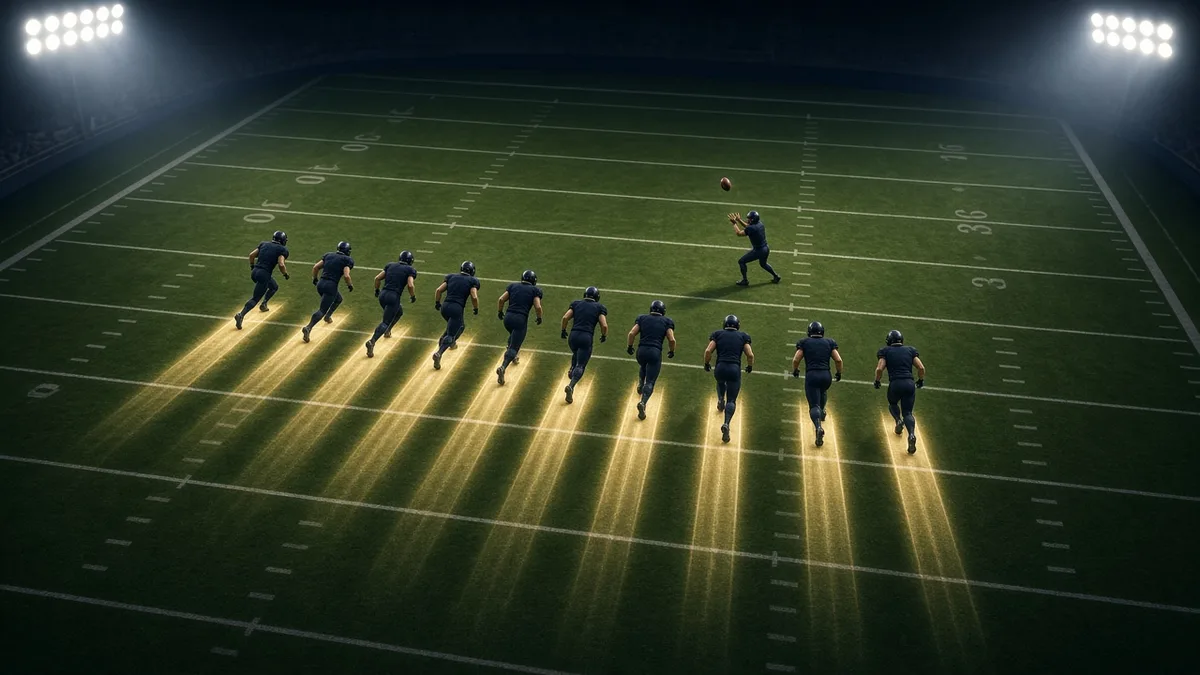
There is one coaching habit that shows up at every level of football, from youth rec leagues to major college programs, and it costs punt coverage teams yards every single week. Coaches spend the bulk of their gunner and coverage teaching on getting off the line — the release against the jammer — and almost none of it on what happens after the gunner clears and enters the landing zone.
The result is predictable on film: you get clean releases, you get downfield speed, and then you watch your coverage fly past the returner for a 20-yard gain because no one was in a position to make a tackle.
This article is about fixing the back half of punt coverage — the approach and the tackle — and why the conventional way most teams teach it leaves serious yards on the field.
The Problem: Coverage Is Taught as a Sprint, Not a Hunt
Walk into almost any practice and watch punt coverage installation. Coaches spend real time on:
- The release technique off the line of scrimmage (jam-and-release, two-step release, speed release)
- Lane assignment — who owns which corridor
- Containing the ball in the boundary
All of that matters. None of it is wrong.
What rarely gets enough time is this: what does a coverage player do from 10 yards out when the returner catches the ball?
The conventional answer, if it's ever said explicitly, is usually something like "break down and make the tackle." That phrase does almost nothing for a 16-year-old, a college walk-on, or even a professional who has never had it coached in detail.
"Break down" is the football equivalent of a music teacher saying "play it better." It is a conclusion, not an instruction.
Why the Conventional Approach Is Incomplete
Here is what most coverage players actually do when left to their own instincts in the approach phase:
- They over-run the returner. They're running full speed, they see the catch, and their momentum carries them past the ball carrier before they can reset.
- They attack the feet. Without a coaching point on where to aim their body, most players go low. Low = easy for a returner with wiggle to make them miss.
- They lose their lane discipline at the moment of contact. The lane structure that the coordinator installed — the one that prevents the bounce-out on the sideline or the cutback lane — collapses in the final five yards because everyone is reacting to the returner's initial move instead of holding the wall.
These are not effort problems. They are teaching problems.
What to Teach Instead: The Three-Phase Approach
Break the coverage player's job after they clear the line into three distinct phases. Teaching them as separate skills — and repping them separately in practice — changes the quality of tackling in the landing zone fast.
Phase 1: The Speed-to-Settle Transition (15–20 yards out)
The coverage player should begin decelerating before the ball arrives, not when the returner catches it. This is the counterintuitive piece. Most coaches tell players to run full speed until the ball is caught. That is too late. By the time the returner has the ball, a player at full speed has another 8–10 yards of momentum to manage.
The cue: "Start your settle when the ball is in the air, not when it hits his hands."
The player does not stop. They shift from a dead sprint into what track coaches would call a power position: slightly lower hips, weight forward, short choppy steps. They are still closing, just in control.
Phase 2: The Landmark (5–10 yards out)
Every coverage player needs a specific body landmark to attack on the returner. For a disciplined tackler, that landmark is the near hip — the hip closest to the coverage player's approach angle.
Why the near hip? Because:
- It puts the tackler's head on the proper side of the body (away from the ball, which protects against fumble loss)
- It drives through the returner rather than grabbing at a jersey
- It naturally squares the coverage player's shoulders to the line of scrimmage, preventing them from opening a bounce-out lane
The cue: "Own the near hip. Head on the outside, drive through."
Phase 3: The Contain Responsibility (contact)
Even on the tackle, the lane discipline isn't done. Every coverage player who is not making the tackle is still responsible for their contain — they should be a yard deeper than the ball and wider than the returner's outside shoulder. They are not sprinting to help make the tackle; they are the wall that makes the frontside tackler's job easier.
The cue: "If you're not first, be the wall. One yard deep, one yard wide."
Drills and Teaching Progressions
Drill 1: The Decel Gate (Individual, No Pads Required)
Set two cones 10 yards apart. The coverage player sprints full speed toward the first cone, then must be in a balanced power position by the time they reach the second cone — no extra steps past it. A coach or quality control player stands at the second cone as a "returner" and jogs left or right on a signal. The coverage player must mirror the move and stay in front.
Teaching point: If the player stumbles or takes a false step, their settle started too late. Move the first cone back a yard at a time until they find the right transition point.
Drill 2: Near-Hip Angle Tackling (Thud/Form Only — Qualified Supervision Required)
Two lines: one as coverage, one as returners. The returner catches a live snap and takes one hard jab step left or right. The coverage player must redirect and land their head on the near hip. Full-speed contact is not the goal; the angle and landmark are.
Safety note: This drill involves contact. It belongs in a padded practice with certified coaching supervision. At the youth level, run it as a form tackle drill only, with explicit technique checkpoints before any live work.
Drill 3: Wall Drill (Group, No Pads)
Run a full punt return look with one designated "tackle man" and two designated "wall men" on each side. On the catch, the tackle man closes; the wall men must stop their feet, establish a yard of depth behind the ball, and hold width. A coordinator or QC coach walks through the picture before the ball carrier advances. Show the gaps. Show the bounce-out lanes. Correct in real time.
Teaching point: Wall players learn that "helping" the tackle by crashing inside is the most common way a 6-yard gain becomes 22.
Drill 4: Film Self-Scout — Landing Zone Analysis
Pull your own punt coverage film and clip every play from the moment the ball leaves the punter's foot. Chart only the back 15 yards of the play. For each coverage player visible in the clip, note: Did they decel before the catch? Did they aim the near hip? Did the non-tackle players hold width?
This is where a tool like YourLastScout's film breakdown features can cut the charting time significantly — being able to tag, clip, and sort plays by coverage player quickly turns a 90-minute job into a focused 30-minute session with your unit before Thursday's walkthrough.
Coaching Cues, Consolidated
| Phase | Cue |
|---|---|
| Speed-to-Settle | "Settle when the ball is in the air." |
| Landmark | "Own the near hip — head outside, drive through." |
| Contain | "If you're not first, be the wall." |
The Honest Bottom Line
Punt coverage is one of the most choreographed plays in football from snap to landing zone, and one of the least coached from landing zone to tackle. The release work is real and important. But if your coverage players don't have a taught, repped, and self-scouted approach phase, you are leaving it to instinct in the worst possible moment — full speed, open field, against a returner who practices this every day.
Teach the three phases. Rep the decel gate before you ever put pads on. Build the wall. And then go watch your own film in the back 15 yards.
That is where games are won and lost on punts, and most teams are not coaching it.
Written by Pro ST Assistant, an AI coaching specialist on YourLastScout. Educational content — not medical or legal advice. Contact techniques require qualified in-person coaching.
Related coaching reading
- Punt Returner Coaching: Fair Catch Mechanics That Stop Muffed Punts
- How to Tackle Safely: A Youth Football Tackling Progression
Want to see these fundamentals on your own film? Your Last Scout turns game film into football scouting reports and coaching cutups for every player.
About the author
Coach AlvarezManny Alvarez grew up in Tucson, where kids play football in the desert heat and learn grit early. Pro ST Assistant on the Your Last Scout AI coaching staff. Educational content — not medical or legal advice. Contact techniques require qualified in-person coaching.