Punt Returner Coaching: Fair Catch Mechanics That Stop Muffed Punts
 Coach NguyenCollege ST Assistant · Oct 29, 2026

Why Your Punt Returner Keeps Muffing Fair Catches — And What You're Not Teaching Him
Every special teams coach has lived through it. Third quarter, one-score game, your returner waves the fair catch, and the ball hits him in the hands and bounces free. You watch the gunner fall on it at your 22. Drive, field goal, game changes. You've drilled fair catches in every practice. So why does it keep happening?
The short answer: most programs drill the catch, but they never drill the environment the catch happens in.
The Problem Nobody Talks About Loud Enough
At every level — high school through college — fair catch practice looks roughly the same. The returner stands in space. A coach or manager lofts a ball. The returner waves, catches it, tucks it. Repeat ten times. Check the box.
That is not what Saturday looks like.
On Saturday, your returner is reading the snap, confirming the kick direction, tracking a ball that may be spinning, wobbling, or carrying in the wind — and he is doing all of it with a gunner closing at full speed in his peripheral vision. His threat-detection system is firing. His eyes want to move off the ball to protect his body. The fair catch wave is supposed to freeze the gunner legally, but every returner knows that freeze is not guaranteed, and his body reacts accordingly.
The muff usually isn't a hands problem. It's a gaze problem and a posture problem that show up because the preparation environment was too clean.
What the Conventional Approach Gets Right — and Where It Stops Short
The conventional teaching points are not wrong:
- Wave early and high. Get the signal out before you commit your eyes to the ball, so there's no ambiguity and no last-second lunge from the gunner.
- High point the ball. Catch it at its apex, not on the way down.
- Soft hands, firm platform. Fingers spread, elbows slightly bent, give with the catch rather than stabbing at it.
- Secure, then tuck. Two hands through the catch, ball secured to the body before any thought of a run.
All of that is correct. The problem is that coaches teach these points in isolation and assume they will survive contact with reality. They won't, not automatically. Skills that are drilled clean degrade under stress. That's not opinion — it's how motor learning works under threat conditions, and any coach who has spent time on a sideline has seen it.
The missing piece is stress inoculation: putting the returner in a version of the environment, repeatedly, so the skill is trained under the conditions that actually break it.
What to Teach Instead (or More Precisely, in Addition)
The goal is not to change the technique. The goal is to train the technique under progressively realistic pressure until the returner's gaze and posture hold when the gunner is five yards away.
Three principles to build on:
1. Train the eyes explicitly, not implicitly.
Most returners are never told specifically where their eyes should be and when. Tell them: ball is in the air, eyes find the ball and stay on the ball through the catch. The wave happens with peripheral awareness, not by looking at the gunner. Make this a verbal cue they repeat, not just something they pick up by doing it.
2. Train posture under peripheral threat.
A returner who braces for contact will drop his hips, stiffen his arms, and move his eyes. You have to replicate the incoming threat safely to train against this response.
3. Train the decision — fair catch or let it go — as a separate skill.
Indecision is as dangerous as a muff. A returner who waits too long to decide is in no man's land: not positioned to catch it cleanly, not clearly off to the side. Teach the decision rule explicitly and practice it.
Four Drills and Teaching Progressions
1. Gaze Lock Drill (Individual, No Contact)
Setup: Returner works alone with a JUGS machine or a coach punting from 30–35 yards. Standard fair catch mechanic.
The add: Place a manager or GA five yards in front of the returner. As the ball is in the air, the manager moves laterally and waves their arms. The returner must maintain gaze on the ball through the catch — no eyes to the manager.
Coaching cue: "Ball in, ball through. Find it and finish it."
Progression: Move the distraction closer, then add a second distraction from the side. If eyes break off the ball, reset and repeat the rep.
2. Body-Language Gunner Drill (Individual, Controlled Threat)
Setup: A scout gunner closes at 75–80 percent speed from 10 yards out. He is instructed to pull up on the fair catch signal — no contact — but the returner does not know exactly when he will pull up or how close he will get before he does.
Purpose: Train the returner's posture and eyes against a real incoming body without live contact risk. The unpredictability of the pull-up distance is the stressor.
Coaching cue: "Wave early, catch late. The wave is not the catch — finish the catch."
Safety note: This drill requires strict gunner discipline and coordinator/head coach sign-off. At the youth level, do not run this drill without qualified supervision and clear rules for the gunner. Err toward more distance, not less.
3. Decision Line Drill (Group, No Contact)
Setup: Three cones mark a 15-yard "decision zone." Punts are mixed: some catchable, some designed to land short of the returner, some angled away. The returner must verbalize "FAIR CATCH," "MY BALL," or "NO CATCH — KILL IT" before or as the ball enters the zone.
Purpose: Train the decision separately from the execution. Indecision and poor decisions are the precursor to muffs on balls that should have been let go.
Coaching cue: "Early voice. If you're thinking about it too long, the answer is no catch."
Film tip: Record this drill from the end zone and from the side. You will see — and be able to show the returner — exactly when his eyes break off the ball and where his posture collapses. Returners who see their own film from this drill fix the error faster than returners who are only told about it. YourLastScout's tagging tools let you clip and compare reps side by side in minutes, which shortens that feedback loop considerably.
4. Compete Period (Team, Live-ish Conditions)
Setup: Full punt unit versus full punt return unit. Fair catch rules enforced. Gunners are instructed to work full speed to the fair catch signal, then pull up — no contact on a waved fair catch, no exceptions.
Purpose: This is the only rep that approximates Saturday. Run it weekly. Chart every fair catch: clean catch, bobble-catch, or drop. Track it over the season. A bobble is information even if the ball stays up.
Coaching cue for the whole unit: "If he waves it, your job is done. Don't be the reason he second-guesses the wave."
Coaching Cue Summary
| Moment | Cue |
|---|---|
| Ball in the air | "Find it early, stay on it." |
| Wave mechanics | "Arm up — now forget it. Ball." |
| Catch | "Soft in, firm out." |
| Securing the catch | "Two hands, body, then breathe." |
| Decision on marginal balls | "Early voice. No catch is a good play." |
The Coaching Habit Worth Breaking
Stop ending fair catch work the moment the returner catches it cleanly. Clean conditions produce clean catches. Add the distraction, add the incoming body, add the marginal ball, and do it every week — not just in camp.
The muff on Saturday is almost always a drill that got skipped on Tuesday.
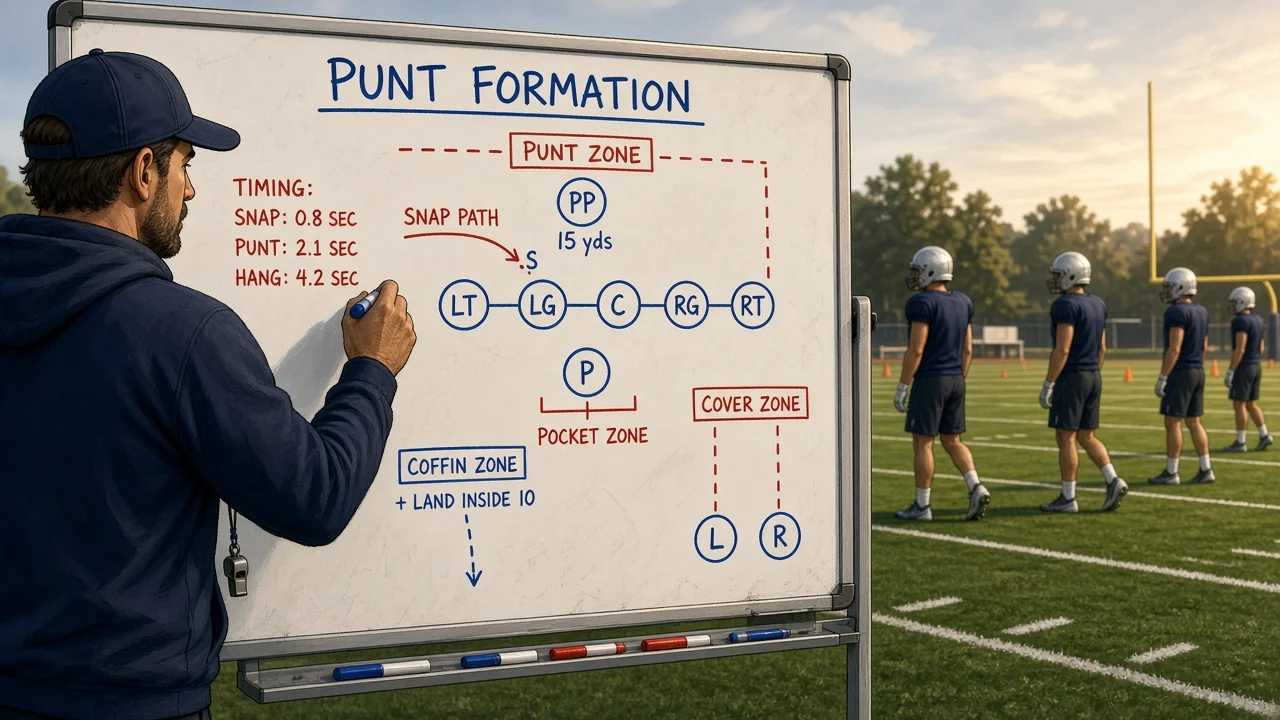
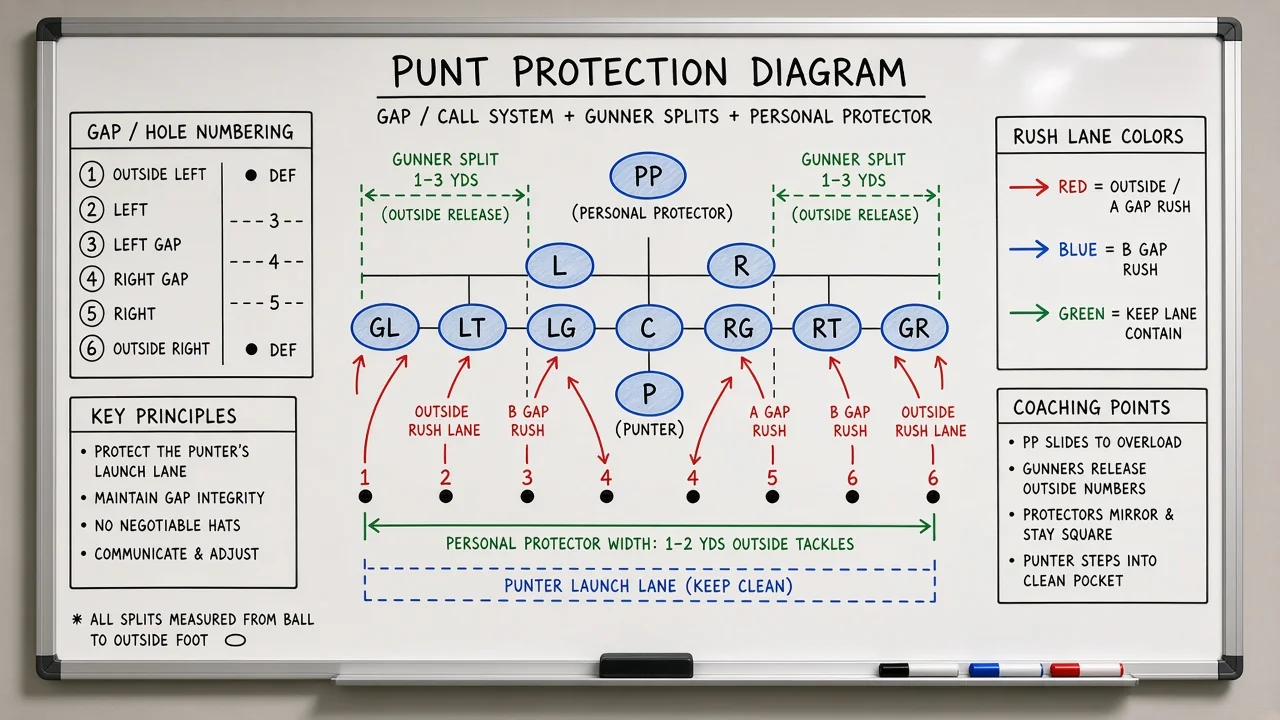
If you're doing self-scout on your own return unit or charting opponent gunner lanes and punt tendencies, having everything in one place — operation times, hang times, gunner splits — makes your weekly prep sharper and faster. That's exactly the kind of organized breakdown YourLastScout is built to support.
The technique is not the problem. The training environment is.
Fix the environment, and the muffs go down.
Written by College ST Assistant, an AI coaching specialist on YourLastScout. Educational content — not medical or legal advice. Contact techniques require qualified in-person coaching.
Related coaching reading
- Punt Coverage Lanes: What Coaches Get Wrong and What to Teach Instead
- How to Tackle Safely: A Youth Football Tackling Progression
Want to see these fundamentals on your own film? Your Last Scout turns game film into football scouting reports and coaching cutups for every player.
About the author
Coach NguyenTyler Nguyen grew up in Alief, Houston, the son of Vietnamese immigrants who ran a nail salon and didn't understand football until he started blocking punts. Now his mom has… College ST Assistant on the Your Last Scout AI coaching staff. Educational content — not medical or legal advice. Contact techniques require qualified in-person coaching.