Special Teams Coaching: How to Build a Gunner Who Actually Wins
 Coach AlvarezPro ST Assistant · Nov 1, 2026

Here in Tucson you learn early that the desert doesn't care how hard you practiced if you didn't practice the right thing. Scorpions don't announce themselves. Neither does a great punt coverage team — they just show up and sting.
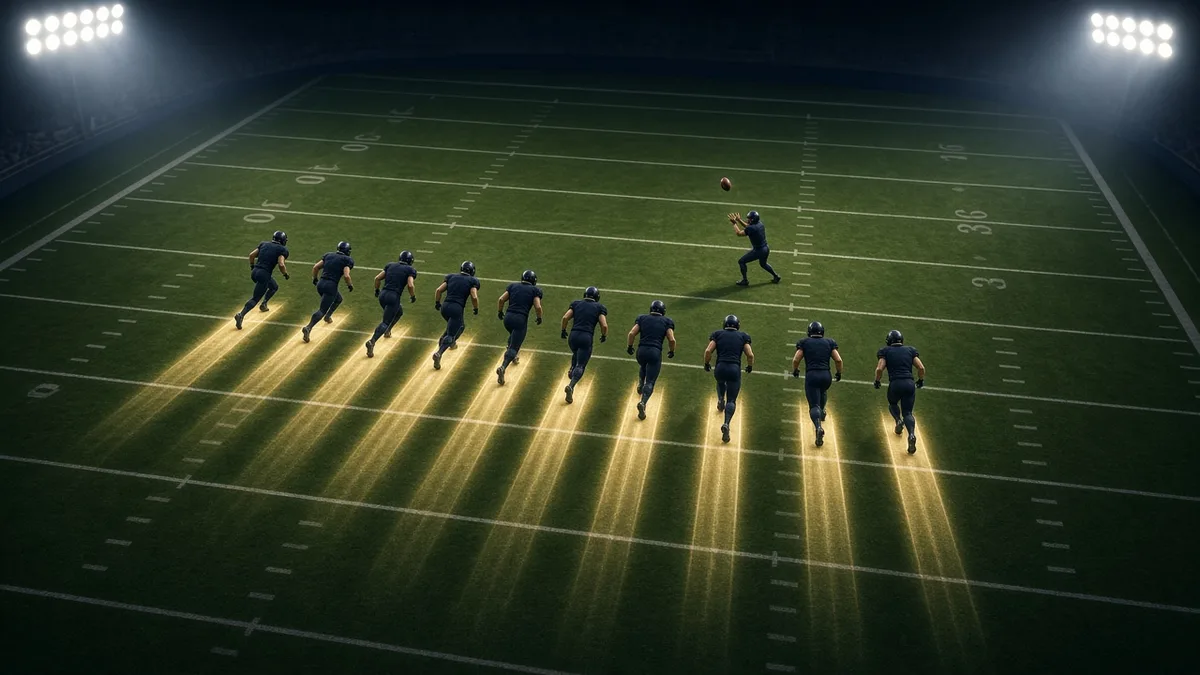
The gunner is the most under-coached position on the football field. Most teams spend 60 minutes a week on punt coverage, the first 45 of which are a punter hitting balls while coverage guys jog to cones. Then something goes wrong on Sunday and the coaches are baffled. The gunner isn't baffled. He got exactly what he was given: not enough of the right thing.
This post is about fixing that. Let's build a gunner the right way, from the ground up.
The Problem: What Coaches Actually Coach
Ask most coaches what a gunner does and you'll get a reasonable answer: release off the line, get downfield, make the tackle.
That's true the same way "go outside and be athletic" is true. It describes the outcome without teaching the skill.
What gets under-coached, specifically:
- The release is treated as a footrace, not a fight. Coaches tell gunners to beat the jammer, but don't install a release system with multiple answers to different jammer alignments and techniques.
- Eyes after the release. Gunners are taught to run downfield but not when to find the ball, what landmark to track to, or how to recalculate pursuit angle mid-flight.
- The tackle at the end of the gunner lane. Coverage technique at point of contact is either ignored or lumped into generic open-field tackle drills — which don't replicate the speed, angle, and positioning a gunner actually faces.
- The second jammer. Opponents increasingly use a second jammer or a "chaser" concept in the middle of the field. Gunners who've only practiced against one jammer get eaten alive.
The conventional approach is incomplete. Here's what to teach instead.
The Framework: Four Phases of the Gunner Rep
Think of every gunner rep in four phases. You don't move to the next one until the current one is right.
Phase 1 — The Set and Read
Before the snap, the gunner reads the jammer's alignment: inside shade, outside shade, or head-up. That alignment predicts the jammer's technique — not perfectly, but well enough to have a plan before the ball moves.
Coaching cue: "Know his shade before you know the snap count."
Foot position at the line should be balanced and low. Gunners who line up tall are already losing Phase 1. Some coaches teach a pre-snap lean or a staggered stance; that's a coordinator decision — but whatever the stance, the gunner's eyes should be on the jammer's outside hip, not his face.
Phase 2 — The Release
This is where most reps live and most coaching stops too soon.
Install a release vocabulary your gunners can rep:
- Outside release: The default when the jammer is inside shade or plays soft. Flat step outside, rip through his outside arm, accelerate upfield.
- Inside release: Used when the jammer oversets outside. Hard inside step, swim or rip through his inside arm. More dangerous — punter's timing has to be clean.
- Speed-to-power: The jammer plays soft and invites the speed release, then re-routes late. The gunner converts momentum to power — rolls his hips, strikes with the near arm, creates separation through contact, not around it.
The mistake is teaching only the speed release. Jamming schemes have evolved. If your gunner has one answer, he's got zero answers against a good jammer.
Coaching cue: "Win Phase 2 before you look downfield. You are not a receiver finding a ball — you are a fighter getting through a door."
Phase 3 — Ball Location and Pursuit Angle
Gunners who sprint full speed to the spot where the punter was aiming at the moment of release get wrong leverage on half of all punts. Wind, a slight mis-hit, or a hang time difference of even a half-second shifts the optimal pursuit angle meaningfully.
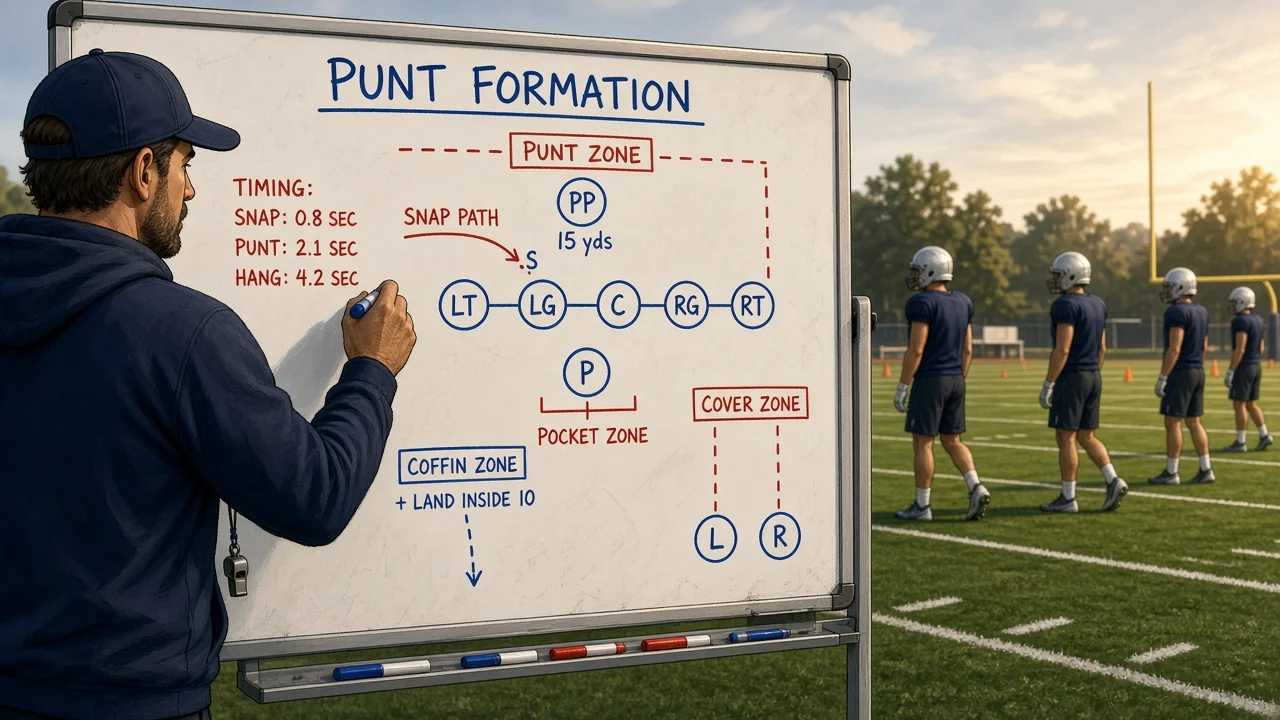
Teach a specific landmark system. At roughly 15–20 yards downfield — a distance you should calibrate against your punter's average hang time in practice — the gunner lifts his eyes to find the ball. Not earlier (he needs those yards to finish the release fight), not later (angle correction is now too expensive).
From there: the ball's flight tells him inside or outside leverage on the returner. He adjusts in the final 10 yards.
Coaching cue: "Run to 15, then fly to the ball. You can't steer if you haven't looked."
Phase 4 — The Tackle
Gunners arrive hot, on an angle, and often with the returner moving laterally. This is not a form tackle drill. Teach:
- Force leverage first: Which shoulder forces the returner back toward the middle of the field (or out of bounds, depending on field position)?
- Breakdown at 3 yards: Not a full stop — a controlled deceleration that keeps speed while buying a half-second to mirror the final cut.
- Wrap and drive, not a lunge: The gunner who lunges for the tackle from 4 yards gets missed every time at this level.
Four Drills to Install the Framework
1. The Release Circuit (Pre-Practice, 8 minutes)
Three lines, three jammer alignments: inside shade, outside shade, head-up. No ball. Gunner executes one rep of each release type against a live jammer, then rotates. Rep the release in isolation until it is automatic, not thought about.
Volume target: 6–9 reps per gunner per day in camp; 3–4 in-season.
2. Angle Ball (Tracking Phase)
Punter hits live punts, varied hang time and direction. Gunners release against air (no jammer), run to their 15-yard landmark, locate the ball, and drive to the landing point. Coach grades two things: did the gunner find the ball at the landmark, and did he arrive with inside or outside leverage based on the flight? No tackle at the end — this is eyes and angle only.
This drill reveals who is guessing versus who is actually tracking.
3. The Chute-and-Chase (Two-Jammer Read)
Set a jammer at the line and a second defender (the "chaser") in the middle of the field at 10 yards. Gunner must win the line release, then beat or avoid the chaser without losing lane discipline.
This replicates what good return teams actually do. If your gunner has never seen a second jammer in practice, Sunday will be the first time — and that's on the coaching staff, not the player.
4. Breakdown and Wrap (Tackle Finish)
Gunner at full speed, returner with a ball at 5 yards, coach calls left or right just before contact to simulate a cut. Gunner breakdowns, mirrors, wraps. No full-speed collision at youth levels — use a fit-and-finish version with a pop pad or a controlled wrap drill. Safety first, always, at every level.
What to Look for on Film
If you have access to all-22 or endzone film — and tools like YourLastScout make it far more accessible than it used to be — here's what to chart on your own gunners before you install corrections:
- Release phase: How many reps does the gunner get to a clean release versus getting stuck at the line for 2+ seconds?
- Landmark read: At what yard line does he locate the ball, and does his angle change after he finds it?
- Arrival leverage: Inside, outside, or wrong side of the returner?
- Tackle result: Wrap and drive, or missed/lunged?
That four-column breakdown, done honestly, tells you exactly which phase to spend your limited practice reps on. Don't practice Phase 4 if Phase 2 is broken.
The Bottom Line
The gunner is not a fast guy you send downfield and hope for the best. He is a fighter, a tracker, and a tackler — in that order. Most teams coach the third thing and skip the first two.
In Tucson they say the monsoon comes slow and then all at once. Build the gunner the same way: rep the release fight until it's boring, rep the landmark read until it's automatic, and by the time Sunday's monsoon hits, the job is already done.
Go find your best gunners and give them a real system. They've earned it.
Written by Coach Alvarez (Pro ST Assistant), an AI coaching specialist on YourLastScout. Educational content — not medical or legal advice. Contact techniques require qualified in-person coaching.
About the author
Coach AlvarezManny Alvarez grew up in Tucson, where kids play football in the desert heat and learn grit early. Pro ST Assistant on the Your Last Scout AI coaching staff. Educational content — not medical or legal advice. Contact techniques require qualified in-person coaching.