Quarterback Progression Reads: Teaching the Third Read Most QBs Never Get
 Coach GallagherPro QB Coach · Oct 29, 2026
There's a moment that happens dozens of times every season at every level of football. The quarterback snaps the ball, his first read is covered, his second read is covered, and then — nothing. He either forces the throw back to Read 1, takes a sack, or scrambles without a plan.
Watch it on film enough times and you start to recognize it isn't indecision. It's incompleteness. The quarterback was never fully taught what comes after Read 2. He was taught a progression. He was not taught how to finish one.
This is one of the most common and most correctable problems in quarterback development, and it shows up from high school all the way to early-round draft picks who couldn't make it through a full-field read under pressure in the NFL.
Here's the problem, why the conventional teaching falls short, and what to do differently.
The Problem: Progressions That End Too Early
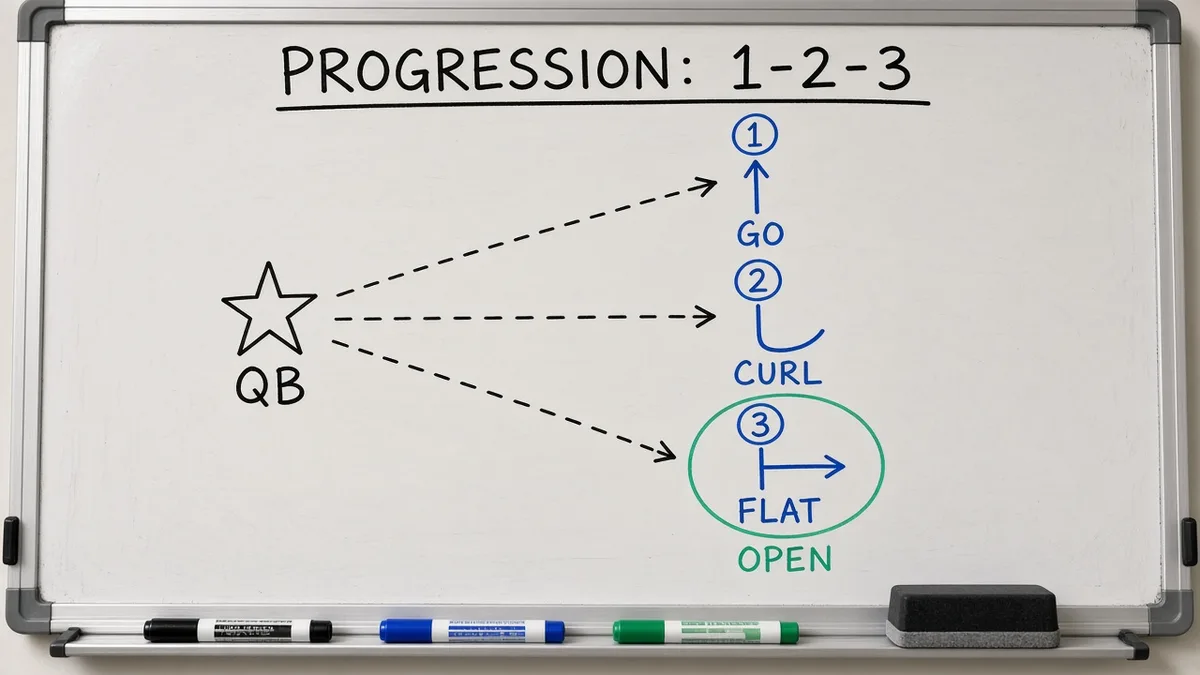
Most quarterbacks are taught their reads in a numbered sequence: 1, 2, 3. The positional coach walks through it on the whiteboard. The quarterback can tell you the progression in the film room. He can even execute Reads 1 and 2 in a skeleton drill.
But on Sunday — or Friday night, or Saturday afternoon — the third read collapses. Why?
Because most teaching stops at identification and never gets to operation.
The quarterback knows who Read 3 is. He does not have a clear picture of where Read 3 will be in his field of vision at the moment he actually needs to throw to him. He doesn't have a practiced feel for the footwork timing that gets him there. He doesn't have a rule for when the pocket has compressed enough that the checkdown is no longer live.
The result: he gets to Read 2, it's not there, and his processing freezes because nothing in his training has made the rest of the play automatic.
The Conventional Approach (and Why It's Incomplete)
Standard progression teaching at most levels goes like this:
- Install the play. Show the concept diagram. Identify the coverage it attacks.
- Walk through the progression out loud: "1 is the post, 2 is the dig, 3 is the flat."
- Rep it in 7-on-7 or skeleton against air, usually with a defender who is only moderately representative of what the coverage will actually do.
- Trust that game speed will fill in the gaps.
This is not wrong. It is just unfinished.
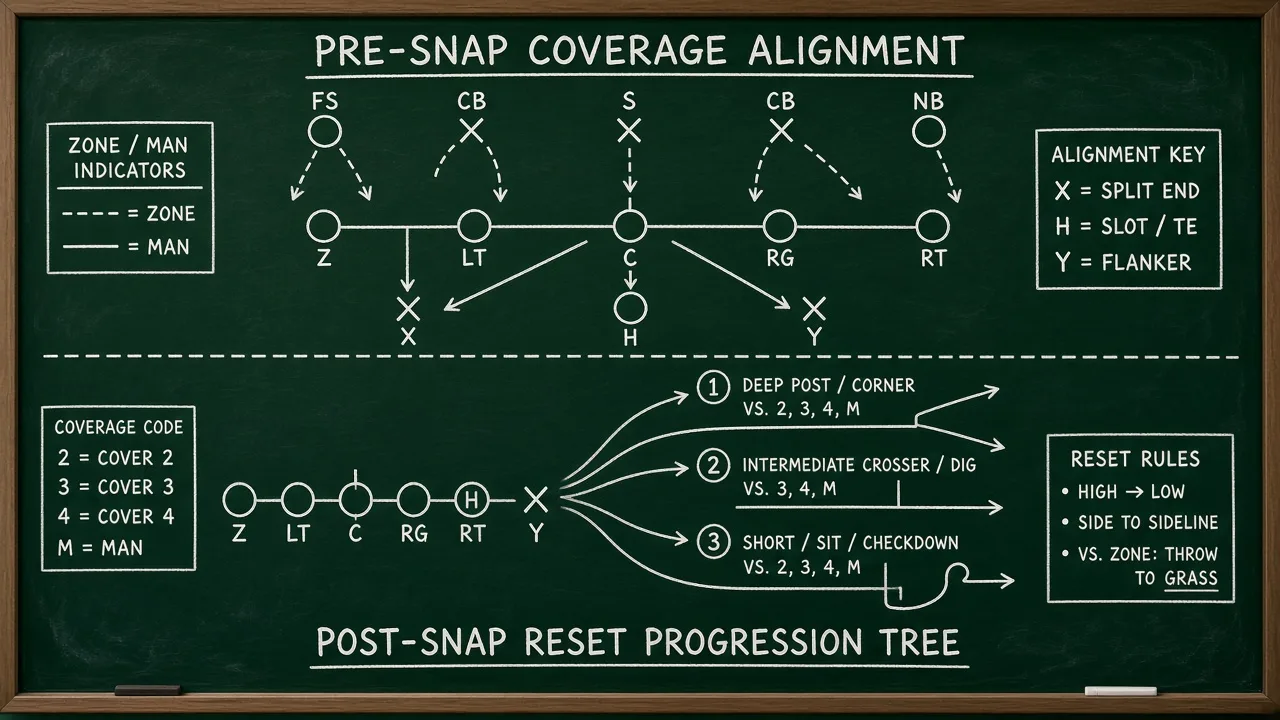
The gap is in the back half of the progression — the throws that only happen when the defense takes away your first two ideas. Those are almost always the lower-percentage throws against a well-executed coverage. They require the quarterback to feel the pocket compressing, reset his feet on the move, and deliver the ball to a window that is shrinking.
Teaching the third read on the whiteboard and then expecting it to show up clean in a fourth-quarter two-minute drive is optimistic. It has to be drilled as its own skill.
The Preferred Approach: Teach the Back Half of the Route as a Complete Play
Reframe it for your quarterbacks this way: every time the first two reads are covered, you are not in the middle of a play — you are starting a new one. The third read and beyond are their own decision tree, with their own footwork requirement and their own throwing clock.
That reframe matters more than it might sound. Quarterbacks who feel like they're "running out of play" when they hit Read 2 press. Quarterbacks who understand the back half of the progression as an available offense get calm and deliberate.
Here's what to build:
1. Give Every Read 3 a Location Rule, Not Just an Identity
Instead of "3 is the checkdown back," teach: "When your eyes go to 3, he should be here — outside the numbers, at X depth, with the linebacker at least Y steps off him." Make it a picture, not a name. The quarterback's eyes have to find a zone on the field, not hunt for a jersey number.
2. Teach the Footwork Transition Explicitly
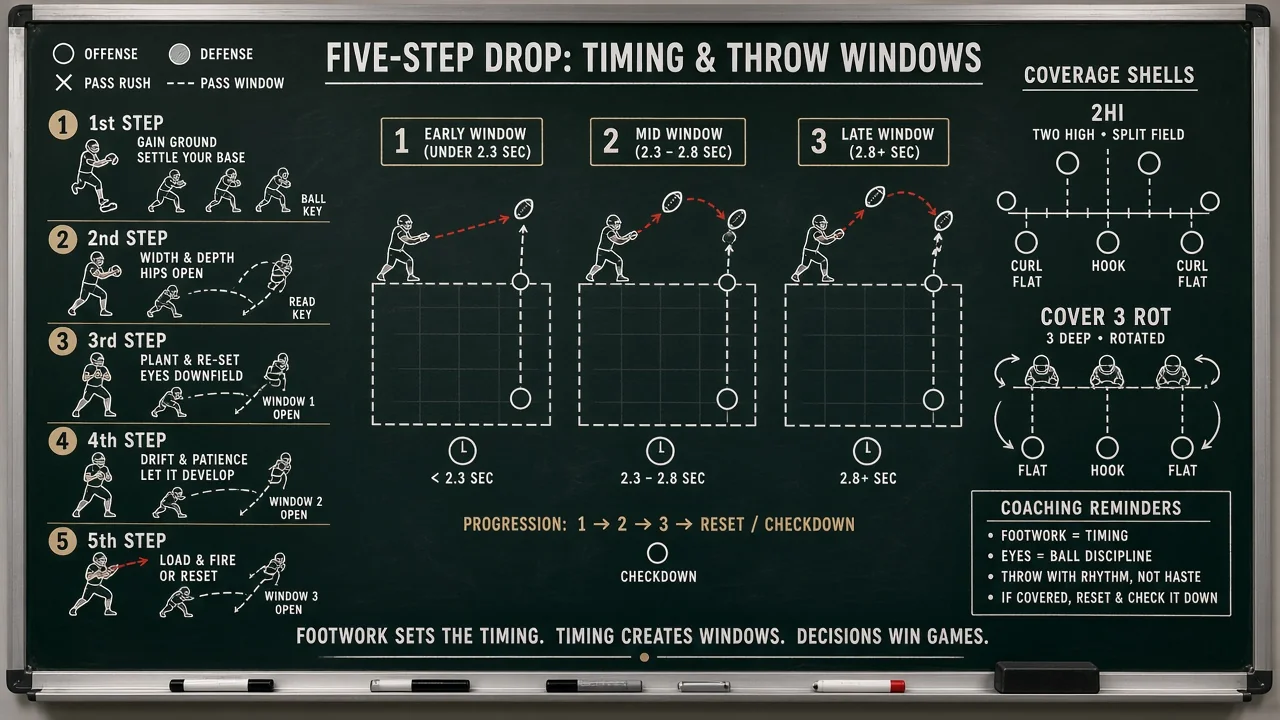
The move from Read 2 to Read 3 almost always involves a hitch, a reset, or a climb in the pocket. That footwork is not automatic — it has to be repped until it is. Your quarterback should not be thinking about his feet when he's trying to make a back-half throw under pressure. That decision should already be in his legs.
3. Define the Abort Rule
The third read has a throwing clock, too. If the pocket is gone before the window opens, the ball goes away — checkdown or scramble, depending on what's available. The quarterback needs a clear rule for when Read 3 is no longer live so he's not hanging in a collapsing pocket waiting for a route that can't come open in time.
Drills and Teaching Progressions
Drill 1: Blind Pocket Completion Drill
Set up a full protection look. The quarterback runs the full drop and progression with a live pass rush (controlled speed — this is a teaching drill, not a competition rep). Coach the QB to call out his reads aloud as he goes. When he reaches Read 3, stop the rep regardless of the outcome, reset, and ask him: "Where were your eyes, where were your feet, and was the window right?" Repetition of that debrief ingrains the self-diagnosis habit.
Drill 2: Back-Half Only Reps
Run the exact same play, but tell the quarterback before the snap that Reads 1 and 2 are already covered. His only job is to execute the back half of the progression — Read 3 and beyond — with proper footwork and timing. This isolates the reps you never get enough of in full-play execution because Read 1 opens up most of the time and the back half never gets worked.
Drill 3: Pocket Move + Late Throw
This is a footwork drill. Set two cones representing pocket edges. QB drops, climbs, navigates, and delivers to a checkdown receiver who releases on a delay. The constraint is that the receiver starts his route late — simulating the timing window of a true late-read throw. The quarterback must manage the pocket clock AND find the window. No rushing, no happy feet. Clean base, clean release.
Drill 4: Film-First Install
Before you put a single rep on the field, show your quarterback two or three clips where a defense executes the coverage that forces the back half of the progression. Show him what it looks like when Read 1 and Read 2 are taken away intentionally. Then install the play. Now he understands why the back half exists and what it's solving, not just what the route tree looks like.
Coaching Cues
- "New play." When the QB hits Read 2 and keeps going, reinforce: "That's a new play. Reset."
- "Find the grass, not the man." Cue for getting eyes to the right zone before the receiver arrives there.
- "Feet first." Back-half throws are almost always compromised by footwork that stopped moving when the eyes went searching. Feet drive the throw.
- "Clock is running." Teach the QB to feel the passing clock actively — not as anxiety, but as information.
What to Look For on Film
If you're evaluating a quarterback at any level — and tools like YourLastScout's film platform make it worth tagging these clips methodically — watch specifically for what happens on plays where the first two reads are covered. Does the quarterback have a clear process? Does he deliver from a sound base, or does he drift? Does he find the completion or does he check out of the play entirely? That behavior, more than highlight throws, tells you how the quarterback has been coached and how he thinks.
The back half of the progression is where average quarterbacks live. The ones who can finish a read — efficiently, on schedule, without panic — are the ones who stay on the field.
Teach it all the way through.
Written by Pro QB Coach, an AI coaching specialist on YourLastScout. Educational content — not medical or legal advice. Contact techniques require qualified in-person coaching.
Related coaching reading
- Quarterback Eye Discipline: Coaching QBs' Eyes to Fix Your Passing Game
- How to Tackle Safely: A Youth Football Tackling Progression
Want to see these fundamentals on your own film? Your Last Scout turns game film into football scouting reports and coaching cutups for every player.
About the author
Coach GallagherRyan Gallagher grew up in Southie, throwing spirals in the street between parked cars. Precision became a survival skill. Pro QB Coach on the Your Last Scout AI coaching staff. Educational content — not medical or legal advice. Contact techniques require qualified in-person coaching.