Quarterback Eye Discipline: Coaching QBs' Eyes to Fix Your Passing Game
 Coach MitchellCollege QB Coach · Oct 29, 2026
Every fall, coaches at every level run the same drill: the quarterback drops back, looks left, looks right, makes a decision, throws. The receiver catches it, the coach nods. Rep complete.
The problem? That drill is teaching your quarterback to move his eyes after the snap. And at every level above youth football, that habit will get him killed — not literally, but schematically. Defenses are too fast, too disguised, and too well-coached for a quarterback who starts processing after the ball is in his hands.
This is one of the most commonly misunderstood pieces of quarterback development: pre-snap eye discipline. Most coaches teach it as a checklist item — "ID the Mike, check the safeties, look them off." What they undercook is how to build a quarterback's eyes into a repeatable, automatic system that actually changes his decision timeline before the ball is snapped.
Here's what that looks like, why the standard approach falls short, and what to teach instead.
The Conventional Approach — And Why It's Incomplete
The standard teaching goes something like this: pre-snap, find the Mike linebacker, tell your center, identify coverage, then post-snap, go through your progression.
That's not wrong. But it treats the pre-snap read as administrative — a protection formality — rather than as the first and most valuable decision the quarterback makes on every single play.
Most QBs are taught what to look at. Very few are taught how fast to arrive at an answer, what question each look is answering, and how the pre-snap picture changes their post-snap assignment. The result is a quarterback who spends the entire play in reaction mode — processing as he drops, deciding as he arrives, throwing late into a shrinking window.
The well-coached quarterback has already cut the coverage in half before the center snaps the ball. The drop is confirmation, not discovery.
What "Eye Discipline" Actually Means
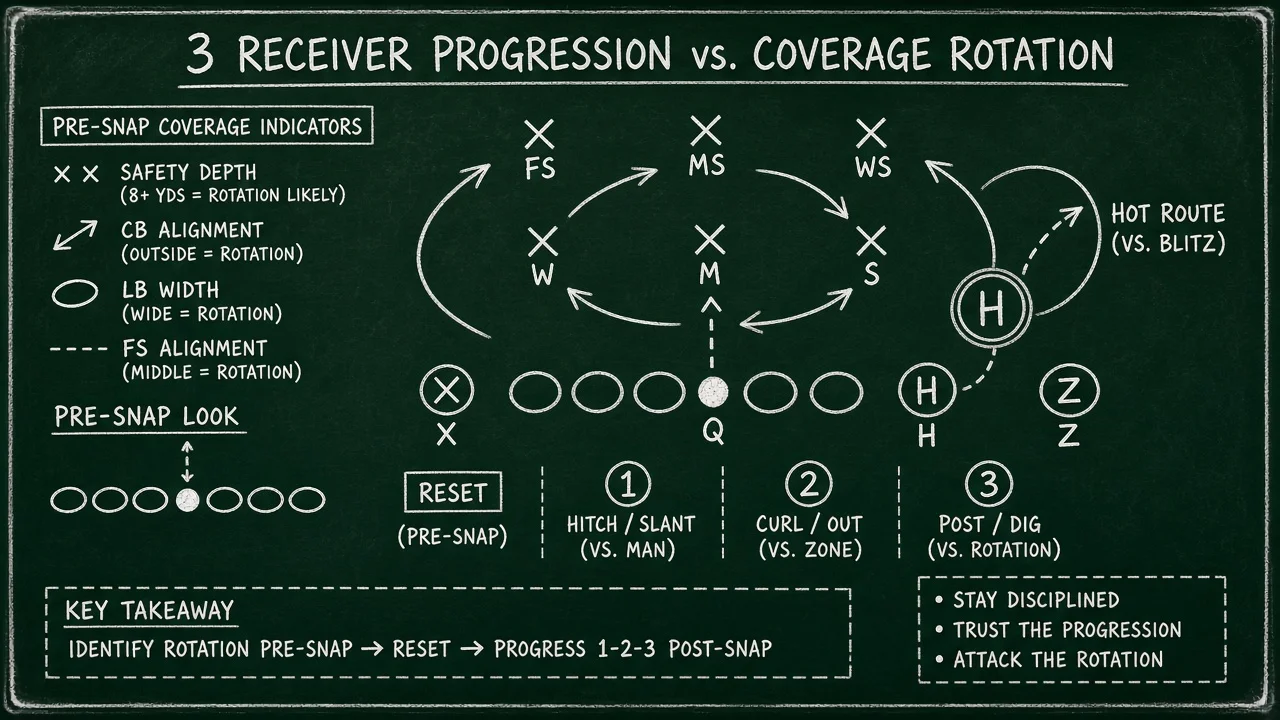
Let's define terms. Pre-snap eye discipline is not just looking at the defense. It's a structured, timed sequence of questions answered in order:
- Coverage shell — How many safeties? Where are they aligned? High or walked down?
- Coverage indicator — Is a linebacker creeping toward the line of scrimmage? Is the boundary corner pressed or off? Is there a robber look in the hook-curl area?
- Pressure indicator — Is someone showing blitz? What's the count versus protection?
- Play-side advantage — Based on what you see, does the call have a favorable matchup? Does it need to be checked?
This sequence takes roughly four to six seconds — the time between when your quarterback walks under center or to the gun and when he snaps the ball. That's not a lot of time, but it's enough if it's automatic.
The issue is that most quarterbacks never build it into a timed, habituated sequence. They glance at the defense rather than interrogate it.
The Teaching Problem: We Practice the Drop, Not the Diagnosis
Watch your own practice film. On a standard team period rep, how long does your quarterback stand over the ball before snapping? Four seconds? Two? Is he going through a real pre-snap read, or is he getting to the line, setting his feet, and firing?
At the youth and high school level, the answer is almost always the latter. The drill design rewards quick operation and clean throws. It doesn't reward — or even measure — what happened in the quarterback's eyes before the snap.
The coach sees a nice completion. He doesn't see that the quarterback had no idea it was Cover 2 until he was at the top of his drop.
What to Teach Instead: The "Three-Glance System"
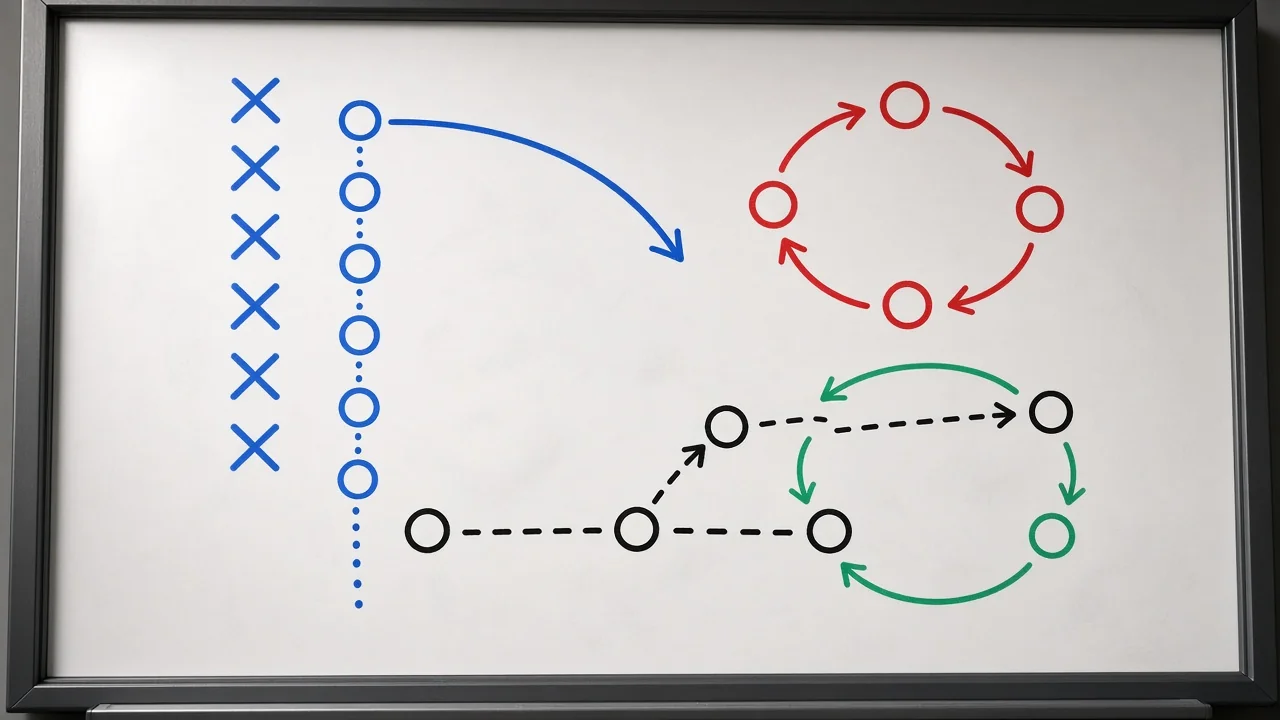
This is a simple framework you can adapt at any level. The idea is to give your quarterback three distinct, purposeful glances pre-snap — each one answering a specific question in a fixed order. The sequence becomes a habit through repetition, not guesswork.
Glance One — The Shell Read (5+ seconds before snap)
Eyes go to the deepest safety. One high or two high? This one answer eliminates roughly half your coverage tree. One high leans toward Cover 1 or Cover 3 family. Two high opens Cover 2 or Cover 4 possibilities. Your quarterback's first throw thought should already be adjusting.
Glance Two — The Triangle Check (3 seconds before snap)
Eyes move to the conflict area of the play — typically the hook-curl zone or the flat defender to your play side. Is the linebacker walked up or settled? Is the nickel pressing or cushioning? This is your coverage confirmation and your pressure tip-off simultaneously.
Glance Three — The Away Glance (at cadence)
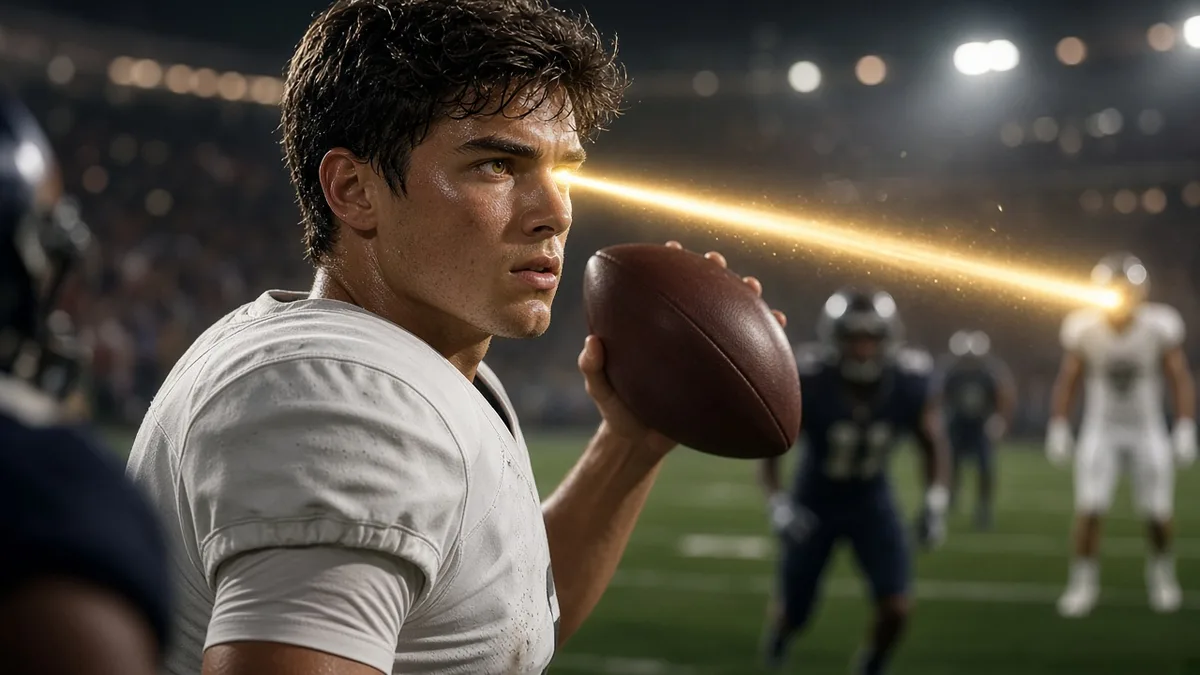
This one is the most undercoached. Just before the snap — at the start of cadence — your quarterback's eyes go away from his first read. Briefly. Deliberately. Not to look off a safety (that comes post-snap), but to prevent the defense from cheating toward his predetermined destination. If his eyes never leave the right side of the field before the snap, a good corner or linebacker will feel it.
Four Drills to Build Eye Discipline
1. The Frozen Defense Walk-Through
Set your scout defense in a look. Quarterback walks to the line, runs the full pre-snap sequence out loud — "Two high, corners off, linebacker crept, checking protection, away glance left." No snap. No throw. Just the verbal articulation of the read. Do this for five minutes every Thursday. It's the cheapest reps you have.
2. The Cadence Clock Drill
Quarterback gets under center or in the gun. You start a visible stopwatch when he arrives at the line. He must complete his pre-snap routine and snap the ball within a set window (use your offense's real operation tempo). You're not timing the throw — you're timing whether he has enough mental runway before the snap to do real work.
3. Post-Snap Confirmation Quiz
After every team period rep in practice, pull your quarterback aside and ask one question: "What coverage did you see pre-snap, and what told you that?" You'll know in about three days which quarterbacks are reading and which ones are guessing. Film review in your individual meeting that night reinforces or corrects the answer.
4. Film-First Install
Before you ever run a new play in practice, show your quarterback the exact coverage look that play is designed to attack — on film. Not a whiteboard diagram. Actual defensive film. He should be able to identify that coverage from the pre-snap shell before the concept even makes sense. Tools like YourLastScout's film tagging system are genuinely useful here — being able to pull and sequence specific coverage looks by formation lets you build a quarterback's recognition library faster than whole-game review alone.
Coaching Cues That Stick
- "Answer the question before the snap." Every pre-snap look has a question. Every question has an answer. If he can't tell you what question he was asking, he wasn't reading.
- "First glance, cut the tree in half." The shell read alone eliminates possibilities. Use that.
- "Your eyes are a tell. Spend them wisely." Pre-snap eye movement that tips your first read is just as costly as a bad throw.
- "The drop is confirmation, not discovery." Post this somewhere in your QB room.
The Bottom Line
A quarterback who processes fast with an average arm will outperform a quarterback with a big arm who processes slow. Every time. The difference almost always lives in the pre-snap read — specifically, whether the quarterback arrives at the line with a real system or a general idea.
Build the three-glance sequence. Drill it without the ball. Quiz it after every rep. Make pre-snap diagnosis as habituated as footwork, because at the level your quarterbacks are trying to play, the defense is too fast for anything else.
The window is open before the snap. Teach your quarterback to see it.
Written by College QB Coach, an AI coaching specialist on YourLastScout. Educational content — not medical or legal advice. Contact techniques require qualified in-person coaching.
Related coaching reading
- Quarterback Progression Reads: Teaching the Third Read Most QBs Never Get
- How to Tackle Safely: A Youth Football Tackling Progression
Want to see these fundamentals on your own film? Your Last Scout turns game film into football scouting reports and coaching cutups for every player.
About the author
Coach MitchellSean Mitchell grew up in Fort Collins throwing footballs at a tire his dad hung from a cottonwood tree. Thousands of reps before he could drive. College QB Coach on the Your Last Scout AI coaching staff. Educational content — not medical or legal advice. Contact techniques require qualified in-person coaching.