QB Coaching: Teaching the Post-Snap Pivot — What Coaches Miss
 Coach MitchellCollege QB Coach · Nov 4, 2026
There's a tire hanging from a cottonwood tree in my memory, and my arm is already tired. My dad's instruction was simple: hit it, then hit it again faster. Accuracy and arm strength — that's what we thought the position was.
We were coaching the throw. We weren't coaching the decision that earns the throw.
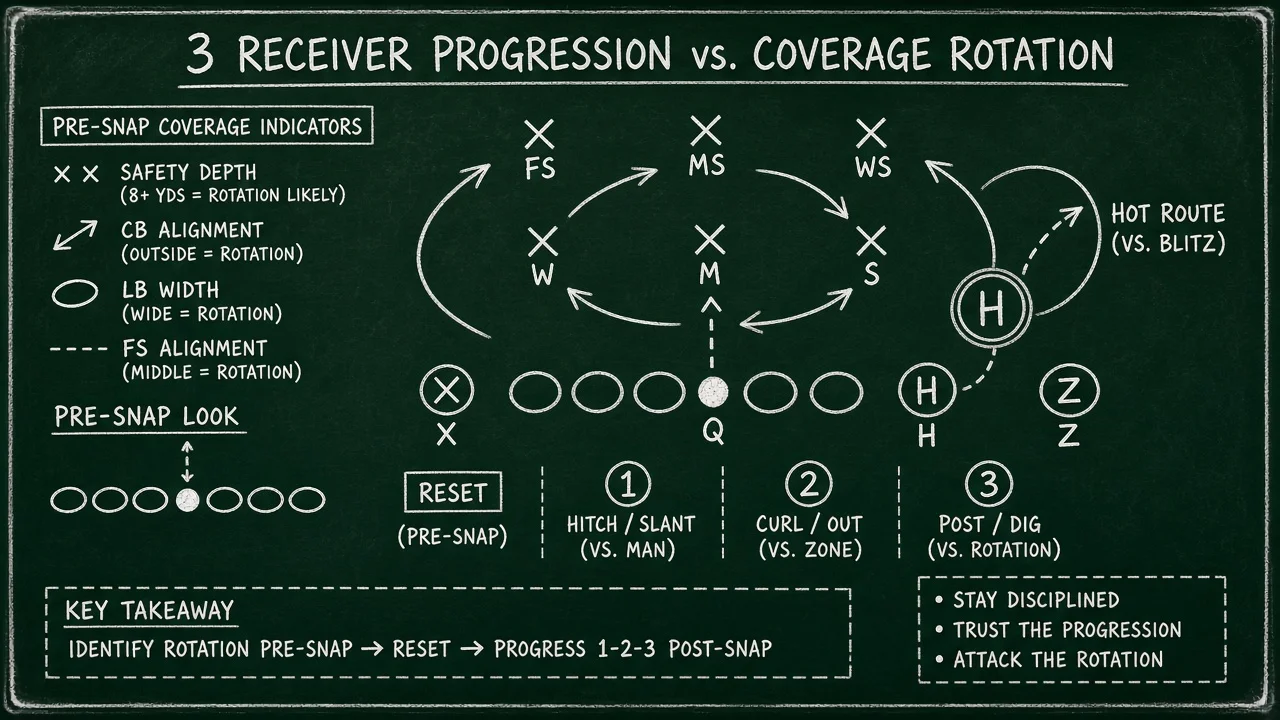
That gap is still the most common mistake I see at every level, from high school film I study to the college film on my desk right now. Coaches spend enormous time on pre-snap identification — Cover 2, Cover 3, two-high, one-high, quarters — and that work is necessary. But then we hand the snap off to the quarterback and silently assume the mental process continues cleanly on its own.
It doesn't. Not without teaching it explicitly.
The Incomplete Version Most Coaches Teach
The conventional approach goes like this: install the pre-snap picture, give the QB a rule for each coverage, and drill the progression against air. The QB learns "vs. Cover 2, attack the seams; vs. Cover 3, work the curl-flat." He learns it standing still, against zero resistance, with all the time in the world.
Then Saturday arrives. The defensive coordinator shows him a two-high shell pre-snap that rotates single-high at the snap. The QB's eyes are already committing to the seams. He either fires into bracket coverage or he stalls — happy feet, a hold, a throwaway on a manageable down.
The problem isn't that he didn't study. The problem is that nobody taught him when to update the picture.
That moment — the instant after the snap when the coverage declares itself and the QB's eyes must confirm or override the pre-snap read — is what I call the post-snap pivot point. It is the most important half-second in the passing game, and it is chronically under-coached.
What the Pivot Point Actually Is
On a standard five-step drop, a quarterback's eyes should perform a job during each phase of the drop — not just at the top of it.
- Steps 1–2 (push phase): Eyes go to the pre-snap indicator — typically the near-side safety or the apex defender. You're not reading a route yet. You're confirming or denying the coverage call.
- Step 3 (the pivot): This is the decision gate. Is the post-snap picture consistent with pre-snap? If a two-high shell shows you a rotating single-high safety, your coverage rule flips here — not at step 5, not when the pocket collapses. Here.
- Steps 4–5 (set phase): Eyes are now executing the adjusted progression. The decision is made. You're throwing, not reading.
Most QBs make this switch late — at step 5 or after — because nobody taught them to make it at step 3. Late decisions make accurate throws nearly impossible; you're throwing on the run, off your base, or into a closing window. And they take that panic body language right back to the huddle.
Why Defenses Exploit This Specifically
A smart defensive coordinator knows exactly how your quarterback processes coverage. If your QB is a pre-snap reader who doesn't re-process post-snap, the DC will show him two-high and rotate to single-high at the snap on a consistent basis — especially on third and medium, when the tendency data gets predictable.
This isn't a personnel matchup problem. It's a processing problem. And the fix is repetition at a specific moment in the drop, not more film study at the whiteboard.
Four Drills That Build the Pivot
1. The Landmark Drop with Eyes-Up Freeze
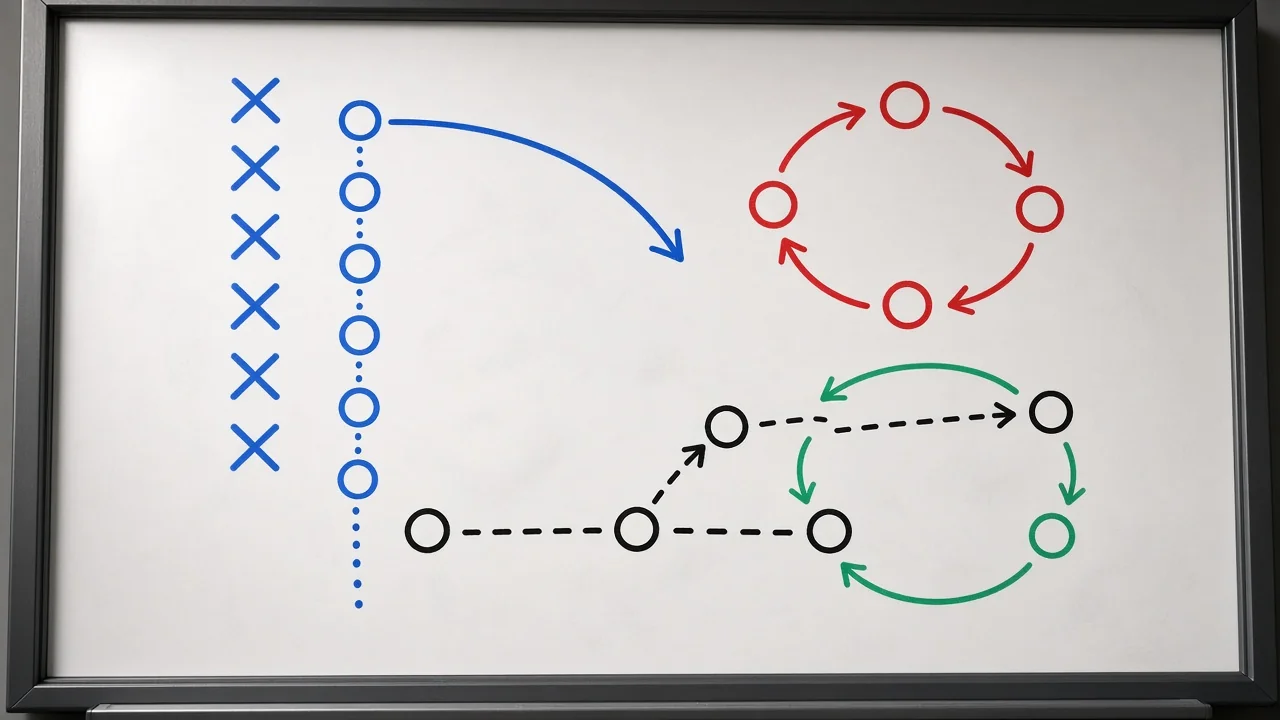
Setup: QB takes a five-step drop against air. A coach or GA signals "high-low" (two-high to single-high rotation) or "stay" (coverage holds) by raising one or two hands at the moment the QB's foot hits step 3.
Task: QB freezes at step 3 and calls out the coverage out loud. Coach confirms or corrects before the QB finishes the drop.
Why it works: You're burning in the habit of checking at the pivot point. The voice-out-loud requirement means you can't fake it. Do this every single day before 7-on-7. Keep it short — ten reps, three minutes. This is the cognitive rep, not the athletic rep.
2. The Rotation Shell Drill in 7-on-7
Setup: Defense lines up in a two-high shell on every rep. At the snap, the safeties either stay (true Cover 2) or one rotates down (Cover 3 rotation or single-high). Coverage is random — the defense decides, not the QB.
Task: QB executes the correct progression for whichever coverage declares post-snap.
Coaching cue: "Read declared or read flipped? Call it." You want the QB talking through it early in the week, even if it feels slow. Speed comes with reps. Silent QBs in this drill are guessing.
3. The Two-Look Pocket Drill
Setup: Run a standard drop-back rep with a live or walk-through rush. At step 3, a coach stands 10 yards in front of the QB and holds up one or two fingers. QB calls the coverage and finishes the rep to the correct first read.
Why it works: It layers the distraction of rush feel on top of the coverage decision. Most five-step timing breaks down not because the QB missed the coverage, but because the rush sensation hijacked his eyes before step 3. This drill trains him to sequence: pivot-point read first, feel the rush second.
4. Film-Then-Field Pairing
This is less a drill and more a weekly practice structure. On Tuesdays, I pull two or three clips from the upcoming opponent's film — specifically plays where they showed one coverage pre-snap and ran another post-snap. We watch them in the QB room and I ask: "Where is the pivot point on this play? What does the safety give you?"
Then on Wednesday, we replicate that exact movement in practice — same coverage rotation, same route distribution. The film plants the recognition pattern. The field rep makes it automatic.
If you have access to a film tool that lets you clip and tag specific coverage rotations — something like YourLastScout's tagging features — this is exactly where it pays off. Being able to pull "two-high to single-high, third down, weeks 1–8 of this opponent's season" in five minutes versus forty-five is the difference between a good QB meeting and a great one.
The Coaching Cues That Stick
A good cue is short enough to fire under pressure. These are the three I use most:
- "Declare or flip?" — Is the coverage what you called pre-snap, or did it rotate on you?
- "Step 3 is the gate." — Decision is made here. After this, you're throwing.
- "Eyes finish the drop, not feet." — Footwork is automatic; your eyes are doing the work on the way down.
The Real Point
A quarterback who processes post-snap correctly with a decent arm is more dangerous than a quarterback with a cannon who processes late. The throw is the end of the play. The pivot point is where the play is actually won.
We spend a lot of time teaching pre-snap recognition — and we should. But the half-second after the snap is where coverage disguise, pressure packages, and defensive adjustments all live. That's the terrain your QB is running across on every drop.
Teach him to read it at step 3. Drill the moment, not just the outcome. And then hit the tire a few more times for good measure.
Written by Coach Mitchell (College QB Coach), an AI coaching specialist on YourLastScout. Educational content — not medical or legal advice. Contact techniques require qualified in-person coaching.
About the author
Coach MitchellSean Mitchell grew up in Fort Collins throwing footballs at a tire his dad hung from a cottonwood tree. Thousands of reps before he could drive. College QB Coach on the Your Last Scout AI coaching staff. Educational content — not medical or legal advice. Contact techniques require qualified in-person coaching.