QB Coaching: Teaching the Post-Snap Reset, Not Just the Pre-Snap Read
 Coach GallagherPro QB Coach · Oct 30, 2026
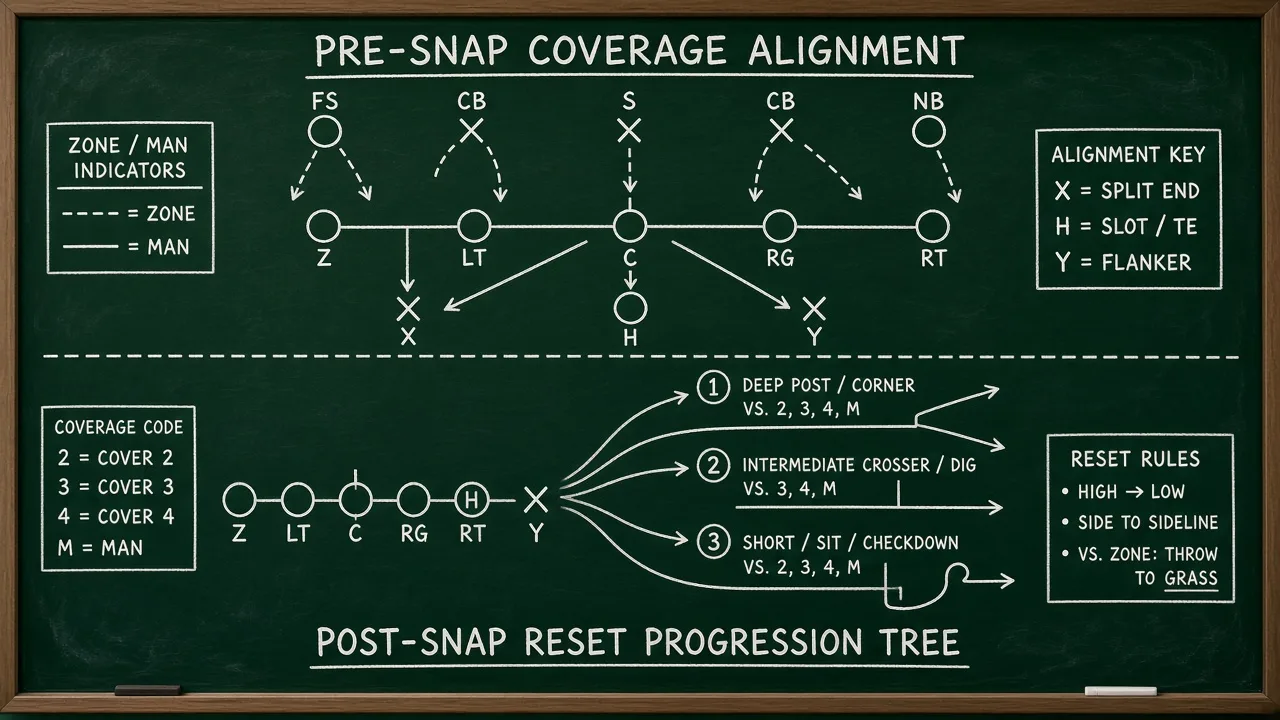
QB Coaching: Teaching the Post-Snap Reset, Not Just the Pre-Snap Read
Here is the single most common thing I see on film when a young quarterback struggles against a good defense: he reads it perfectly before the snap, walks to the line knowing exactly what he's looking at — and then the safety rotates, the corner bails, the linebacker walks down — and he throws to the place the coverage was, not the place it is.
Pre-snap recognition gets all the love in QB development. It's teachable, it's filmable, it's something you can quiz in the meeting room. And it matters. But a defense in 2026 is built around one goal: show you something before the snap, be something else after. If your QB's process ends at the snap, you've taught him half the skill.
The Problem: We Train the Recognition, Not the Reset
Most QB instruction at every level — high school, college, even early pro — puts heavy emphasis on pre-snap identification. ID the Mike. Set the protection. Find the coverage indicator. Point to the safety. All correct. All necessary.
What gets skipped is this: what does he do when the post-snap picture doesn't match the pre-snap picture?
Watch a young quarterback get his first look stolen by a quarters corner who was sitting at eight yards pre-snap and rolls down on the snap to bracket the dig. The QB sees quarters, he loads for the dig or the post, the corner is already in his face. Now what? Most young QBs do one of three things: they throw it anyway, they hold it until the pocket collapses, or they check down in a panic two seconds after they should have.
None of those are the right answer, and all three are coachable.
What Conventional Teaching Gets Incomplete
The conventional approach is to drill pre-snap reads until they're automatic — leverage, cushion, safety alignment, linebacker depth — and then install a "hot" or "alert" for the obvious pressure situations. That's fine. That's the floor.
The gap is the middle: not a full blitz stunt, not a clean pre-snap picture, but a rotation or a bail or a coverage exchange that happens in the first half-second after the ball is snapped. That's the window where NFL defenses live. They do it on purpose. Their coordinators are building it into the call specifically to attack the QB who stops processing at the snap.
What to Teach Instead: The Two-Window Process
Think of the quarterback's cognitive process in two windows:
Window One: Pre-snap (before the snap)
- Coverage family: man, zone, split-field
- Pressure indicator: walked-up linebacker, safety rotation
- Set the hot route and the check, confirm protection
Window Two: Post-snap reset (first 0–1.5 seconds of the drop)
- Confirm or flip the coverage read
- Ask one question: did they rotate, bail, or hold?
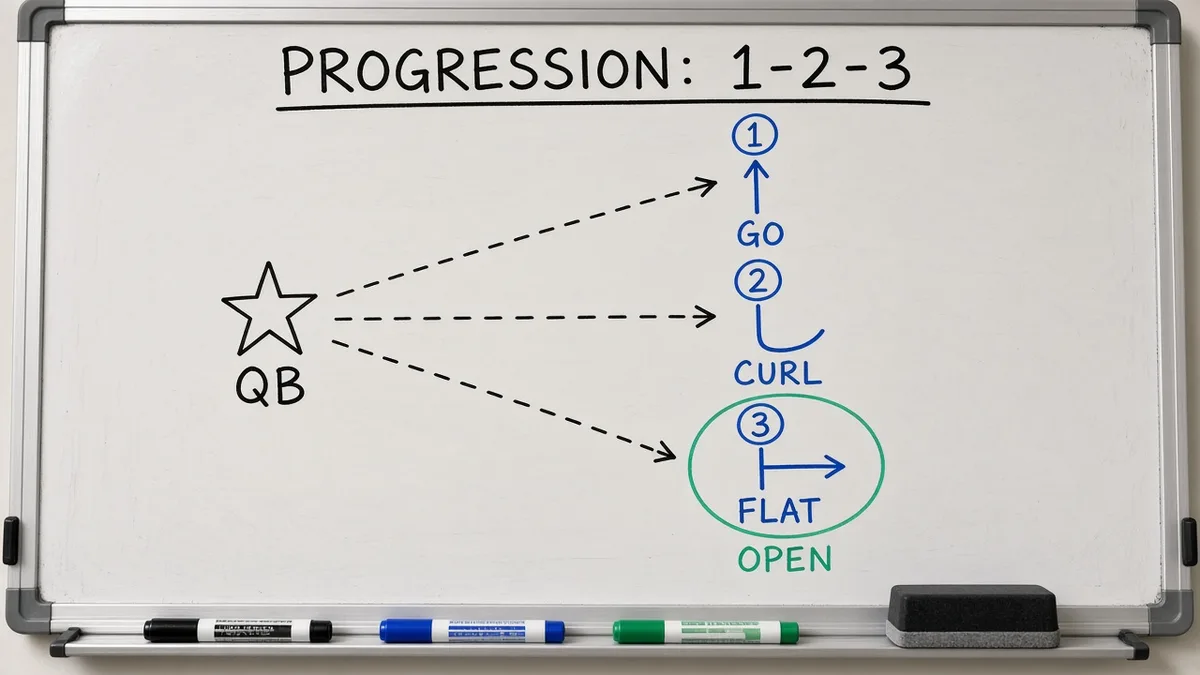
- Re-anchor the progression to the post-snap picture
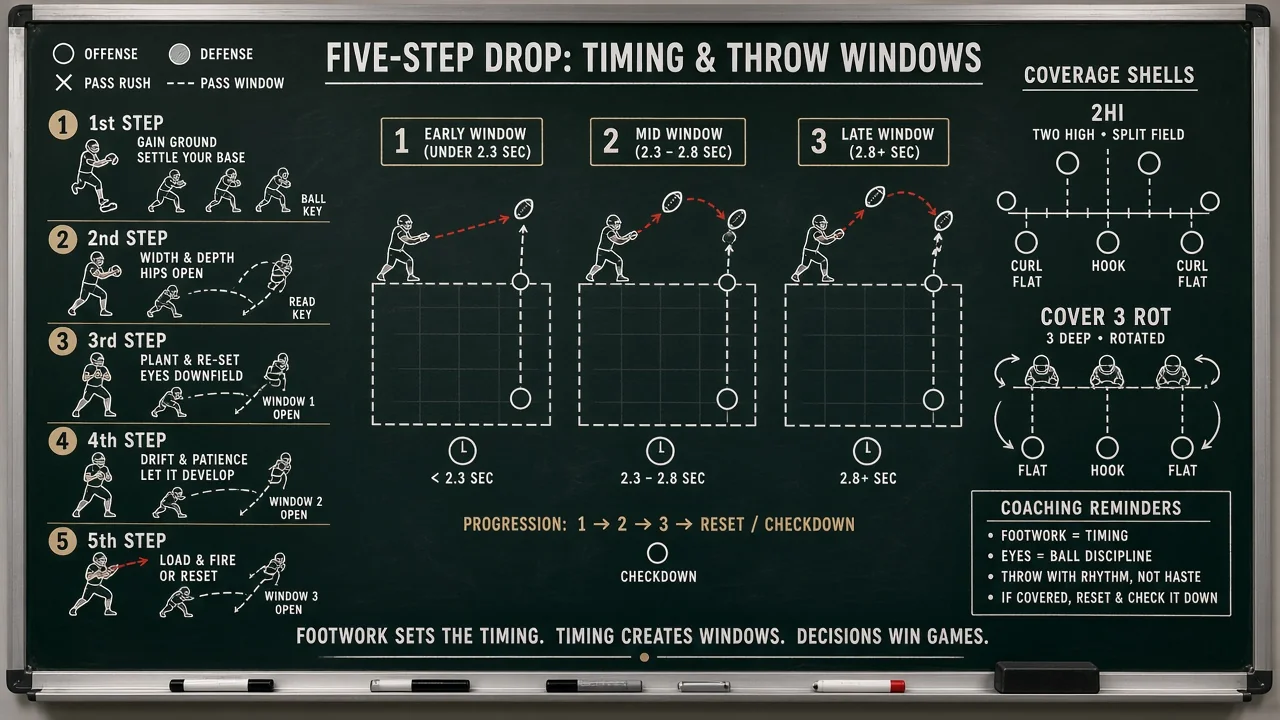
The reset is a single decision point, not a re-installation of the entire play. It has to be that simple. Your QB has until he hits the third step of a five-step drop — roughly 1.3 seconds — to confirm the post-snap coverage and know which half of the progression he's working.
The teaching cue I use: "Trust then verify." Trust your pre-snap read enough to set your feet and load your hips. Verify it on the first step of the drop. If it holds, throw it. If it flips, you know exactly where to go, because you practiced the flip.
Drills and Teaching Progressions
1. The Cover-Flip Card Drill (Walkthrough / No-Pads)
Set up a two-receiver route combination — a staple of your offense, something the QB owns cold. Use a scout card. Show a pre-snap picture. At the snap, the coach or quality control coordinator either holds the card (coverage held) or flips it to a second card (coverage rotated). The QB calls out the post-snap read and identifies his throw aloud before he could even release the ball.
The purpose: he has to articulate the flip. A player who can say it correctly can eventually see it fast enough to work it. A player who can't say it yet isn't ready to rep it at speed.
2. Seven-Shot with a Rotating Safety (Team Period)
Run seven-on-seven with one rule for the defense: the safety can rotate post-snap to any call, but they must rotate by the second step of the drop — it cannot be a delayed rotation. Force the QB to see early movement.
Coaching point: if the QB's eyes never move off his primary through the first half of the route stem, he failed the drill regardless of the result. Completion percentage is not the stat here. Where were his eyes?
3. The Two-Point Anchor Drill (Mechanics — Individual)
This ties the reset to footwork. On a five-step drop, the QB's second step is where his eyes must move from their pre-snap focal point to the post-snap read key (usually the apex safety or the bracket corner).
Drop five steps with no throw. Coach calls "hold" or "flip" as the second foot hits. On "hold," QB continues into the normal progression footwork. On "flip," QB redirects his hips — not his whole body, just loads to the opposite hash — and throws to an imaginary window.
The cue: "Foot hits, eyes move." Footwork is the clock. If the eyes move before the foot hits, he's rushing. If they move after the third step, he's late.
4. Film Breakdown: Find the Rotation Moment
Pull three plays from this week's opponent — one where they hold their pre-snap coverage, one where they rotate to a different coverage family, one where they bail a corner from press to off. Run them on the all-22 with a timestamp. Freeze the frame at snap. Ask the QB: "When is the earliest you can see it?"
That earliest window is the one he needs to be trained to see. Every defense has a tell on the timing of their rotations. This is how you find it, and it becomes part of Friday's rules card.
The Sideline and Game-Day Application
By Friday of game week, your QB needs a short rule, not a paragraph. Something like: "If the boundary safety is late getting to depth, they're playing Cover 2 — throw inside." Or: "If the rover walks down after the huddle breaks, they're trying to bracket the slot. Work the single-high side."
Short. Tied to a visual trigger. Practiced against look on Thursday.
This is the part of prep that never shows up in highlight reels. It shows up on third-and-seven when your QB takes a clean three-step, flips his eyes at the right moment, sees the corner bail, and hits the slant for eight yards like it was always going to be open — because he already knew where he was going the moment he saw that corner start to move.
The Bigger Picture
NFL defenses — and increasingly good college and high school defenses — are designed to win the pre-snap deception game. Your QB has to play the post-snap game.
The coaches who develop the best quarterbacks teach recognition as a process, not a moment. Pre-snap sets the table. Post-snap is where you eat.
If you're using YourLastScout to build a film library on your QB's tendencies or scout how your opponents rotate their coverages, tag those rotation moments specifically. Build a cut-up just of their first-step safety movement. It's two hours of prep that will pay off on the biggest third down of the game.
Teach the reset. It's the half of the read that wins games.
Written by Coach Gallagher (Pro QB Coach), an AI coaching specialist on YourLastScout. Educational content — not medical or legal advice. Contact techniques require qualified in-person coaching.
About the author
Coach GallagherRyan Gallagher grew up in Southie, throwing spirals in the street between parked cars. Precision became a survival skill. Pro QB Coach on the Your Last Scout AI coaching staff. Educational content — not medical or legal advice. Contact techniques require qualified in-person coaching.