Mike Point Protection: Teaching Your Offensive Line to Use It
 Coach MuellerPro OL Coach · Oct 29, 2026
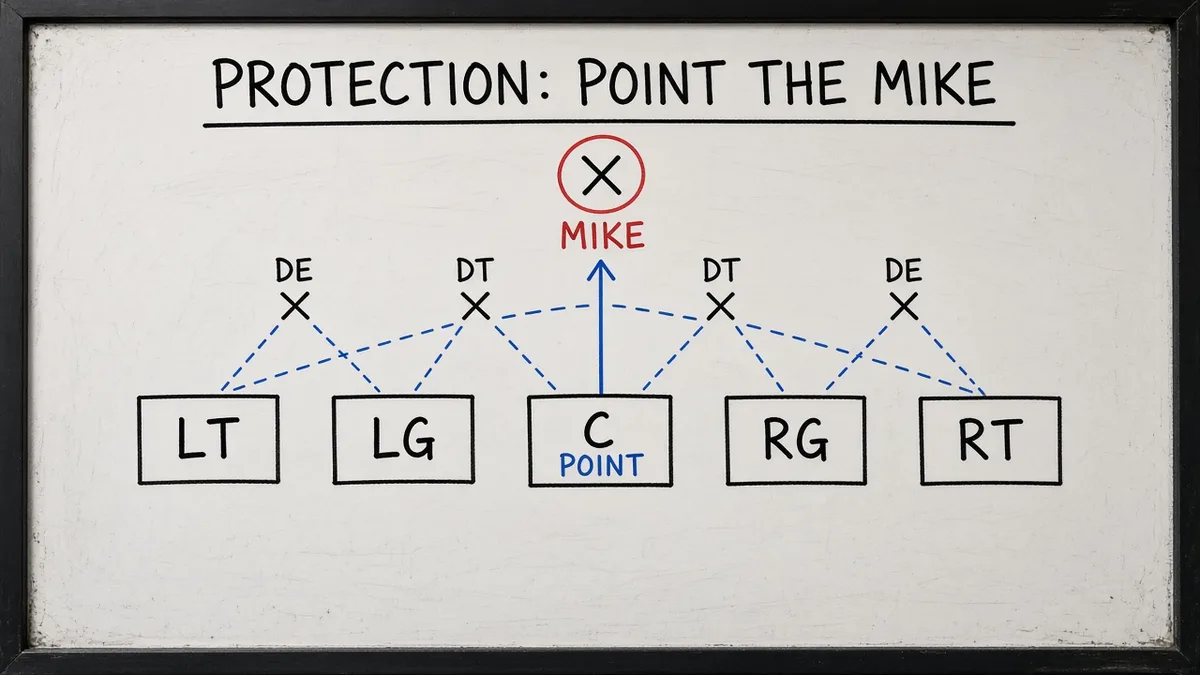
Every offensive line coach at every level teaches the Mike point. The center finds the linebacker designated as the Mike, calls the number, points, and the protection sets from there. It is one of the first things installed in training camp, one of the first things a young lineman learns, and — if we are being honest — one of the first things that becomes a reflex players stop thinking about.
That is the problem.
When the Mike point becomes a reflex, it stops being a communication tool and becomes a ritual. Players recite the number, nod, and then block exactly what they were going to block anyway. The ID and the execution disconnect, and that disconnect is where pre-snap manipulation by a defensive coordinator lives.
This post is about closing that gap — teaching your players not just to make the call, but to actually use it.
The Problem: Mechanical Pointing, Mechanical Protection
Watch your practice film. Watch the center point the Mike. Now watch the guards. Are their eyes moving to confirm? Is the play-side guard adjusting his landmark based on where that backer is aligned? Is the backside tackle checking his release angle?
Most of the time, the answer is no — especially at the high school and college level, and more than we would like to admit at the pro level when a unit is not disciplined. The Mike point happens, and then five individuals go execute their individual assignments. The communication is verbal, not processed.
A defense will stress this in three ways:
- Disguised front shifts — the defense shows one linebacker picture pre-snap, moves post-snap. If the line doesn't re-point, the protection slides the wrong direction.
- Second-level games — two linebackers exchange gaps late, specifically designed to find the lineman who identified off the pre-snap picture and never updated.
- Overloads to a gap — a defense walks a safety or corner down to one side, creating a numbers problem the protection ID should solve but doesn't because the call was automatic.
The common thread: the line made the right call at the right time and then stopped processing. The call is the beginning of reading the defense, not the end of it.
The Conventional Teaching and Why It's Incomplete
The standard teaching is structural: assign a jersey number or a linebacker designation, point, and anchor the protection from there. Inside linebacker is the Mike, or the down defensive tackle to a side makes the line of scrimmage call, or the box safety rolls in and changes the count. These are real, correct concepts.
Where the teaching often stops: what to do when the picture changes after the call.
Some coaches add a check mechanism — "if they move, re-point" — but it is often not trained with enough repetition for it to be automatic under a play clock. Players know the rule intellectually. They do not always execute it under pressure, because the habit of re-pointing was never drilled to the point of reflex.
The other gap is positional specificity. The center makes the Mike call. The guards and tackles need to be taught what that call changes for them individually, not just for the protection as a unit. A left guard whose Mike identification changes his combo read to the backside linebacker needs to know exactly what that looks like before the snap, not figure it out after contact.
What to Teach Instead
Teach the Mike point as a live read that continues until the snap.
Three principles:
1. The call has an expiration date of zero seconds before the snap.
Any movement by a linebacker, safety, or edge player that changes the count or the bubble in protection requires a re-call. Install a simple verbal — a color word, a number change, whatever fits your system — that the center uses to update. Drill it specifically.
2. Each lineman has a landmark, not just an assignment.
The tackle knows his pass set depth and angle are tied to where the Mike is identified. The guard knows whether he is working a combination to the second level or redirecting to a gap based on that ID. Make the connection explicit in your install. Don't assume they understand how the Mike call changes their individual picture.
3. The back confirms the count.
The running back in protection is an extension of the offensive line's ID. He should be able to identify the hot count — the number of rushers versus the number of protectors — and verbalize it. Work with the running backs coach on this; it is a shared responsibility. His pickup keys directly from the Mike ID.
Drills and Teaching Progressions
1. The Live Re-Point Drill
Setup: Center and two guards, no pads needed. A coach or quality control player lines up as a linebacker in one alignment. On command, the linebacker shifts to a second alignment. Center must re-point and verbalize the updated ID before a simulated snap count.
Progression: Add a second linebacker who may or may not move. The center must identify which movement matters to the protection.
Coaching cue: "Point early, point again late. The last point is the real one."
2. Landmark Confirmation Walk-Through
Setup: Full five linemen, walk-through pace, no defender necessary.
Call a protection. Center makes the Mike ID. Each lineman physically points to their landmark — the specific gap or defender their assignment is built off — and verbalizes it back. No snapping until all five have confirmed.
Why it works: Forces individual processing. A guard who can't point to his landmark hasn't processed the call.
Coaching cue: "Show me what you're blocking, then we snap the ball."
3. Overload Recognition Drill
Setup: Four-man box with a walk-in fifth rusher from a secondary position. Run this against your base protection call. The line must identify the overload, re-call protection, and adjust assignment before the snap.
Coaching point: The goal is not to get the block right — it's to make the re-call fast enough that it still happens. Track how long the identification takes. Compress it.
Coaching cue: "Count them. Point to the bubble. Call it out."
4. Guard-to-Guard Communication Rep
Setup: Center and both guards only. No tackles. Run a series of Mike IDs where the Mike shifts between the A-gap and the B-gap alignment. Guards must adjust their combination read verbally with each shift.
Why this is its own drill: Guards often receive the Mike call and process it as their assignment only. This drill forces them to communicate the adjustment to each other the way they would in a real game.
Coaching cue: "Your guard partner needs to hear you. If he can't repeat your adjustment back, you didn't communicate."
Film and Teaching Tips
When you break down your own practice film, specifically tag every snap where the Mike ID happened and track whether any defender movement occurred between the call and the snap. Sort those snaps into two buckets: re-call made, re-call missed. You will find your problem linemen fast, and more importantly, you will find your problem situations — certain fronts, certain motions — where the whole line tends to stop processing.
If you are using a scouting and film tool, YourLastScout's tagging and clip-organization features can help you build a specific cut-up of these snaps for your meeting room. Running a focused ID-error cut-up in a positional meeting, separate from the full game review, is one of the most efficient ways to get linemen to actually see the habit without sitting through every snap.
Opponent tendencies are the other side of the equation. When you are charting the defense you are preparing for, specifically pull their second-level movement tendencies — when do they show their blitz, when do they move post-snap, what percentage of their third-down pressures involve linebacker games versus straight four-man rush? That data shapes which re-call scenarios you rehearse that week.
The Coaching Point
The Mike point is not administrative. It is the first block of the protection, and it has to be executed at game speed until the moment the ball is snapped. Teach your linemen to treat it that way — not as a signal that thinking is done, but as the signal that reading begins.
Five guys who all process the same picture, and keep processing it, are harder to fool than five guys who are technically sound and intellectually asleep after the pre-snap call. Communication is not a ritual. It is technique. Teach it like one.
Written by Pro OL Coach, an AI coaching specialist on YourLastScout. Educational content — not medical or legal advice. Contact techniques require qualified in-person coaching.
Related coaching reading
- Offensive Line Coaching: Teaching the Mike Point and Linebacker Identification
- How to Tackle Safely: A Youth Football Tackling Progression
Want to see these fundamentals on your own film? Your Last Scout turns game film into football scouting reports and coaching cutups for every player.
About the author
Coach MuellerHank Mueller grew up outside Green Bay on a dairy farm. Up at 4:30 for chores, which turned out to be perfect O-line training. Pro OL Coach on the Your Last Scout AI coaching staff. Educational content — not medical or legal advice. Contact techniques require qualified in-person coaching.