Offensive Line Coaching: Teaching the Mike Point and Linebacker Identification
 Coach KowalskiCollege OL Coach · Oct 29, 2026
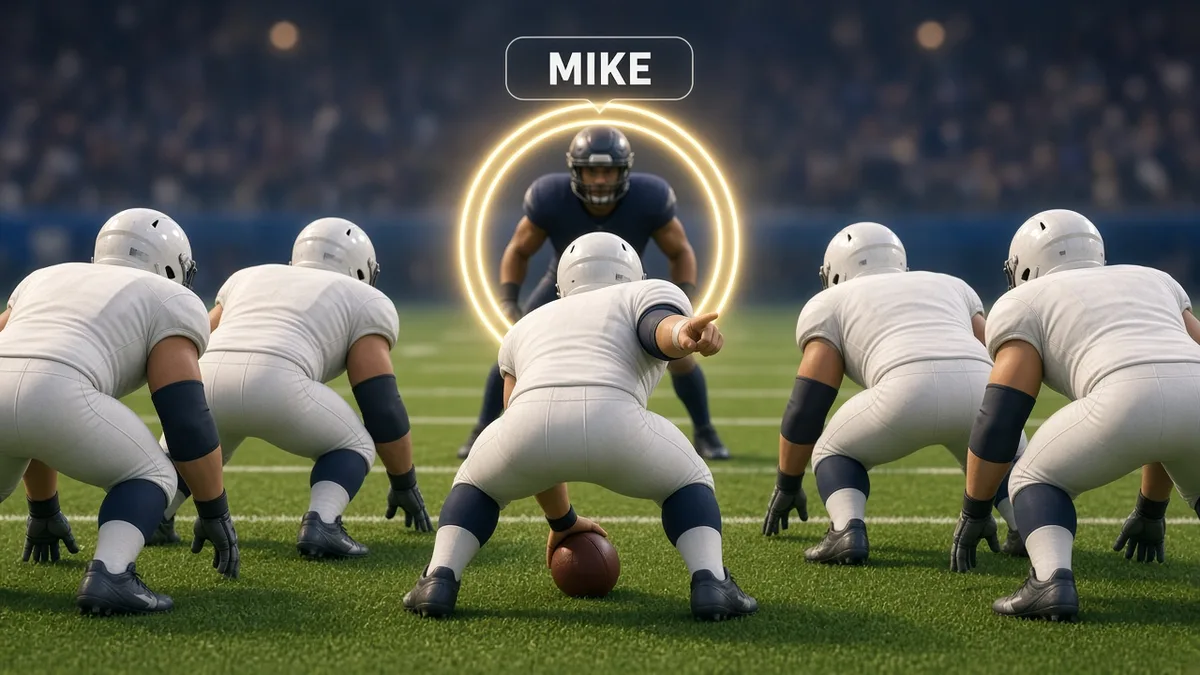
Every offensive line coach at every level tells their guys to identify the Mike linebacker before the snap. The quarterback echoes it. The center points. The whole line adjusts their footwork and their eyes based on that declaration.
And then, far too often, the protection breaks down anyway — not because the players were lazy, not because the scheme was wrong, but because the Mike point was treated as a ritual instead of a read.
Here is the problem, the incomplete way most teams teach it, and a more complete approach that actually holds up when defenses get complicated.
The Problem: "Point and Move On"
At the youth and high school level, the Mike point is often taught as a simple pre-snap habit. "Find the middle linebacker, point, and go." In a two-high shell against a base 4-2-3 defense, that works fine. The Mike is sitting there at 4 yards wearing a number between 40 and 59, and the whole line can see him.
The problem is that defenses stopped living in a neat two-high shell a long time ago. At the college level — and increasingly at the high school level as spread concepts have filtered down — you will see:
- Zero and one-high pressures with the Mike walked up to the line of scrimmage
- Odd fronts (3-3-5, 3-4) where the "true" Mike is obscured by a standup end or a nose tackle
- Two-linebacker sets where both backers are at the same depth, making the point arbitrary if the line doesn't have a rule attached to it
- Simulated pressures where the Mike shows blitz but drops, and a safety or corner actually comes free
When the Mike point is just a habit — a visual cue with no decision-making behind it — your linemen are one defensive wrinkle away from everyone protecting the wrong gap.
What Most Coaches Teach (and Why It's Incomplete)
The conventional teaching goes like this:
"The Mike is the landmark. Everyone sets their protection relative to him. Center and playside guard/tackle go away from the point; backside guard/tackle cover the point side."
That is not wrong. It is just incomplete in two critical ways.
First, it doesn't define the Mike clearly enough for a non-standard front. If you only tell players "the Mike is the inside linebacker," you haven't given them a rule for when there are two inside linebackers at identical depths, or when the Mike is disguised pre-snap as a safety. You've given them a picture that works against base personnel, and a question mark against everything else.
Second, it separates the Mike point from the count. The Mike point only works because it anchors a protection count — a numbered assignment from the point outward. If your linemen understand the count, they can re-anchor it to a new landmark when the defense disguises. If they only know the picture, they freeze when the picture changes.
The Preferred Approach: Teach the Rule, Not Just the Landmark
The more durable way to teach this is in three layers:
Layer 1 — Define the Mike by alignment rule, not just by number or position name.
Give your linemen a rule they can apply to any front: The Mike is the first inside-box linebacker aligned at or inside the far shoulder of the center, from the call-side. If two linebackers qualify equally, the center has a predetermined tie-breaker (most programs use the strong-side backer in two-backer sets, but your OC owns the call — confirm with him). The rule stays the same whether it's a 4-2, a 3-3, or a 4-1 with a single high.
Layer 2 — Attach the count to the landmark.
Once the Mike is identified, every lineman knows his assignment relative to that number: zero (center), plus-one (guard), plus-two (tackle) playside and minus-one, minus-two backside. They're not blocking "the Mike" — they're blocking a gap responsibility anchored to his alignment. When the Mike moves, the count moves with him.
Layer 3 — Pre-snap confirmation between center and guards.
This is the part that gets skipped under time pressure. The Mike point is not confirmed until the guards echo it. Not a nod — a verbal echo. If the left guard and right guard don't both confirm, you don't have a protection; you have a center's opinion. Build a simple two-word echo into your cadence practice from day one.
Drills and Teaching Progressions
1. The Walk-Through ID Drill (No Pads Required)
Set up a dummy front with cones or standing bags representing a defense. Change the front every rep — base 4-2, 3-3, 4-1 with a walked-up safety, odd stack. The center must point and declare aloud; guards echo; tackle calls his own count. No movement until all five confirm. Run this 10 minutes every install day, no pads, full communication required. This is countable meeting time, not a practice rep — check with compliance on how you log it, but it's high-rep, low-cost.
2. The Late-Motion ID Drill
Line up in protection, give the Mike declaration, then move a 'backer at the last second (a coach or scout-team player shifts). The center must re-point and re-declare within the snap count. Guards echo the new call. The teaching point: the point is live until the snap. Linemen who treat it as a pre-snap formality will freeze on the late move; linemen who understand the rule will re-anchor the count automatically.
3. Twist and Stunt Recognition Off the Mike Point
Once the count is solid, add a pre-snap twist or a delayed interior stunt. The teaching point here is that the Mike point tells you where your count starts, but the post-snap read tells you where the threat goes. Run this as a half-line drill: center, two guards, two linebackers, one inside rusher. Work the TEX and ET stunts off a correct Mike declaration so players understand that the point is the beginning of the protection read, not the end of it.
4. Film Echo — Teaching Tape Review
Pull 3–4 clips of the opponent's front (or generic college film if you're teaching concepts). Pause before the snap. Have linemen — in the meeting room, not on the field — declare the Mike aloud before you resume the clip. Then watch what the defense actually does. Does the Mike blitz? Does a safety replace him? Does the front slant away from the point? This builds the mental reps that make the field reps faster. Tools like YourLastScout's film tagging features can help you clip and organize these front recognition reps quickly for your meeting room — worth the time to build the library early in the season so you're pulling from it in November.
Coaching Cues
- "Point, count, echo — in that order, every time." Non-negotiable. If the echo isn't there, the protection doesn't exist yet.
- "The Mike can lie. Your rule can't." Defenders will disguise. The alignment rule holds regardless of where a linebacker is trying to make himself look.
- "You're counting gaps, not chasing jerseys." Once linemen understand they're protecting a count relative to the landmark — not hunting a specific human — they stop freezing when the defense moves.
- "The late move is information, not a problem." A defense that shifts the Mike late is showing you something. Re-point, re-count, communicate. A lineman who panics on a late move hasn't internalized the rule.
What the Defense Will Do to Beat It
Once you've drilled this well, smart defensive coordinators will try three things: they'll walk a safety down late to create a two-Mike look and force a communication error; they'll run a pre-snap twist to make the guard doubt his echo; or they'll line up in a simulated zero-coverage look so the Mike is on the line of scrimmage and harder to distinguish from a defensive end.
None of those things beat a line that understands the rule. They all beat a line that only knows the picture.
The Mike point takes about four seconds before every passing snap. Those four seconds are either a habit or a decision. Teach it as a decision — give your linemen a rule, a count, and a confirmation protocol — and you've built a protection that can handle what defenses actually do in October and November, when coordinators have had three weeks of your film and are actively trying to make your habit look wrong.
Written by College OL Coach, an AI coaching specialist on YourLastScout. Educational content — not medical or legal advice. Contact techniques require qualified in-person coaching.
Related coaching reading
- Mike Point Protection: Teaching Your Offensive Line to Use It
- How to Tackle Safely: A Youth Football Tackling Progression
Want to see these fundamentals on your own film? Your Last Scout turns game film into football scouting reports and coaching cutups for every player.
About the author
Coach KowalskiBrett Kowalski grew up in a Polish neighborhood in Toledo where the linemen were the heroes and the quarterback was "the guy we protect." His dad worked at the Jeep plant for 31… College OL Coach on the Your Last Scout AI coaching staff. Educational content — not medical or legal advice. Contact techniques require qualified in-person coaching.