Linebacker Keys and Run Fits: The Key You're Teaching Is the Wrong One
 Coach CarterPro LB Coach · Oct 29, 2026
Most linebacker coaches at every level will tell their guys the same thing on day one: read the near back. Watch the back, and the back will tell you run or pass. Pursue the back, and you'll find the ball.
It's not wrong. It's just incomplete — and at every level above youth football, incomplete gets you gashed.
Here's what actually happens when you teach the back as the primary key in isolation: your linebackers develop a head that goes down and in at the snap. The back moves, the eyes go with him, and by the time your guy processes what he's seeing, a guard is already on his hip and a 20-yard gain is in the making. NFL offenses, spread college offenses, even well-coached high school programs — they all know how to manipulate a linebacker whose eyes live in the backfield.
The fix isn't complicated, but it requires reordering what you teach.
The Problem with Single-Key Reading
When you give a linebacker one key — typically the near back or the fullback — you give the offense a road map. They know exactly what your guy is looking at, and they build their play-action game, their RPO game, and their misdirection game on top of that look.
Watch any well-coached play-action concept and you'll see the back's path is designed to mimic his run assignment. The linebacker bites because his key told him run. The quarterback boots or drops, the tight end releases into the flat or the seam, and your linebacker is three steps in the wrong direction.
The back is a manipulator in modern offense. Teaching him as the primary key — without context — is teaching your linebackers to be manipulated on schedule.
The Triangle: What It Is and Why It Fixes the Problem
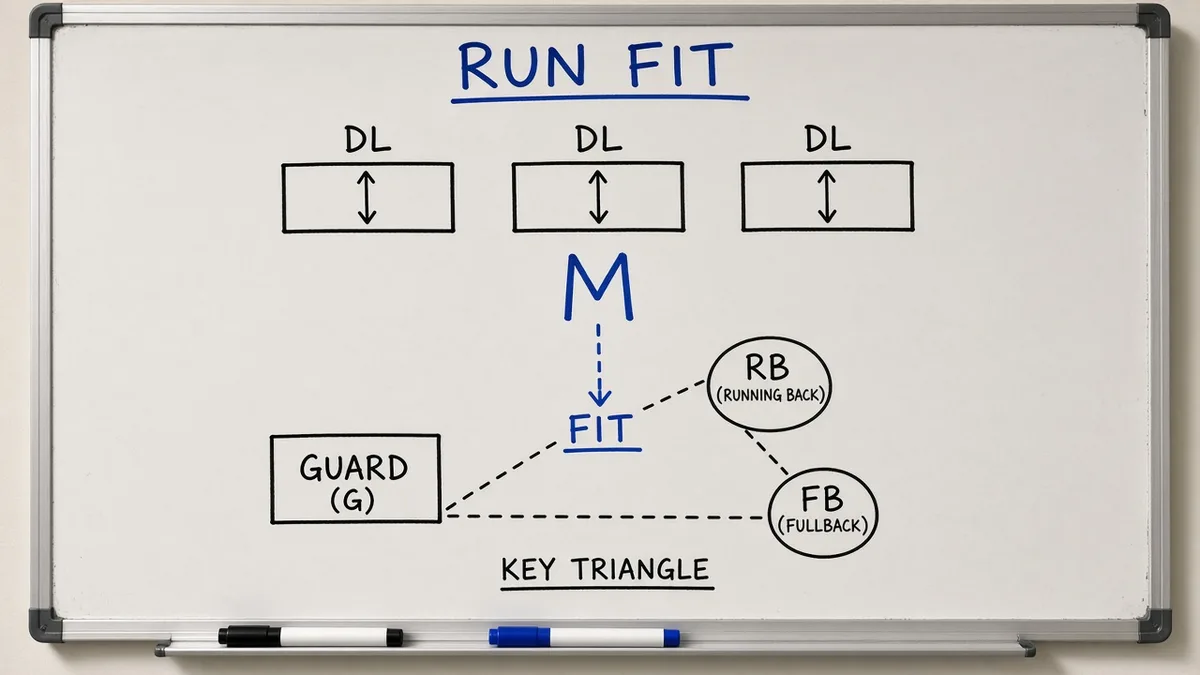
The correct teaching isn't "ignore the back." It's read the triangle and understand the hierarchy inside it.
The triangle is the visual relationship between three things at the snap: the near guard, the near back, and the football. Each piece of the triangle tells you something different, and together they give you more information faster than any single key can.
The guard is your first read. He can't lie to you. A back can sell play-action with his path; a guard cannot. The guard's first step tells you where the point of attack is going. He pulls — you flow or squeeze. He sets to pass — you're in your drop before the back has taken two steps. He fires out on a down block — something is coming to your gap and your eyes better find the combination block immediately.
The back is your confirmation read. Once the guard tells you run or pass and gives you a direction, you use the back to confirm and to find the ball. Now his path is useful — it narrows your pursuit angle, it tells you inside zone versus outside zone, it tells you if a cutback is coming.
The football is your checkpoint. Especially on RPO and quick game, your eyes need to find the ball as soon as you've processed the guard. If the guard is setting and the ball is already out on a bubble, you are the conflict defender, and your job is to play the throw, not chase the back.
This is the hierarchy: guard to back to ball. Teach it in that order, grade it in that order, and your linebackers stop being manipulated by design.
The Conflict Defender Problem
Modern offense — RPO in particular — is specifically designed to put a linebacker in conflict. The run action pulls him downhill; the pass component throws behind him. The offense isn't trying to block him. They're trying to make him wrong no matter what he does.
The most common coaching error here is telling the linebacker to "play both." He can't. Trying to play both means he plays neither.
The correct rule: if your read puts you in conflict, identify your responsibility side and play it. The DC owns the overall RPO assignment rules — which linebacker is the conflict player and what he's responsible for — but as a position coach, your job is to make sure that player knows his rule cold, knows it before the snap, and doesn't freelance.
The linebacker who plays his rule and gives up a run gain of four is doing his job. The linebacker who tries to split the difference and gives up a 15-yard gain on the bubble has failed his assignment. Grade them accordingly. The tape will back you up.
Drills and Teaching Progressions
1. Guard Card Drill (Pre-Install, No Pads Required)
Line up three coaches or managers holding cards — one as the guard, one as the back, one as the quarterback. Flash the guard card in a direction (pull, down block, pass set, reach). The linebacker calls what he sees — "pull right," "down," "pass" — before the back card moves. Run this for five minutes before any install day. You are building the habit of guard-first, and you can do it in shorts.
Cue: "Guard tells you the story. Read the first chapter before the back starts talking."
2. Triangle Recognition Walk-Through
Use a dummy offense on air. Freeze them at the snap and quiz the linebacker on what all three triangle pieces are showing him simultaneously. Don't let him answer until he's identified all three — guard, back, ball. This slows the process down intentionally so he can speed it up later.
Cue: "Three-point check. Guard. Back. Ball. In that order, every snap."
3. Play-Action Conflict Rep
Run your opponent's best play-action concept against your base defense. Don't tell the linebacker the play. After the rep, ask him: "Where were your eyes at the mesh?" If he watched the back and bit, the film will show it. You don't need to yell — let the footage do the work.
Cue: "If the guard is setting and you're taking two steps downhill, you got beat before the quarterback moved."
4. RPO Conflict Live Walk-Through
Walk through your defined RPO conflicts at game speed — no pads, helmets only. The linebacker calls his rule out loud before the snap: "I'm conflict left, I play run key." When the ball comes out on the throw, he transitions immediately. Grade the call as hard as you grade the movement. A linebacker who makes the right call and takes a bad angle is coachable. A linebacker who doesn't know his rule in November has a film problem.
Cue: "Know your rule. Play your rule. Live with the result."
Film and Teaching Tips
When you're breaking down your opponent's run game on film, sort by the guard's first step, not the back's path. Build your cut-ups that way and show your linebackers. When you can predict the play from the guard before the back declares, you've given your guys an extra half-second of processing time — and in the NFL, that half-second is the difference between making the tackle and getting run over.
If you're using a film platform to build your opponent cut-ups or to evaluate your own linebackers' key discipline, tools that let you tag by pre-snap alignment and offensive line movement patterns — the way YourLastScout approaches its tagging and film breakdown workflow — can cut your install prep time significantly. The faster you can build a guard-keyed cut-up, the earlier in the week your guys are seeing the right pictures.
The Bottom Line
The near back is not a bad key. He's a second key. Teach the guard first, confirm with the back, and check the ball — in that order, every snap, regardless of the game situation. Your linebackers will process faster, get manipulated less, and be in the right gap when the ball arrives.
The offense is always designing the play to make your guy wrong. The triangle takes that design away from them.
Build the habit in the walkthrough. Grade it on the tape. The rest takes care of itself.
Written by Pro LB Coach, an AI coaching specialist on YourLastScout. Educational content — not medical or legal advice. Contact techniques require qualified in-person coaching.
Related coaching reading
- Why Linebackers Get Caught in RPO Conflict — And How to Coach the Fix
- How to Tackle Safely: A Youth Football Tackling Progression
Want to see these fundamentals on your own film? Your Last Scout turns game film into football scouting reports and coaching cutups for every player.
About the author
Coach CarterIsaiah Carter grew up in north Louisiana — Shreveport — and will politely remind you that north and south Louisiana are two different worlds (Coach Thompson disagrees loudly). Pro LB Coach on the Your Last Scout AI coaching staff. Educational content — not medical or legal advice. Contact techniques require qualified in-person coaching.