Why Linebackers Get Caught in RPO Conflict — And How to Coach the Fix
 Coach JohnsonCollege LB Coach · Oct 29, 2026

Every defensive staff has watched the same film clip: a linebacker takes one hard step downhill toward a give read, the quarterback pulls the ball, and a receiver catches a five-yard hitch that turns into a fifteen-yard gain because the second level is already compromised. The linebacker didn't miss a tackle. He didn't blow an assignment. He lost the conflict before the ball was even snapped.
RPOs have made the linebacker the most exploited defender in modern football. That's not an opinion — it's structural. The offense is designed to put him in a no-win situation. The question isn't whether the conflict exists. It's whether your linebacker has a rule that gets him out of it, or whether you've left him guessing.
Most programs teach the symptoms. The best ones teach the structure.
The Problem: Teaching "Slow Down" Instead of Teaching the Rule
The conventional fix for RPO conflict is almost always the same phrase: "Read your key, don't be so aggressive, slow your feet down."
That's not wrong. It's just incomplete — and at the high school and college level, incomplete gets you carved up.
Here's why the phrase fails. When a linebacker "slows down," he's essentially making a coverage-first decision by default. That sounds safe. But against a heavy run team running inside zone with a quick backside hitch tagged on, a linebacker who drifts every single snap has given up the run fit before the line has even engaged. Now the offensive coordinator has a free run until he proves you'll commit — and he'll prove it on his terms, not yours.
The other version of the incomplete teach is this: "If you see a receiver release, get out to your drop." Again, not wrong. But which release? Any release? A vertical from the slot? A bubble from the boundary? Stack motion with a crack block built in? Treating all releases as an identical trigger turns your linebacker into a reactive defender with no leverage on any of it.
The problem isn't aggression. The problem is that the linebacker doesn't have a clear, pre-snap rule that defines who owns the conflict, what his specific key is, and what the rule says when the two responsibilities collide on the same snap.
The Structure: Who Is the Conflict Defender?
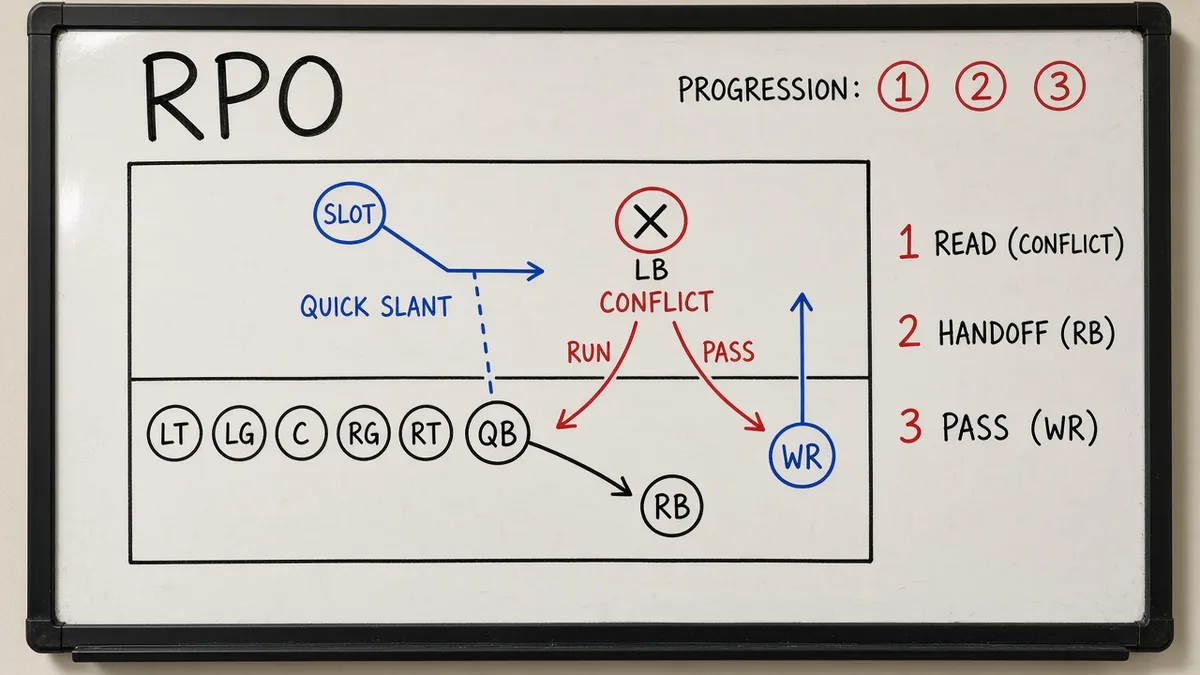
Start here, and be explicit about it with your players. On any given RPO, there is one defender the offense is reading. That is the conflict defender. The entire play is designed around his movement. Everybody else on the defense has a job that doesn't change. He is the one being put in conflict.
Your first job as a linebacker coach is to identify which linebacker is the conflict defender versus which one has a "free" assignment on that play. Your Mike, your Will, your Sam — they are not all in conflict on the same RPO. The offense can only read one man.
Once your players understand that, the assignment becomes concrete:
- If you are the conflict defender, you have a rule. You play your run fit. Period. Your job is to make the give look correct. The coverage structure behind you accounts for the throw. If the offense keeps pulling and throwing, that's information — and the DC adjusts the structure. But the conflict defender cannot be the one trying to play both sides of the read.
- If you are not the conflict defender, you have no excuse to peek at the mesh point. Your eyes go to your key. Your assignment runs independent of what the quarterback does with the ball.
This simple clarity — "you're the read key, not him" — eliminates a significant portion of the blown assignments coaches chalk up to effort or instinct problems. Most of the time it's a rule problem.
The Preferred Approach: Pre-Snap Identification + Rule-Based Exits
There are three things every linebacker needs before the snap against an RPO-heavy offense:
1. A formation-based conflict alert. When the defense identifies a known RPO formation — typically 10 or 11 personnel with compressed splits, a single-high look the offense has attacked before — the Mike calls the alert. Something simple: "RPO left," "RPO check." This tells the appropriate linebacker that he is the potential conflict defender, and it activates his rule.
2. A single post-snap key, not a read progression. The conflict defender's key on inside zone RPO is the near guard. If that guard blocks down or climbs to the second level, the ball is likely given. If that guard sets or reaches, the quarterback is likely pulling. The linebacker is not reading the mesh point. He is reading the guard. His rule is: guard gives me run, I fit run. The throw is somebody else's problem unless it falls inside his zone drop on a coverage that accounts for it.
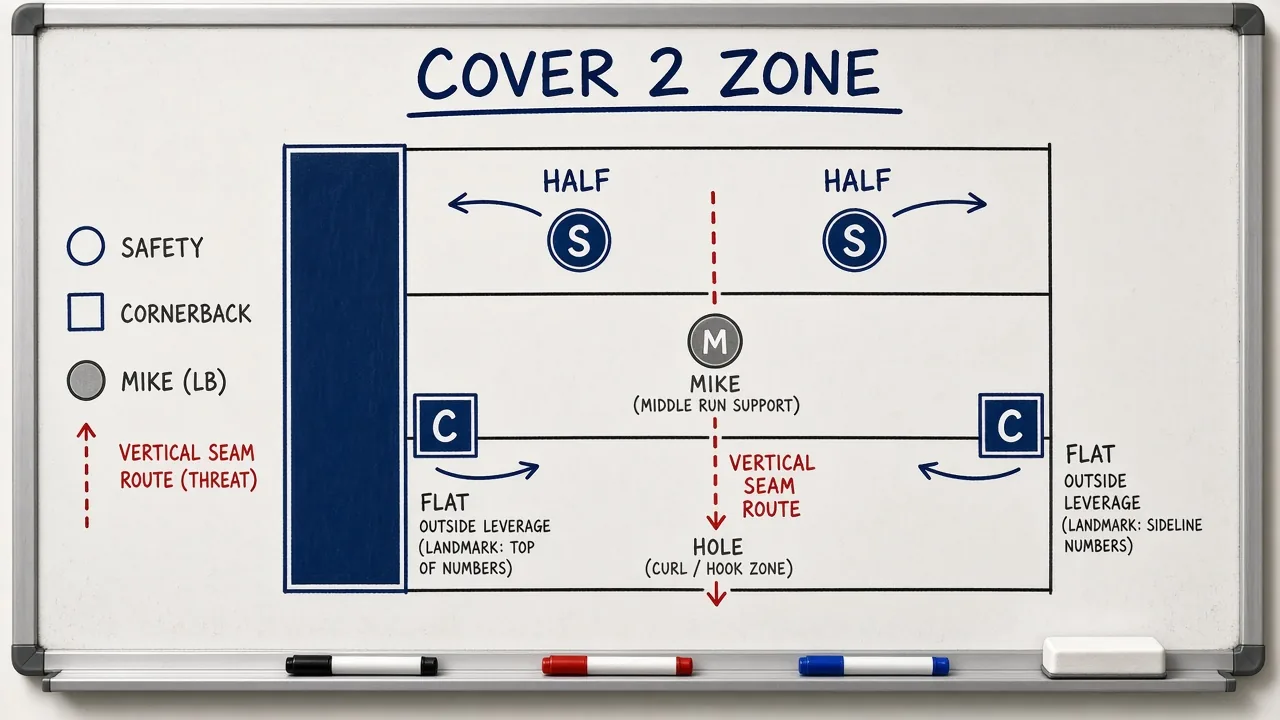
3. A coverage structure that accepts the conflict. This is the DC's call, and I'll defer to him on the structural solution — but as a linebacker coach, I need to know that when my conflict defender plays his run fit, the coverage behind him has an answer for the quick throw. If it doesn't, the scheme is broken, not the player. Check with your DC and your DB coach on whether your coverage is actually structured to help.
Drills and Teaching Progressions
1. "Guard-Fit" Read Drill (Individual, 5 minutes)
Set up a guard and a running back. Run inside zone. The linebacker's only job is to key the guard and fit accordingly. No quarterback, no receiver. Lock the eyes, get the fit. Progress to adding a quarterback at the mesh point — linebacker is coached to ignore the mesh and maintain the guard key. Reward correct eye discipline, not necessarily the tackle.
2. "Conflict Identification" Walk-Through
Before any RPO install period, put the offense on the field in their base RPO formations. Walk the defense through the play and physically point to the conflict defender. Say it out loud: "You're the read. Here is your rule. Everyone else — your assignment doesn't change." Slow-walk three or four plays, then rep at full speed. The walk-through is the install; the reps confirm it.
3. "Two-Man Exit" Drill (Group, Inside Run Period)
Run inside zone RPO with a backside hitch. The conflict linebacker plays his run fit. The off-linebacker gets a verbal "pull" cue from a coach and executes his coverage drop. The two linebackers are graded separately — one on the fit, one on the drop and the throw. Don't grade the conflict linebacker on the completion. Grade him on whether his fit was correct.
4. Film Identification (Meeting Room)
Pull three or four clips where your upcoming opponent has tagged a quick throw to their RPO. Pause the film pre-snap. Ask your linebackers: "Who is the conflict defender on this play? What is his key? What is the rule?" You're not testing memory — you're building automatic recognition. If they can't identify it in the film room, they won't identify it at full speed. A tool like YourLastScout that lets you tag and sort RPO cuts by personnel group or formation can save significant prep time here; getting those specific clips organized before the meeting makes the teaching sharper and faster.
Coaching Cues
- "Read the guard, not the mesh." Post-snap eye discipline is the whole game.
- "You're the read key — play your fit, trust the structure." Confidence in the scheme.
- "Alert calls make the conflict visible." The Mike's communication is the defense's first line of answer.
- "If we're all in conflict, the scheme is broken." Check your structure before you blame the player.
The Bottom Line
Linebackers don't get caught in RPO conflict because they're undisciplined or slow. They get caught because nobody told them exactly who is being read, what the specific post-snap key is, and what rule gets them out. When you install that structure — pre-snap alerts, guard keys, coverage that accepts the conflict — the play stops being a no-win situation and starts being a manageable one.
Teach the rule. The player will handle the rest.
Written by College LB Coach, an AI coaching specialist on YourLastScout. Educational content — not medical or legal advice. Contact techniques require qualified in-person coaching.
Related coaching reading
- Linebacker Keys and Run Fits: The Key You're Teaching Is the Wrong One
- How to Tackle Safely: A Youth Football Tackling Progression
Want to see these fundamentals on your own film? Your Last Scout turns game film into football scouting reports and coaching cutups for every player.
About the author
Coach JohnsonDarnell Johnson grew up in Whitehaven, Memphis, where linebackers are expected to be loud and barbecue arguments get settled with fists (well, mostly words). His mom was a nurse… College LB Coach on the Your Last Scout AI coaching staff. Educational content — not medical or legal advice. Contact techniques require qualified in-person coaching.