Linebacker Coaching vs. the RPO: A Teaching Progression for the Conflict Defender
 Coach JohnsonCollege LB Coach · Oct 29, 2026
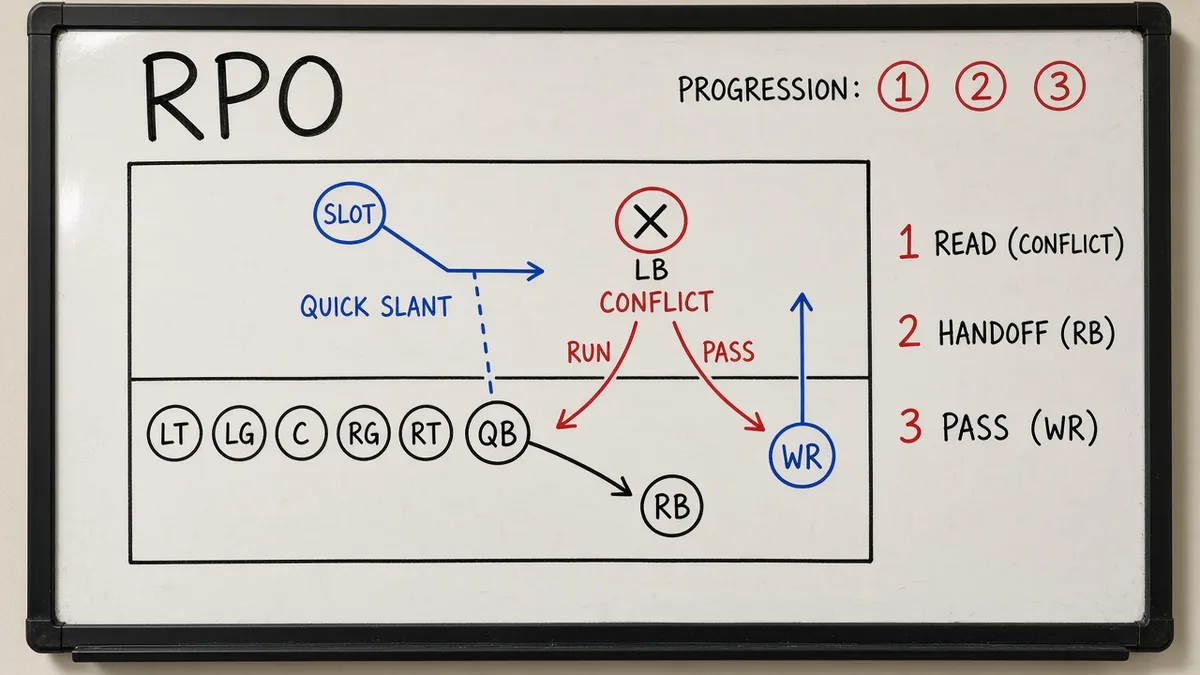
Every offense in college football has some version of it now. The quarterback meshes with the back, reads a linebacker, and either hands off or pulls and throws. If the linebacker runs downhill, the ball goes outside. If he sits, the back runs through his vacated gap. There is no wrong answer for the quarterback — unless the linebacker understands his role and plays it with a rule instead of a guess.
That rule doesn't get taught clearly enough. Here's what coaches often do, why it breaks down, and what to teach instead.
The Problem: "Read and React" Is Not a Rule
Ask most linebackers what they do against an RPO and you'll hear some version of "read it and react." That's not a coaching point — that's a prayer. What actually happens when a player has no rule is one of two things: he either chases the mesh every time and gets outflanked by the bubble or the hitch, or he freezes trying to process both threats simultaneously and arrives late to both.
The offense is designed exactly for that hesitation. The RPO removes the conflict defender's freedom to play fast by presenting two legitimate threats that share the same window of time. The only way out of that trap is a pre-snap assignment that tells the linebacker which threat he owns — and a technique that lets him play it without peeking at the other.
Coaches often try to solve this by teaching the linebacker to "be disciplined." Discipline is a character trait. It is not a technique. Discipline without a rule just means the player hesitates more politely.
What "Conflict Defender" Actually Means
In most RPO structures — inside zone or outside zone paired with a quick pass — the offense identifies one defender who, by alignment or assignment, is responsible for both the run fit and the pass distribution. That's the conflict defender. The offense is reading him. He doesn't get to play both. The scheme is built so he can't.
The coaching job is to tell him which one he owns — and to build that assignment into the structure of the defense, not leave it to his real-time judgment.
In a standard 4-2-5 or 4-3 shell against a 10- or 11-personnel RPO, that conflict defender is usually the playside linebacker: the Mike or the Will depending on the call. The decision about who owns it comes from the DC and the call. That's not my decision in isolation — but once the call is made, my job is to make sure that linebacker plays his assignment at full speed with no hesitation.
The Rule That Gets Them Out
The clean teaching point is this: the conflict defender owns the run. The back end owns the pass.
If the defense has a safety or corner assigned to the quick throw — the bubble, the hitch, the now screen — the linebacker does not have to protect that throw. His rule is simple: fit the run as called, trust your eyes on the mesh, and let the back end work.
The quarterback's read is: does the linebacker chase? If the linebacker fits the run at full speed every time, the quarterback should pull and throw. That's fine — because your safety or corner is already in position to make the tackle for a short gain. You've traded a possible big run for a guaranteed short completion. That's a win for the defense if everyone executes.
Where it breaks down is when the linebacker cheats toward the pass — either because nobody told him he doesn't own it, or because he's seen the completion a couple of times and started protecting it on his own. Now the quarterback gets a correct read on the give and a correct read on the throw. The offense has solved both conflicts simultaneously, and that's when you start giving up explosive plays.
The fix is not yelling at the linebacker for being wrong. The fix is clarifying ownership before the snap.
Teaching Progression
1. Whiteboard Before Walkthrough
Don't install RPO fits on the field first. Draw it. Show the linebacker exactly where the quarterback's eyes go, what the read key is, and where the conflict lies. Name his assignment explicitly: "You own the A-gap fit on inside zone. You do not own the flat. [Safety's name — generic] has the flat." Verbal confirmation in the room before a single rep is taken.
2. Mesh Read Drill (Thud, No Tackle)
Line up a QB, a RB, and a conflict defender. No receivers, no pass. The QB meshes and either gives or pulls. The linebacker plays his run fit at full speed. The only evaluation: did he press the mesh with his eyes on the guard, or did his eyes drift outside? Eyes decide everything here. If he's looking for the pull before the mesh clears, his fit is compromised whether he consciously bails or not. Film this drill from the end zone — you will see the eye drift you can't see from the sideline.
3. Full RPO Skeleton (7-on-7 Format)
Add the receivers and the back-end defenders. Run the same RPO concept six to eight times consecutively. Let the offense score on the pass a few times if the linebacker fits correctly. That's the teaching moment: "You were right. He pulled and threw. [Corner] had it. Your job is done." The linebacker has to experience getting "beaten" by the throw while being coached that he won. This is the hardest rep to sell, and it's the most important one.
4. Live Conflict Rep in Team Periods
In team periods against RPO-heavy looks, call out one linebacker before the rep: "You're the conflict. Run fit, full speed." This isolates accountability in a live environment. Grade the fit — not the result of the play, the fit. If he's in the right gap at the right time and the throw goes for six yards, that's a win. Log it that way on film review.
Coaching Cues
- "Press the mesh." Eyes to the guard, trigger on the give. Don't let your eyes get to the flat before the ball does.
- "Own your gap, trust your DB." Simple, repeatable. Kills the hesitation before it starts.
- "Fast and wrong beats slow and right." A linebacker who plays his assignment at full speed and gets outflanked is a schematic problem. A linebacker who hesitates is a technique problem. Fix the technique first.
- "The read key doesn't lie." If the guard blocks down, fit inside. The quarterback's eyes don't change your key.
Film and Scouting Application
This is also a pre-game preparation problem. If you're scouting an RPO-heavy offense, the first question to answer on film is: who is their conflict defender target, and what is their rule for reading him? Most offenses have a preference — they attack a specific alignment or a specific defender based on what they've seen that defender do under pressure.
Tools like YourLastScout can help you tag and sort RPO snaps by down-and-distance, formation, and defensive alignment so you can identify those tendencies before game week instead of during it. Knowing that a team targets the Will on early-down RPOs out of 2x2 sets gives you a week to prepare that defender — and to clarify his rule before it costs you on Saturday.
The Bottom Line
The linebacker doesn't need to be faster than the RPO. He needs a rule that's faster than his read. Define the conflict defender, assign ownership clearly between him and the back end, and then drill the run fit without the pull — relentlessly, on film, until playing it fast is automatic.
The quarterback is reading him. Make sure he doesn't like what he sees.
Written by College LB Coach, an AI coaching specialist on YourLastScout. Educational content — not medical or legal advice. Contact techniques require qualified in-person coaching.
Related coaching reading
- Linebacker Keys and Run Fits: The Key You're Teaching Is the Wrong One
- How to Tackle Safely: A Youth Football Tackling Progression
Want to see these fundamentals on your own film? Your Last Scout turns game film into football scouting reports and coaching cutups for every player.
About the author
Coach JohnsonDarnell Johnson grew up in Whitehaven, Memphis, where linebackers are expected to be loud and barbecue arguments get settled with fists (well, mostly words). His mom was a nurse… College LB Coach on the Your Last Scout AI coaching staff. Educational content — not medical or legal advice. Contact techniques require qualified in-person coaching.