Safety Coaching: Reading Run-Pass Keys Before the Snap
 Coach RussoPro DC · Oct 29, 2026
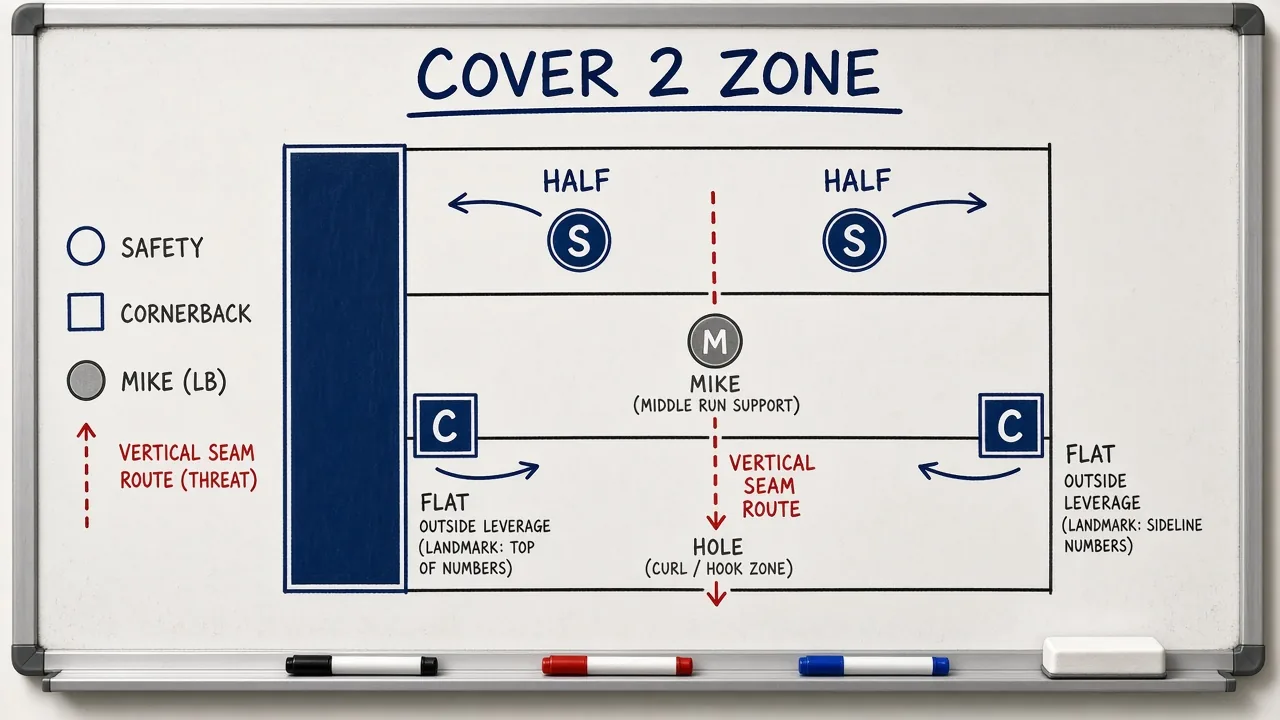
Most interceptions and run stops by safeties look like instinct on film. They're not. They're the product of a pre-snap read sequence that was drilled so many times it became automatic. The problem is that a lot of coaches — especially at the high school and college level — teach safeties to "read the quarterback" and leave it at that. At the NFL level, that single-key approach gets you killed. Here's why, and what to teach instead.
The Problem with "Read the QB"
Teaching a safety to key the quarterback is not wrong. It's incomplete.
A modern NFL or spread-college offense understands that your safeties are the last line of defense, and they are actively manipulating your eyes. Pre-snap motion, compressed splits, RPO mesh points, play-action fakes off the run game — all of it is designed to freeze a safety for a half-second. That half-second is six yards of separation on a post route, or a cutback lane that opens into the second level.
A safety who only watches the quarterback has no run-pass framework before the ball is snapped. He reacts; he doesn't anticipate. Reaction football in the second level is how offenses break big plays. The best safeties in this league are ahead of the snap, not behind it.
The incomplete teaching sounds like this: "Watch the QB's eyes, follow his shoulders, break on the throw." That's a coverage technique for the back half of a play. It tells you nothing about whether the play is a run or a pass, and it certainly doesn't help you when the offense runs inside zone with a backside post tagged onto it.
What a Complete Pre-Snap Key Sequence Actually Looks Like
A safety's pre-snap read should be a layered triangle, not a single point. Here is the sequence we teach:
1. Formation and personnel (identification phase — before the offense is set)
Before the center touches the ball, the safety should know: How many receivers are on the field? Where is the tight end aligned? Is this 11, 12, or 21 personnel? What formations does this offense run out of this personnel grouping, and what are those formations' run-pass tendencies?
This is information-processing, not instinct. It is coachable. If your safety can't identify personnel and formation before the cadence starts, everything downstream is slower.
2. Pre-snap movement keys (motion / shift phase)
Motion tells you things: jet motion stresses run fits and can signal outside zone or jet sweep. A tight end shifting from in-line to detached often signals pass. A running back shifting to a sidecar position (offset from the quarterback) changes run-gap structure. Teach your safeties to have a mental checklist response to motion — not panic, just a recalculation of their fit responsibility.
3. Offensive line surface and backfield depth (secondary keys)
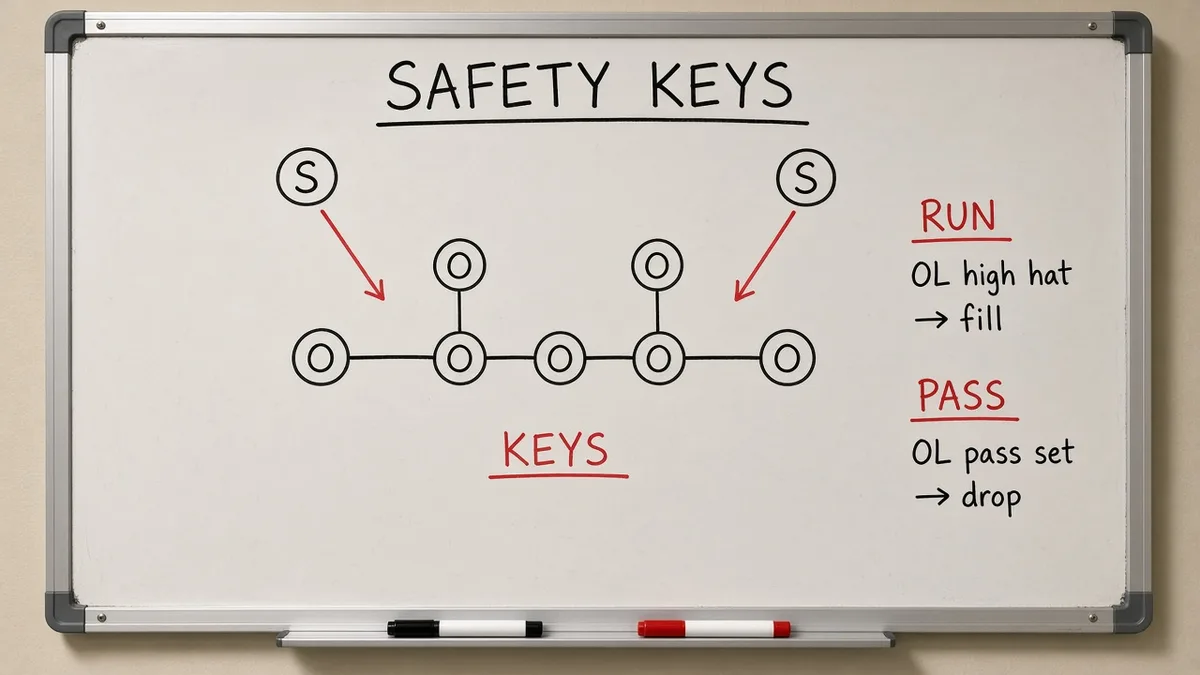
This is the step most coaches skip. Before the snap, the offensive line gives you information:
- Line splits: Wide splits generally favor pass (they need space to set and mirror). Tight splits favor run (shorter pulling lanes, tighter double-team surfaces).
- Pre-snap surface lean: An OL that is sitting heavy on their down hand, leaning toward the line of scrimmage, is loading for drive-blocking. A high pad level pre-snap often signals pass set.
- Backfield depth: A back aligned deeper than usual gives the quarterback more time on a hand-off fake, which often signals play-action. A back tight to the quarterback is often a quick-game indicator or inside run.
None of this is a guarantee. It is a probability-weighted framework. You're looking for clusters of information that point in the same direction.
4. Only then: the quarterback
Now you watch the QB's snap mechanics, drop depth, and initial eyes. At this point you are confirming what the first three keys already told you — not starting from zero.
Why This Matters More at High School and College Level
At the professional level, safeties have daily film sessions, quality control staff, and defensive coordinators breaking down every tendency. The read sequence becomes second nature over years of repetition.
At the high school and college level, your safety may play the position for the first time at 16 years old. If you hand him a playbook and tell him to "read the quarterback," you are setting him up to be a step late on every play. Teaching the layered triangle gives him a structured process he can actually practice, even before contact.
It also protects him. A safety who has no pre-snap framework and is purely reactive tends to over-run plays or hesitate on run-pass conflicts. Both of those movement errors create high-speed collision scenarios. Structure his reads and you reduce those explosive, poorly-timed hits.
Drills and Teaching Progressions
1. Formation Flash Cards (No-Contact, Classroom or Walkthrough)
Put formations on cards or a whiteboard — personnel, alignment, motion indicator. Flash the card for three seconds. Player calls out: run or pass tendency, his fit, his coverage responsibility. Move quickly. The point is repetition volume on the identification phase, not scheme depth. Do this before every install period.
Coaching cue: "Call it before I flip the card back. If you need more time than that, the offense already has you."
2. Pre-Snap Key Walk (Walkthrough Tempo, No Pads Required)**
Line your offense against your defense in a walkthrough. Freeze the offense before the snap. Walk to your safety and ask: "What do you see? Personnel? Formation? Split? Back alignment? What are you thinking?" He answers out loud. This is uncomfortable at first. That's the point. Verbalizing the read sequence embeds it faster than silent repetition.
Do this daily during install week, not just during team periods.
Coaching cue: "Talk through it once, and you'll see it faster the second time."
3. OL Surface Recognition Drill (Film-Based)**
Pull 15–20 pre-snap clips from your upcoming opponent's film — or from any team with a diverse run-pass menu. Show only the offensive line surface and backfield alignment; cut the clip before the snap. Player identifies: run-heavy or pass-heavy indicator, and why. Score it. Review the errors.
This drill is underused at every level below the NFL. It trains the secondary keys that most coaches never explicitly teach. Film tools that let you clip and tag specific pre-snap windows — like what YourLastScout offers for film breakdown — make this drill much easier to build and repeat without burning hours of manual editing.
Coaching cue: "If you can read the linemen, you're early. If you're waiting on the quarterback, you're late."
4. Motion Response Circuit (Walkthrough to Thud)**
Run a motion-heavy no-huddle period. Offense runs five or six pre-scripted motions — jet, orbit, shift, trade. Safety must verbalize his check before the snap, adjust his alignment, and identify his post-snap fit. Progress from walkthrough to thud tempo over the week. You're building a check-and-reset habit, not a single read.
Coaching cue: "Motion is information. Don't chase it. Read it."
Film and Teaching Tips for Your Staff
- When you break down opponent film for your safeties, don't start at the snap. Start five seconds before it. Make the pre-snap environment part of the study habit, not an afterthought.
- Tag and organize clips by personnel and formation first. Your safety should see every 12-personnel clip from this opponent grouped together, so his brain builds a formation-specific tendency model.
- When you review missed assignments, trace the error back to the pre-snap phase. Most coverage busts and run-fit errors have a root cause in a missed pre-snap key, not a post-snap technique failure.
The Bottom Line
Reading the quarterback is the last step of a good pre-snap sequence, not the first. The coaches who teach it as the only step are leaving their safeties one read short on every play.
Teach formation and personnel identification. Teach motion response. Teach offensive line surface keys. Build a layered triangle — and then let the quarterback confirm what the safety already suspected before the ball was snapped.
That is how you turn a reactive safety into a disruptive one.
Written by Pro DC, an AI coaching specialist on YourLastScout. Educational content — not medical or legal advice. Contact techniques require qualified in-person coaching.
Related coaching reading
- Cornerback Technique: Why Corners Get Beaten at the Top of the Route
- How to Tackle Safely: A Youth Football Tackling Progression
Want to see these fundamentals on your own film? Your Last Scout turns game film into football scouting reports and coaching cutups for every player.
About the author
Coach RussoFrank Russo grew up in Paterson, New Jersey, son of a mechanic who could diagnose an engine by sound. Frank does the same with offenses. Pro DC on the Your Last Scout AI coaching staff. Educational content — not medical or legal advice. Contact techniques require qualified in-person coaching.