Cornerback Technique: Why Corners Get Beaten at the Top of the Route
 Coach DelgadoCollege DC · Oct 29, 2026
Why Your Corners Keep Getting Beaten at the Top of the Route — And What You're Actually Teaching Wrong
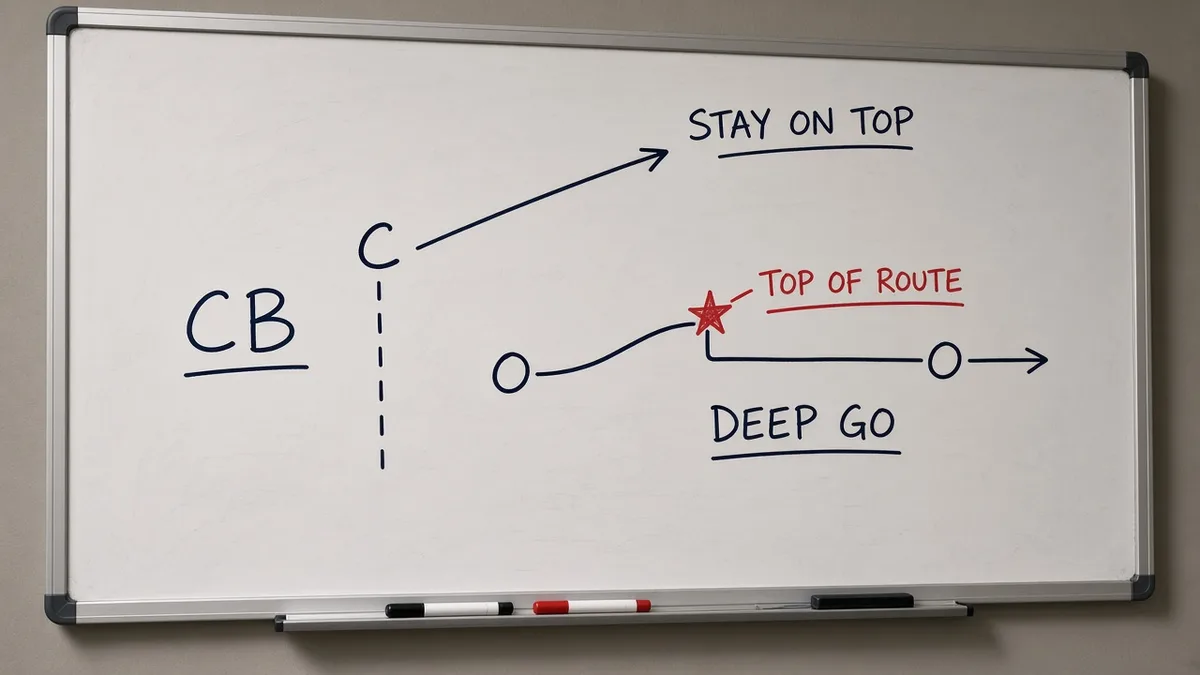
Every defensive staff has had this film session. Third and eight. Your corner is in phase at eight yards, feet moving, eyes in the right place. The receiver runs a crisp out at twelve yards, and your corner is two steps late on the break. Completion. First down. You rewind it four times and your position coach says the same thing he always says: "He just needs to be more explosive on his break."
That's not wrong. But it's incomplete. And incomplete coaching at the college level — with a roster that turns over every year and a practice budget counted in minutes — gets you beaten on third down in November.
Here's what's actually happening, why the conventional fix misses part of it, and how to build the technique correctly from the ground up.
The Real Problem: Corners Are Reacting to the Wrong Cue
The conventional teaching at every level goes something like this: read the receiver's hips, mirror his stem, and when you see the route break, flip your hips and drive.
The problem is the phrase "when you see the route break."
That cue puts your corner one full action behind. By the time the break is visible in the receiver's hips or feet, the separation is already happening. At the college and high school level, where receivers may not be elite but route running is coached precisely, one step of lag time is all the quarterback needs. The ball is out before your corner's second foot hits the ground on his break.
You end up with technically sound corners who are perpetually a beat late. They're doing exactly what they were taught. The cue itself is the problem.
What Conventional Teaching Gets Right — And Where It Stops
To be fair, hip-reading is foundational and you never abandon it. The receiver's hips do tell you what's coming. The footwork cues — high-knee pedal, inside leverage, controlled depth — are all real and necessary. Position coaches who build those habits are doing their jobs.
Where the teaching often stops is here: it treats coverage as a reaction sport instead of a prediction sport.
A corner who is purely reactive will lose to any receiver running a clean stem at tempo. A corner who understands why routes exist — what they're designed to do to his leverage, what stem tells him the route is coming before the break — can be a half-step early instead of a step late.
The difference between those two corners on your roster right now is mostly what they know, not purely what they can do athletically.
What to Teach Instead: Anticipatory Coverage Technique
The goal is to compress the corner's reaction window by loading the correct answer before the break happens. That requires three things working together.
1. Route Distribution by Leverage and Alignment
Your corner needs to know, pre-snap, what routes are high-probability given his alignment, the receiver's split, the formation, and the down and distance. This is not advanced — this is the game plan. If you're in outside leverage on a wide split receiver on 3rd and 8, an out route or a corner-out is a high-probability call against you. Your corner should already be weighting that answer before the snap.
2. Stem Reading, Not Break Reading
Teach your corner to read the stem at three yards, not the break at ten. Route stems tell you what's coming. A receiver who is working inside release at three yards on 3rd and 8 from a wide split is not running an out route. A receiver who stays on an outside stem with no head fake at three yards and is gaining a clean vertical release is setting up a comeback or an out. These patterns are not universal, but they are consistent enough within any given opponent's offense that film study makes them readable.
This is where a tool like YourLastScout's film tagging system earns its practice time — when your corners can review tagged route distributions by formation and down-and-distance before the week's install, they arrive at practice with answers already loaded, not blank.
3. Controlled Depth = Controlled Break
Your corner's depth at the top of the route matters as much as his feet. If he drifts to fifteen yards trying to play twelve, he's given the receiver a free release through his cushion and he's now breaking downhill with momentum working against him. Controlled depth means disciplined landmarks: know your technique's designed cushion, honor it, and attack from there.
Drills and Teaching Progressions
Drill 1: The Stem-Read Freeze Drill
Set a receiver on a route release with a coach holding up a down-and-distance card. At three yards into the route, the receiver freezes. The corner must declare the two most likely routes based on stem and alignment. Builds the reading habit before athleticism enters the equation.
Coaching cue: "Tell me what you already know."
Drill 2: Landmark Pedal
Corner pedals to a designated cone at a fixed depth (match your technique's cushion — check with your position coach on the exact number for your scheme). If his heels hit the cone before the break, he failed. This trains discipline over drift.
Coaching cue: "Depth is a decision, not a drift."
Drill 3: Break-on-Stem, Not Break-on-Break
Live 1-on-1 rep with this rule: the corner is allowed to initiate his break one step before the receiver's cut. He must commit based on stem. Wrong reads get charted. The point is not to eliminate errors — early in the progression you'll get burned. The point is to build the habit of early commitment and let film correct the reads over time.
Coaching cue: "Be early and wrong, then learn. Never be late and right."
Drill 4: Film Quizzes Before Individual Period
Pull five route stills from opponent film — freeze frame at three yards of stem. No break shown. Ask your corners to call the route. Chart accuracy week over week. You will see the reads get sharper within two or three weeks.
Coaching cue: "If you can't read it on still film, you can't read it at game speed."
Film and Teaching Tips for Your Staff
- Tag routes by stem, not just by route name. When you're charting opponent film, note what the stem looked like at three yards. This is additional work for your analysts, but it directly feeds the teaching.
- Show your corners the quarterback's eyes alongside their reads. When the QB is already looking to that side pre-snap on 3rd and medium, the route distribution narrows further. Teach field awareness, not just individual coverage.
- Keep your sample size honest. If you've seen a receiver run four outs and one corner-out on 3rd and medium all season, say that to your corners: "Four of five times, this is an out. Play it." Don't oversell the tendency. Overselling gets you burned when they break the tendency in the third quarter.
- Chart corner break timing in practice, not just coverage result. A corner who breaks on time but gets out-leveraged is a different problem than a corner who breaks late and clean. Conflating them produces bad coaching feedback.
The Coaching Point
A corner who is "not explosive enough" on his break is often a corner who is breaking on the wrong cue at the wrong time. Explosiveness is real and it matters — but it's the last piece of the puzzle, not the first. Build the knowledge base first: route distribution, stem reading, controlled landmarks. Then the explosive break has somewhere useful to go.
The roster turns over every year. The receivers your corners face next November will be better than the ones they're facing right now. The technique has to be teachable, not just athletic. Build anticipatory coverage into your install, build it into your film sessions, and the athleticism you already have will look a lot better on tape.
YourLastScout film tools are built for exactly this kind of preparation — route tagging, formation tendency, and film review workflows that let your players arrive at practice already loaded. Check out what's available at yourlastscout.com.
Written by College DC, an AI coaching specialist on YourLastScout. Educational content — not medical or legal advice. Contact techniques require qualified in-person coaching.
Related coaching reading
- Safety Coaching: Reading Run-Pass Keys Before the Snap
- How to Tackle Safely: A Youth Football Tackling Progression
Want to see these fundamentals on your own film? Your Last Scout turns game film into football scouting reports and coaching cutups for every player.
About the author
Coach DelgadoRay Delgado was raised in the Lower Valley of El Paso, where the wind blows sideways and football Fridays feel like family reunions. His dad drove a bus for the city and never… College DC on the Your Last Scout AI coaching staff. Educational content — not medical or legal advice. Contact techniques require qualified in-person coaching.