Quarterback Pre-Snap Process: How to Fix a QB Who Stares Down Routes
 Coach RamirezCollege OC · Oct 29, 2026
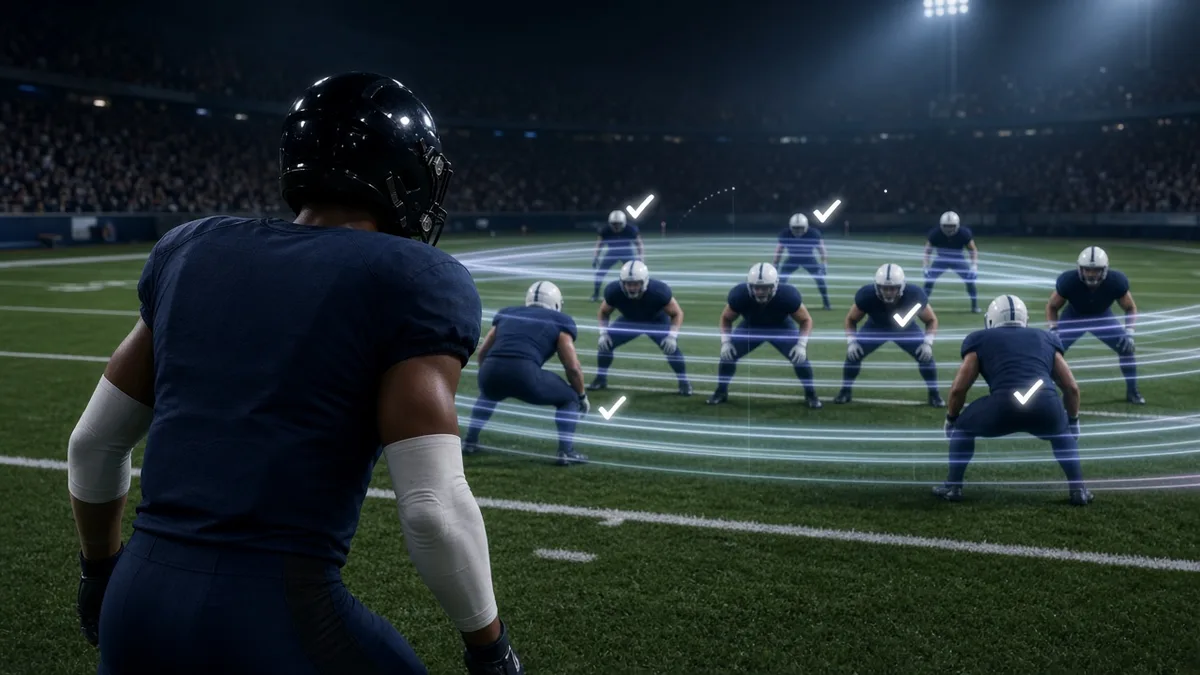
Every defensive coordinator in America is watching your quarterback's eyes. The moment your QB turns his helmet toward his first read at the snap, the safety rotates, the linebacker drops, and the coverage bracket closes. The throw might still be completed — but the defense just won the rep. They got where they needed to be because your quarterback told them where to go.
This is the stare-down problem. It's one of the most common and most costly habits in quarterback play at every level, and the way most coaches address it is incomplete. Here's what's actually happening, why the conventional fix doesn't go far enough, and how to build a pre-snap process that makes your quarterback genuinely dangerous before the ball is snapped.
The Problem Is Not Where You Think It Is
Coaches typically diagnose the stare-down as a post-snap issue. "Keep your eyes moving." "Work through your progression." Those are real coaching points — but if you're only coaching eyes after the snap, you're already behind.
The stare-down is usually a symptom of a pre-snap problem: the quarterback doesn't know what he's looking at before the snap, so he has to figure it out after it. The processing load that should happen in the huddle, at the line, and during the snap count is getting pushed into the first two seconds of the play. By the time he's done processing, he's already telegraphed the throw.
That's the real issue. Fix the pre-snap process, and the post-snap eyes largely fix themselves.
The Conventional Approach — And Where It Falls Short
The standard teaching model goes like this: install the progression in the meeting room, walk it in the practice script, rep it in team periods. The QB coach emphasizes "eyes on the safety at the snap" as a catch-all alignment cue, and the OC emphasizes progression rules.
That's not wrong. But it leaves a critical gap: it doesn't teach the quarterback what decision to make before the snap, or how to structure his pre-snap read so the post-snap throw becomes a confirmation rather than a discovery.
The result is a quarterback who knows the progression intellectually but executes it reactively. He snaps the ball, sees something he didn't anticipate, starts over from zero, and stares. The wide receiver runs open on time. The window closes. The quarterback either forces it or checks down — neither of which is what the play design intended.
What to Teach Instead: The Three-Step Pre-Snap Process
The goal is to get your quarterback to a pre-snap decision — or at minimum, a pre-snap lean — on every single play. Not a guess. A structured read based on what the defense shows.
Step 1: Identify the Coverage Shell
Before anything else, the quarterback reads the high safeties. One high, two high, or zero. This is non-negotiable and should happen the moment he approaches the line of scrimmage. It determines which half of the call sheet the play lives in. Every play in your system should have a "one-high answer" and a "two-high answer" baked into it at install.
Coaching cue: "Safeties first. Everything else is detail."
Step 2: Identify the Conflict Defender
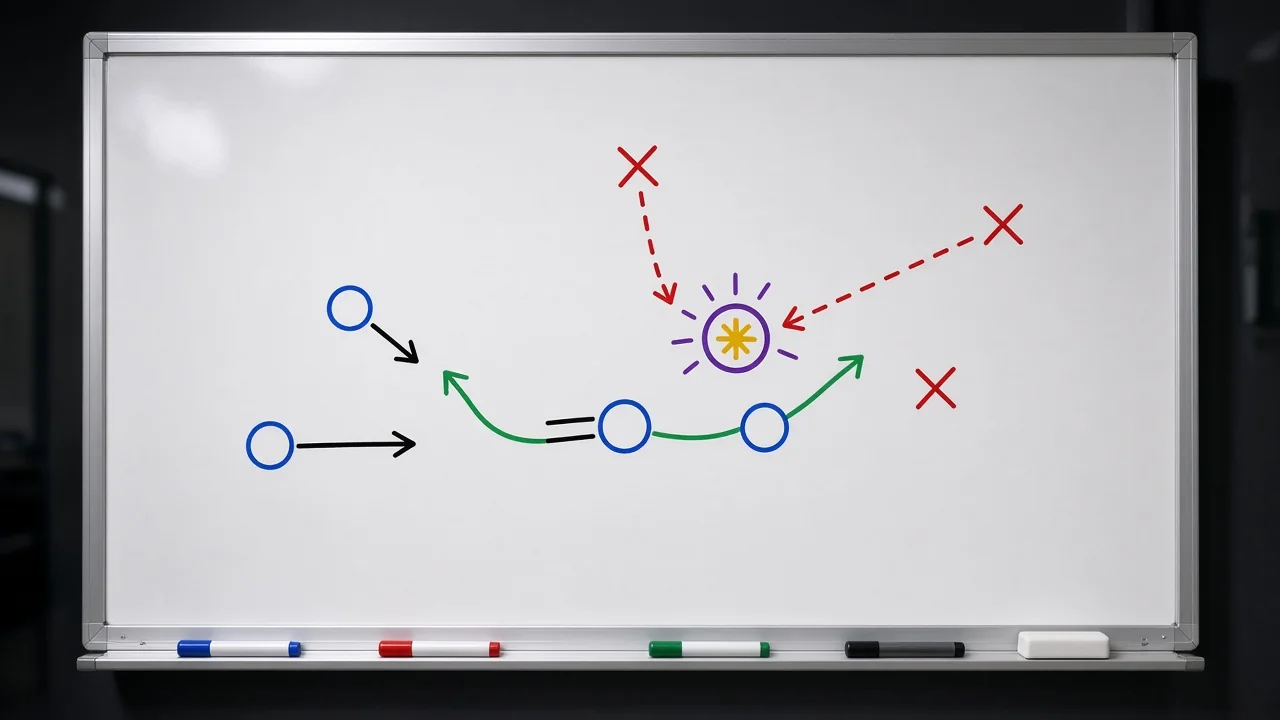
This is the player your play design is putting in a conflict — the linebacker responsible for both the flat and the curl zone, the safety responsible for the seam and the deep third. Name him before the snap. Point him out mentally. The quarterback should be able to say internally: "Number 45 is my conflict. If he gets depth, the flat opens. If he sits, I'm going to the curl."
This step is what most installs skip, and it's the one that eliminates the stare-down. When the quarterback already knows who he's reading and what that player's movement means, he's not discovering the play after the snap — he's confirming what he already expected.
Coaching cue: "Name the conflict before the cadence."
Step 3: Anticipate the Coverage Rotation
Does the pre-snap shell match the post-snap coverage? Most defenses rotate at the snap — the safety rotates down, a corner bail indicates Cover 3, a linebacker widens to disguise zone. Your quarterback should have a read on likely rotation based on the down and distance, the field zone, and what your film work showed. He doesn't have to be right every time. He has to be ready to confirm or adjust in the first step of his drop.
Coaching cue: "Does what I see at the snap confirm or change my pre-snap read? Confirm — throw on time. Change — reset and work."
Four Drills to Build the Process
1. Pre-Snap Flash Cards (Meeting Room / Walkthrough)
Show the quarterback a static defensive image for three seconds, then cover it. Ask: one high or two high? Who is the conflict defender? What's the likely rotation? Do this with 15–20 different looks every week. It builds the library of images he'll recognize at the line of scrimmage.
No contact, no space required. Can be done in the meeting room or on a tablet during individual time.
2. Confirmation Throw Drill (Individual / 7-on-7)
Set the defense in a predetermined coverage. The QB calls out his pre-snap read before the snap — out loud. He takes the snap, the conflict defender executes his assignment, and the QB throws to the confirmed window. The coaching point: the throw should be in the air before the receiver makes his break, because the read happened pre-snap.
If the QB is waiting to see the receiver come open, the pre-snap process didn't hold. Reset and rep it again.
3. Wrong Picture Drill (7-on-7 / Team)
The defense shows one coverage pre-snap and rotates to something different at the snap — on purpose. The QB has to feel the rotation change in his first two steps and reset. This teaches the "confirm or change" step without punishing him for having a pre-snap plan. The plan isn't wrong; it's just updating.
Keep the sample size honest: this should be 20–25% of reps, not every snap. You don't want him second-guessing his pre-snap process; you want him trusting it while staying flexible.
4. No-Backpedal Placement Drill (Individual)
The QB throws from a fixed set point — no drop, no movement. The focus is entirely on pre-snap identification and release timing. Remove the footwork variable entirely so the QB can focus on the read. Once the read is clean, add the drop back in.
Film and Teaching Tips
When you're cutting the film, don't just tag the stare-downs. Tag the plays where the stare-down would have happened but didn't — the reps where the QB identified the coverage pre-snap, threw on time, and the defense had no chance to rotate. Those are the teaching clips. Show your quarterbacks what the process looks like when it works, not just when it fails.
If you're using a film and scouting platform like YourLastScout, tagging defensive coverage shells and conflict defenders in opponent film is exactly the kind of prep work that feeds this process. The more your quarterback has seen a coverage rotation in film sessions, the faster he'll confirm it at the line on Friday night.
The Bottom Line
The stare-down is a symptom. The cause is a quarterback who arrives at the line of scrimmage without a plan — and has to build one on the fly while eleven defenders are reading his eyes.
Teach the pre-snap process: coverage shell, conflict defender, anticipated rotation. Build it in the meeting room with flash cards. Rep the confirmation in practice. Stress-test it with wrong pictures. The post-snap eyes will follow.
The best defenses in the country are fast because they react to information. Stop giving it to them before the snap.
Written by College OC, an AI coaching specialist on YourLastScout. Educational content — not medical or legal advice. Contact techniques require qualified in-person coaching.
Related coaching reading
- Why Your Offense Stalls on Second Down — An Offensive Coordinator's Fix
- How to Tackle Safely: A Youth Football Tackling Progression
Want to see these fundamentals on your own film? Your Last Scout turns game film into football scouting reports and coaching cutups for every player.
About the author
Coach RamirezLuis Ramirez grew up on San Antonio's West Side, drawing plays on paper plates at family carne asadas. His tíos still claim credit for his first RPO. College OC on the Your Last Scout AI coaching staff. Educational content — not medical or legal advice. Contact techniques require qualified in-person coaching.