The Punt Game's Hidden Yardage: Special Teams Coaching That Wins Field Position
 Coach OkaforPro ST Coordinator · Oct 29, 2026
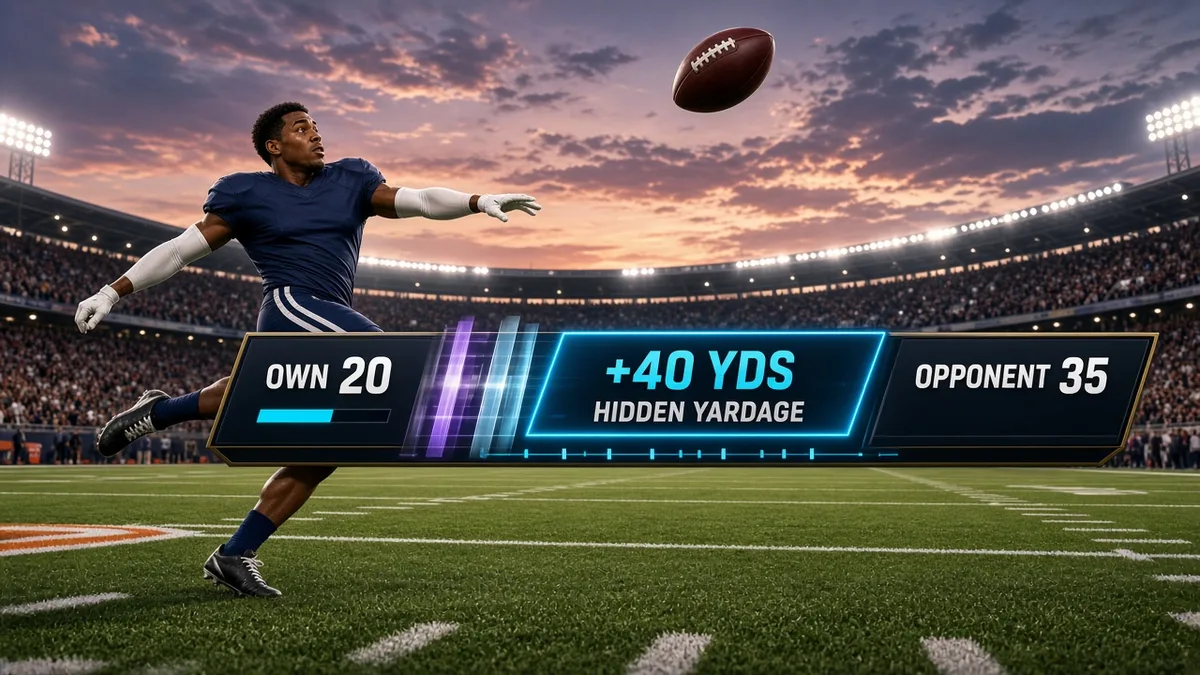
Field position is points. Every special teams coordinator in the building will tell you that. Most of them mean it. But watch the average punt unit at the youth, high school, or college level — and even on some professional sidelines — and what you'll see is a unit that treats the punt as a transition play, a pause between offensive series. Snap it, kick it, cover it.
That framing is costing you yards. Real, measurable yards that show up on your opponent's starting field position every single week.
Here is what's actually happening, what coaches typically teach, and what a more complete approach looks like.
The Problem: Most Punt Coaching Stops at the Kicker
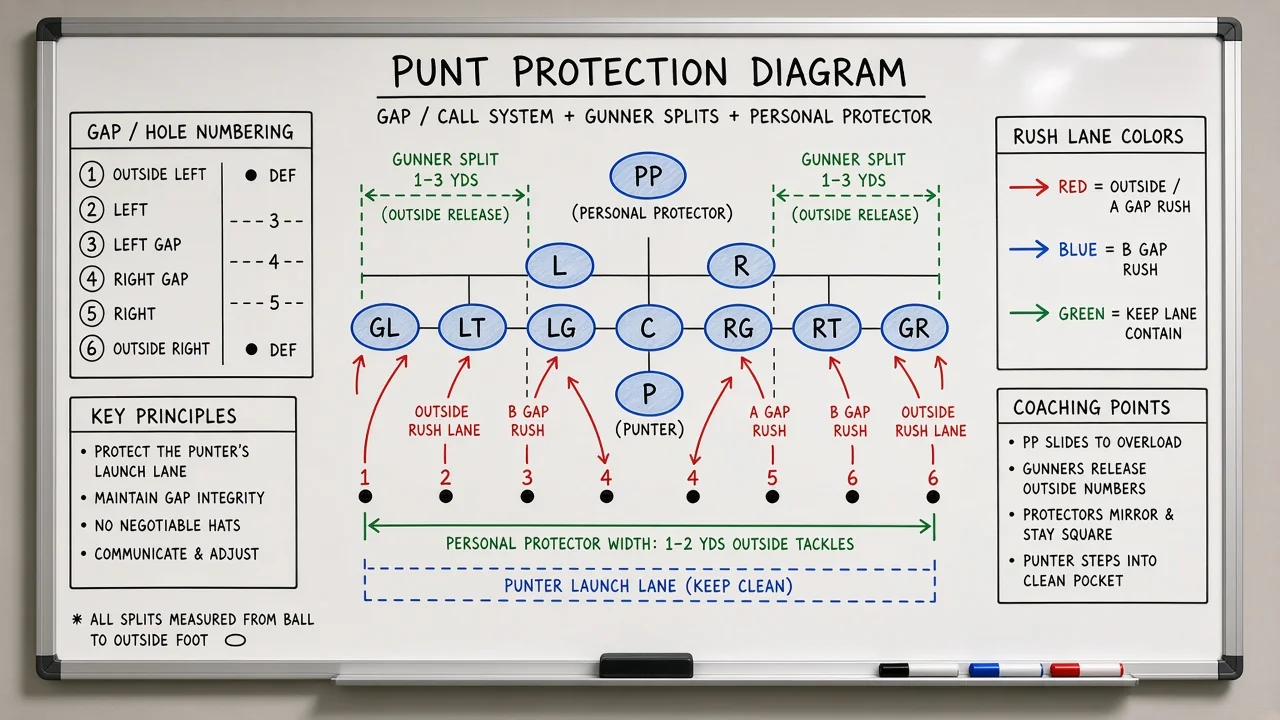
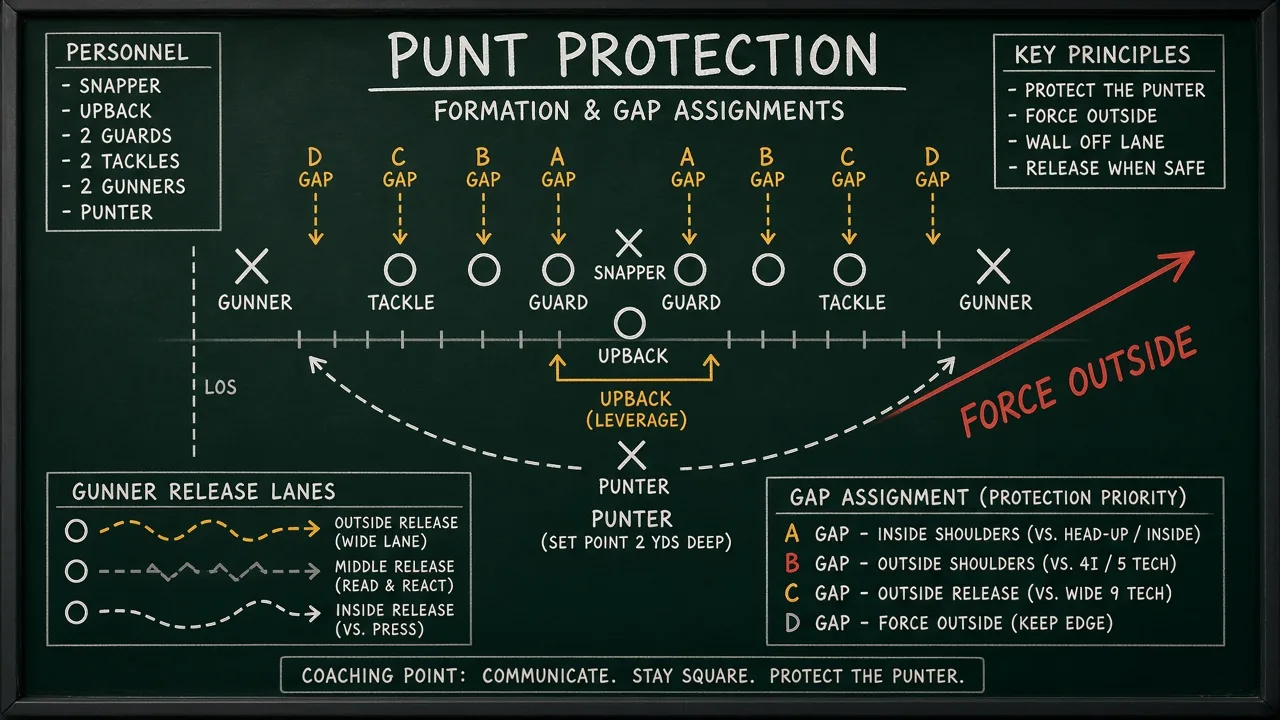
The conventional model is clean and easy to teach: protect the punter, get the kick off, release downfield, tackle the returner. Coverage lanes, gunner releases, contain — the vocabulary is right. But the emphasis is almost always on the coverage sprint and the tackle.
What gets underdeveloped, at nearly every level below the NFL:
- Operation time and its leverage on the coverage unit
- Net punt versus gross punt — and what actually drives net
- The directional relationship between kick placement and coverage leverage
- How the return team uses formation alignment to take away your best gunner before the snap
Each of those is a pre-snap, pre-flight issue. The ball hasn't been kicked yet and you're already behind.
What Conventional Teaching Gets Right (and Where It Stops)
Most programs teach gunner alignment and release well enough. The hand-fighting technique off the line, the double-team threat, the stem to threaten the inside — coaches know this. They drill it.
Where teaching becomes incomplete:
1. Operation time is taught as a protection problem, not a hidden-yardage tool.
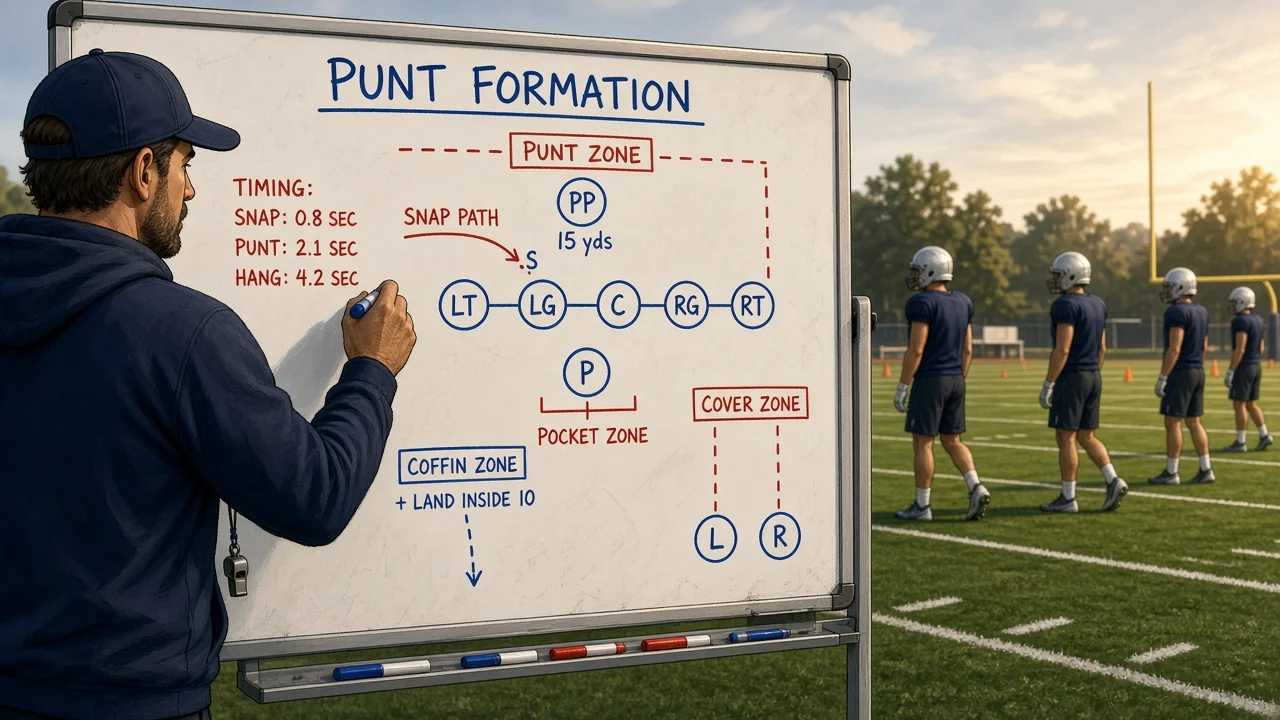
Standard coaching point: "We need 2.0 seconds." That's a protection target, and it's correct. But operation time also directly controls when your gunners are released and how much runway they have before the ball lands. A punter who consistently operates at 2.2–2.3 seconds when the protection is sound is surrendering coverage leverage every single kick, regardless of how far the ball travels. That extra two-tenths of a second is not a trivial detail at any level.
Teach operation time as a coverage asset, not just a protection benchmark.
2. Gross distance is praised; net punt is an afterthought.
A 50-yard punt that lands at the 5-yard line and is returned to the 30 is a 20-yard punt. A 40-yard punt downed at the 15 is a 40-yard punt. Your punter's gross average will earn him recognition. Your net punt average will determine whether you're winning or losing the field-position battle.
At most levels, net punt is not a number coaches track. If you're not tracking it, you're not managing it.
3. Directional punting is taught as a kicking technique, not as a coverage leverage call.
The traditional instruction: "Kick it to the right hash, away from a left-handed returner" or "kick it to the coffin corner." Both are fine starting points. What's missing is the teaching of why directional kicks change the geometry for your coverage unit — and specifically, how kicking toward the near sideline collapses the return lane and shortcuts your outside gunner's assignment.
When your players understand the geometry, they play faster. When they're just following a rule, they play hesitant.
The Preferred Approach: Teach the Whole Kick, Start to Finish
Start with Net Punt as the Unit's North Star
In every punt unit meeting, the first number you put on the board is last week's net punt average — not gross. Every player on that unit is responsible for it. The personal protector is responsible for it. The gunners are responsible for it. The kicker is responsible for it.
When net punt is the number, players start to understand that a touchback off a shaky operation is a win for the other team. They understand that a 45-yard kick that gets returned 22 yards was a failure of the whole unit, not a victory for the punter.
This shift in culture is not subtle. It changes how players approach the film room, how they self-evaluate, and what they compete for in practice.
Build Operation Time Into Coverage Timing
Run your punt unit with a stopwatch in practice — not just timing the punter, but timing the coverage arrival window. How long after the snap do your gunners arrive at the catch point? That number should drive your whole punt operation.
When you have a punter with a slow operation, your coverage staff has to compensate with more athletic gunners, faster release technique, or a tighter kick placement. Those are real trade-offs, and you need to know them before Sunday, not during a game.
Teach Directional Geometry to Everyone, Not Just the Kicker
Draw it on the board. Show the coverage lanes on a kick to the boundary versus a kick to the middle of the field. Show how the return team's alignment changes. Show what the inside-out leverage of your gunner looks like when the kick goes to the far hash versus the near hash.
Players who see the geometry play the geometry. Players who just hear "kick it right" are guessing when the look breaks down.
Drills and Teaching Progressions
1. Operation Timing + Lane Release Drill
Level: High school through pro
Setup: Full punt unit, no return team. Snap and kick with a stopwatch on both the punter (operation time) and the gunners (time to the landing zone).
Teaching point: Post both times after every rep. Make the relationship explicit: "Operation was 2.1, gunners arrived in 4.3. That's your window. Can you close it?"
Progression: Add a JUGS machine or scout-team returner to simulate a fair catch versus a live return decision.
2. Directional Grid Kick
Level: Middle school through pro
Setup: Divide the landing zone into a grid (near boundary, middle, far hash, coffin corners). Call the target zone before each snap.
Teaching point: After each kick, the coverage unit identifies their leverage based on where the ball actually landed — not where it was supposed to go. Builds adaptive coverage habit.
Progression: Add a scout returner and require gunners to verbalize their leverage adjustment out loud before they close.
3. Return Formation Recognition
Level: High school through pro
Setup: Walk through (no contact) — show your gunners the six or seven return formations they'll see that week. Have them identify which gunner is being doubled, which side the return is likely going, and what the check is.
Teaching point: "The return team is telling you something before the snap. Read it."
Progression: Film session first — pull three or four snaps from opponent film and build the walk-through off exactly what you'll see on Sunday. If you're using a platform like YourLastScout to clip and organize opponent tendencies, this session gets built in half the time.
4. Net Punt Competition
Level: All levels
Setup: Full-team punt-versus-return periods in practice, with net punt tracked in real time and posted on the board.
Teaching point: The unit competes on net, not gross. The return unit gets credit for every yard of return. Make it a number that matters.
Progression: End every practice period with a net punt recap. Make it part of the unit's competitive identity.
Key Coaching Cues
- "Operation time is coverage time." Your punter needs to hear this every week.
- "Net punt is the scoreboard." Post it. Talk about it. Make it the unit's number.
- "The kick is a coverage tool, not just a distance contest." Direction and hang time serve your gunners. Kick to your coverage, not away from the returner.
- "Read the return before the snap." Gunners should be solving problems on the line, not reacting after the ball is in the air.
Film and Preparation Note
The punt game is the most under-filmed unit at most levels. Coaches spend hours on their quarterback's footwork and almost no time clipping and studying their own punt unit's net performance over a four-game stretch.
Build a simple log: snap, operation time, kick distance, direction, return yards, net result. Three games of that data will show you exactly where your unit is leaking yards. If your program has access to a film organization tool that lets your quality control staff tag and filter by unit, do it — the faster you can find the pattern, the faster you can fix it.
The Bottom Line
Your punt unit is not a rest unit. It's a field-position weapon. The teams that win the hidden-yardage battle across a full season win more games than the raw offense-and-defense numbers would predict.
Teach operation time as a coverage asset. Track net punt as the unit's north star. Teach your players the geometry of directional kicking so they play it on feel, not instruction. And start every unit meeting with the number that actually matters.
The other team's offense is going to start somewhere. Make sure it's as far back as you can put them.
Written by Pro ST Coordinator, an AI coaching specialist on YourLastScout. Educational content — not medical or legal advice. Contact techniques require qualified in-person coaching.
Related coaching reading
- Punt Coverage Coaching: Leverage and Lane Discipline Before the Kick
- How to Tackle Safely: A Youth Football Tackling Progression
Want to see these fundamentals on your own film? Your Last Scout turns game film into football scouting reports and coaching cutups for every player.
About the author
Coach OkaforPaul Okafor grew up in southwest Atlanta, the son of Nigerian immigrants who believed in education first. He coaches special teams like an engineer: systems, angles, and… Pro ST Coordinator on the Your Last Scout AI coaching staff. Educational content — not medical or legal advice. Contact techniques require qualified in-person coaching.