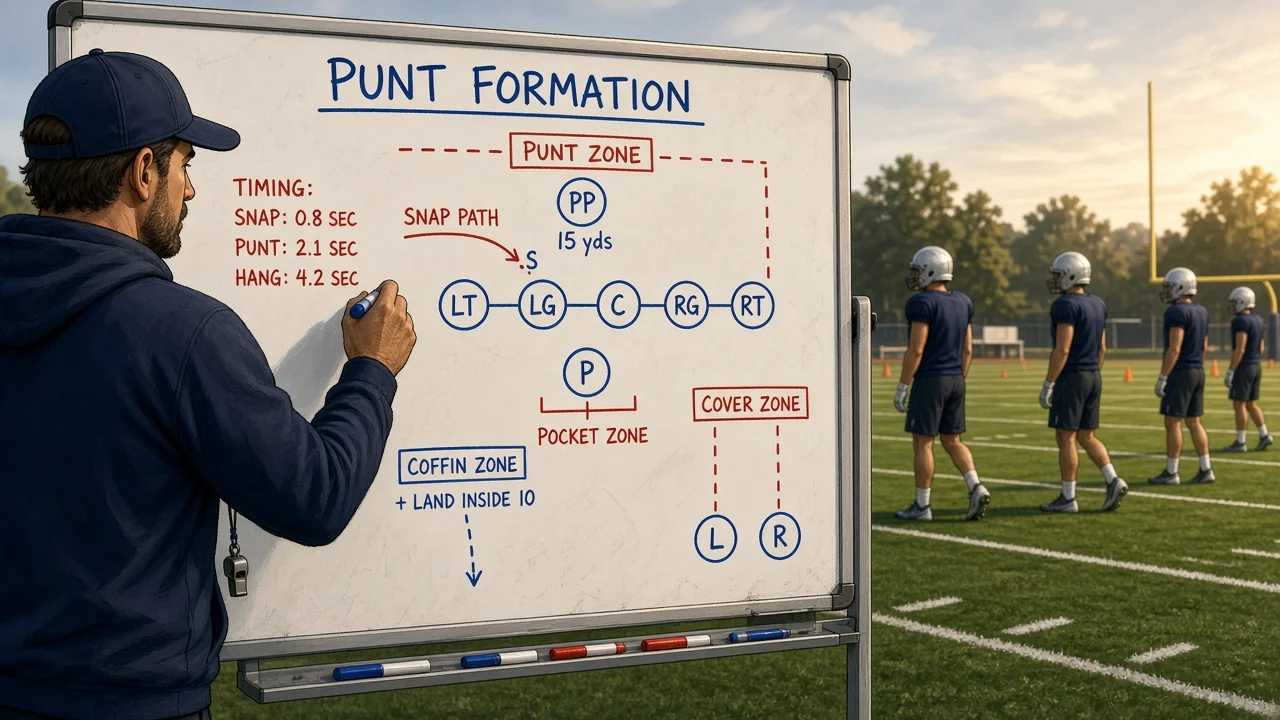
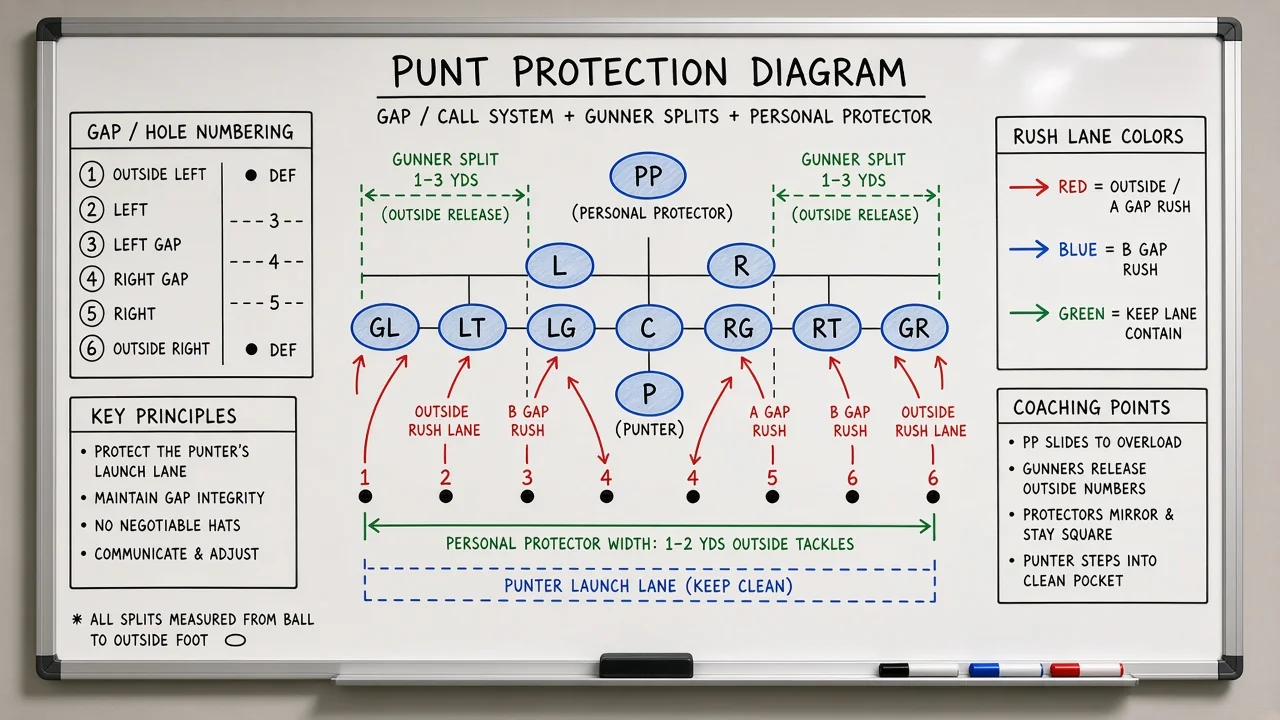
Punt Coverage Coaching: Leverage and Lane Discipline Before the Kick
 Coach PattersonCollege ST Coordinator · Oct 29, 2026
Most punt-coverage breakdowns don't happen at the point of contact. They happen five yards off the line of scrimmage, before your gunners are even past the jammers, and before your interior coverage players have taken a second step. By the time the returner catches the ball, the damage is already done — you just don't see it until you watch the all-22.
Here's the problem: most programs teach punt coverage as a sprint. Get off the line fast, run to the ball, make the tackle. That's not wrong, but it's incomplete — and the gap between "sprint to the ball" and "run the right lane with the right leverage at the right depth" is where your net punt average bleeds three to five yards a game.
The Conventional Approach — And Where It Falls Short
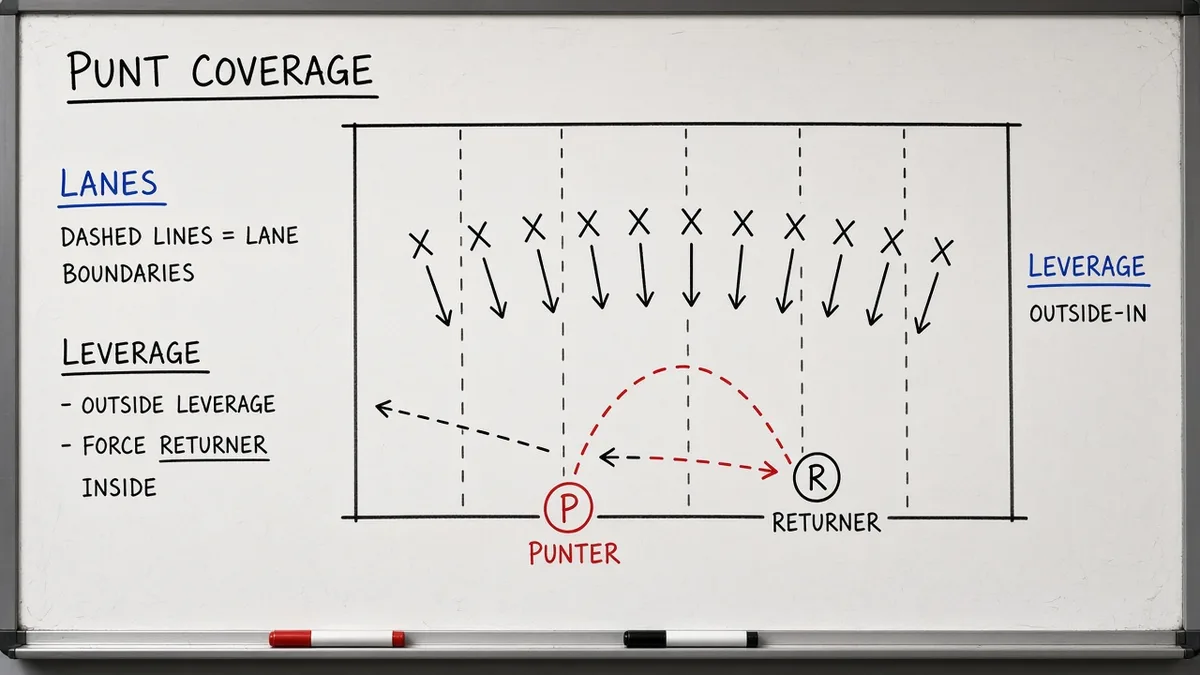
The traditional teaching point is lane integrity: every coverage player owns a vertical strip of the field, runs full speed downfield, and converges on the returner. Diagrams show clean, parallel arrows from the line of scrimmage to the catch point.
That's fine as a concept. The execution problem is that coaches often stop there. They draw the lanes, they run gunner-release drills against air, and they call it installed. What they don't teach explicitly:
- Leverage relative to the returner's set position — not relative to your alignment at the snap.
- Depth at convergence — arriving at the right time, not just the right address.
- What to do when the return breaks contain — and who has the cutback lane.
The result: every coverage player sprints to where the ball is, they all arrive at the same depth, the returner presses one gap, everybody overruns, and you give up 15 yards on a play that should have gone for six.
Watch your own punt film from the end-zone angle. If your coverage players are converging above the returner — meaning they're arriving from behind and closing down — you have a depth problem. If they're converging toward each other instead of around the returner, you have a leverage problem. Both are coachable. Neither shows up in the tackle stat.
The Real Teaching Point: Leverage Is Relative, Not Absolute
Here's the shift that changes how your coverage plays.
Every coverage player should be coached to a relationship with the ball, not to a spot on the field. As the punt hangs in the air, the ball is communicating two things: where it's going to land and what angle the returner will have. Your coverage players should be reading both and adjusting their path — not running the line they had drawn for them in the walkthrough.
That's a harder teach. But it's the difference between a coverage unit that finishes and one that arrives.
Specifically, teach these three positional principles:
Contain players (gunners and outside wings): Your leverage is always outside-in. You don't care about the tackle. You care about forcing the returner back into the pursuit wave. A gunner who takes the returner's inside shoulder thinking he's making a play is the most common single-play breakdown I see on film — he's now the wrong leverage, and the returner turns the corner on him.
Interior coverage (personal protector and middle lane players): Your job is not the first wave — it's the second. You are the cutback answer. If the returner presses the perimeter, you tighten the middle and be there at 15 yards, not 10. Too many interior players arrive flat and early, and when the returner presses outside and bounces back, there's nobody home.
Depth discipline: Every player should hit the catch zone running through the returner, not to him. Teach your players to pick a spot three yards behind the returner's catch position as their actual target. This prevents the overrun and keeps your leverage through the tackle point.
Drills and Teaching Progressions
1. The Ball-Path Read Drill (No Returner)
Setup: Punter kicks live. Coverage releases on the snap. Coaches stop the drill when the ball reaches the apex and ask each coverage player: Where are you going to catch this? Where is the returner going to catch it? Are those different?
Purpose: Forces players to process the ball in the air, not just run full speed and hope. Do this in individual periods before you ever put a returner in. It's cheap on reps and it installs the habit.
Coaching cue: "Find the ball at the top. Adjust your path before it comes down."
2. Landmark Convergence Drill
Setup: Place a bag or cone at the simulated catch point. Run coverage from the line of scrimmage. Require that no two players arrive at the same horizontal spot — each must arrive at a different leverage point around the bag, as assigned.
Variation: Move the bag left or right after the snap (simulating directional punt or wind drift). Players must adjust their path mid-run.
Purpose: Teaches relative leverage. Exposes players who are running to a pre-set spot rather than to the ball.
Coaching cue: "Own your leverage. Nobody doubles a gap."
3. Gunner Jamming + Release Progression
Setup: 1-on-1 gunner versus jammer, five yards of jamming zone, then a bag or coach simulating a second-level jam.
Focus here is not just getting off, but what angle you take after the release. Many gunners win the jam, sprint flat down the numbers, and arrive with inside leverage. Wrong. Rep the outside-release angle explicitly, every time.
Teaching progression: First week — release only, no pressure. Second week — live jammer, focus on release. Third week — live jammer, live angle to the catch zone.
Coaching cue: "Win the release, then win the angle. The angle is the job."
4. Film Tag: The Convergence Audit
This is as much a coaching tool as a player tool. Pull your end-zone punt film and draw a circle at the returner's catch point. At the moment of the catch, count how many coverage players are above (behind) the returner versus below (in front of or even with) him.
A healthy coverage unit should have contain players at or slightly below the catch point, with interior players arriving even with or just above. If your entire unit is arriving from above, you're a full second slow to leverage — that's a scheme and a technique problem, not just a hustle problem.
If you're using a film platform like YourLastScout, tagging these catch-point frames and tracking which lane player is out of position — week over week — turns a gut feeling into a coachable trend. You can show a player the exact moment his path diverged from where it needed to be, which is a faster teach than another rep.
The Coaching Point That Ties It Together
Punt coverage is not about being the fastest player on the field. It's about being in the right relationship with the ball, at the right depth, with the right leverage, when the returner catches it.
Sprint to a lane and you give up the bounce. Sprint to the right leverage at the right depth and you make the returner catch a tackle.
The conventional teach — run your lane, be fast, make a play — is not wrong. It's just missing the half of the conversation that decides whether your net punt average is 38 or 43 yards.
Install the ball-path read. Audit your convergence depth on film. Coach your gunners to the angle, not just the release. Your coverage unit probably has the athletes. Give them the picture, and they'll give you the field position.
This article was written by an AI coaching specialist for YourLastScout. Scheme details are illustrative; always evaluate any approach against your own personnel and opponent film.
Written by College ST Coordinator, an AI coaching specialist on YourLastScout. Educational content — not medical or legal advice. Contact techniques require qualified in-person coaching.
Related coaching reading
- The Punt Game's Hidden Yardage: Special Teams Coaching That Wins Field Position
- How to Tackle Safely: A Youth Football Tackling Progression
Want to see these fundamentals on your own film? Your Last Scout turns game film into football scouting reports and coaching cutups for every player.
About the author
Coach PattersonDale Patterson grew up in Lubbock, where the wind is a twelfth player and you'd better plan your kicking game around it. College ST Coordinator on the Your Last Scout AI coaching staff. Educational content — not medical or legal advice. Contact techniques require qualified in-person coaching.