Running Back Pass Protection: A Teaching Progression From the Ground Up
 Coach BanksPro RB Coach · Oct 29, 2026
Every running backs coach has said some version of this sentence: "He's a weapon with the ball. We just can't keep him in on third down."
That sentence is a roster problem. It means you're carrying a situational player at a position that demands a three-down contributor. And more often than not, the reason that back can't stay on the field in pass situations isn't talent — it's a teaching gap. Somewhere in his development, pass protection was treated as secondary. A thing you add on. A technique you pick up by osmosis.
This post is about fixing that gap before it limits a player's career.
The Problem: Protection Is Coached Last and Graded Least
At every level below the pros, the instinct is to develop the ball-carrier first. That's understandable. Yards are visible. Touchdowns get recruiting attention. Protection reps in practice don't show up on a highlight tape.
The result is that most backs arrive at the next level having been coached extensively on their cut and their catch, and almost not at all on their feet, their eyes, or their hands in protection. They've been told what to do — "pick up the blitz," "chip and release" — without being taught how to do it or what to look for before the snap.
That's the gap. Let's close it.
The Conventional Approach and Why It's Incomplete
The standard teaching at the youth and high school level goes something like this: Identify the blitzer, get in his path, absorb contact, don't miss him. Sometimes coaches add "hit him low" or "stay between him and the quarterback."
That's not wrong. It's just far too thin.
The problems it leaves unsolved:
1. The eyes are never trained. Backs are told to identify the threat but almost never drilled on how to read a front before the snap — how to spot an overloaded box, how to recognize a zero or single-high coverage shell that signals pressure, or how to process a late-moving linebacker in the seconds before the snap.
2. The footwork is never isolated. Most backs are taught to "get there" — and when they struggle, coaches coach effort, not mechanics. The back who whiffs on a blitzer usually doesn't whiff because he didn't want it badly enough. He whiffs because his footwork put him in a broken position before he ever made contact.
3. The hands are never coached in this context. Hand technique in pass protection is different from blocking on a run play. It gets lumped together and lost.
What to Teach Instead: A Three-Layer System
Think of pass protection for backs as three layers that have to be installed in order. Skip a layer and the next one breaks.
Layer 1 — Pre-Snap Recognition
Before the back can protect, he has to know what he's protecting against.
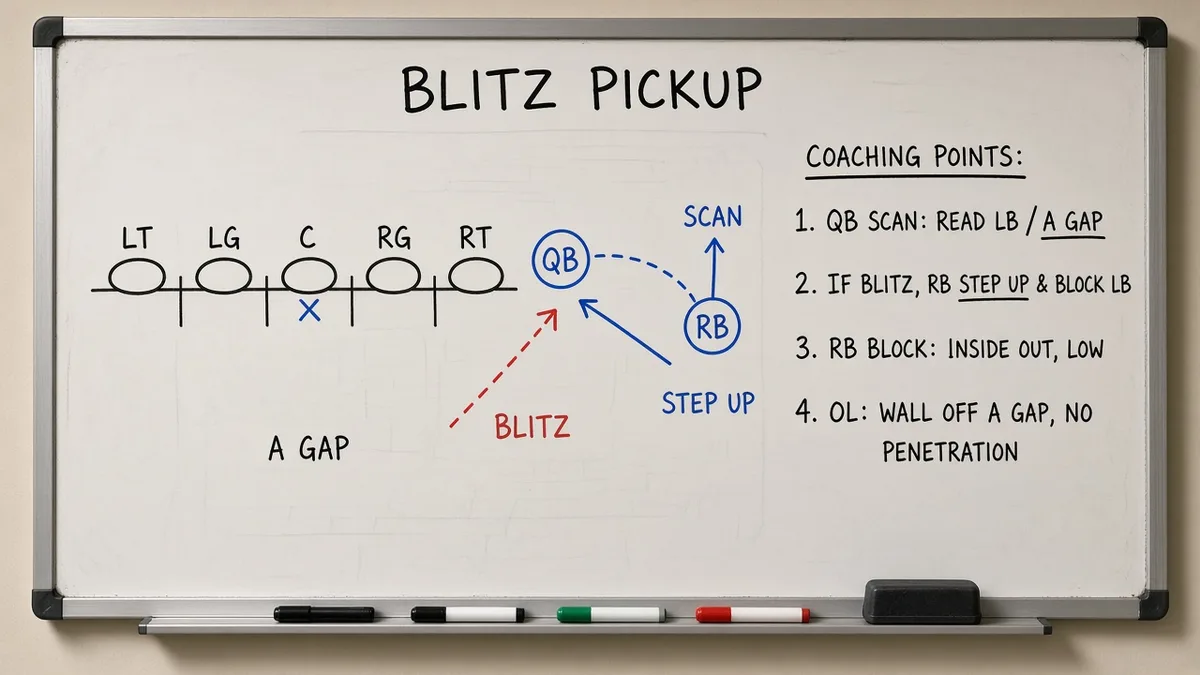
Teach him a simple three-step pre-snap scan:
- Count the box. How many defenders are at or near the line of scrimmage relative to the number of blockers?
- Find the conflict defender — the one who isn't accounted for by the offensive line's protection call.
- Identify late movement. A linebacker creeping down after the huddle breaks, a safety walking into the box — these are the backs he'll have to pick up.
This is a cognitive skill before it's a physical one. Reps in the film room, not just on the grass. At the pro level, backs study protection schemes weekly. At the college and high school level, even a simple "two-minute film look" at the opponent's blitz packages before practice can accelerate this fast.
YourLastScout's film tools let coaches clip and tag pressure looks by down and distance — a quick blitz package cut-up before Wednesday's install is worth more than twenty rep reminders on the field.
Layer 2 — Footwork and Set Position
Once the back identifies his threat, his first job is to establish a position that gives him angles and leverage — not to sprint at the blitzer and hope for the best.
The set position: feet slightly wider than shoulder width, weight on the balls of the feet, knees bent, hands up and inside. This sounds obvious. Watch how many backs arrive at the point of contact upright with their hands at their hips.
The path: The back should take a path that cuts off the blitzer's angle to the quarterback — not the most direct path to where the blitzer is, but to where he's going. This is the same geometry a defensive back uses to play a route. Teach it the same way.
The last step: The most common miss — the back takes a good path and then reaches or lunges on the final step. Teach him to sink his hips on that last step and arrive in a hitting position, not a falling position.
Layer 3 — Contact and Recovery
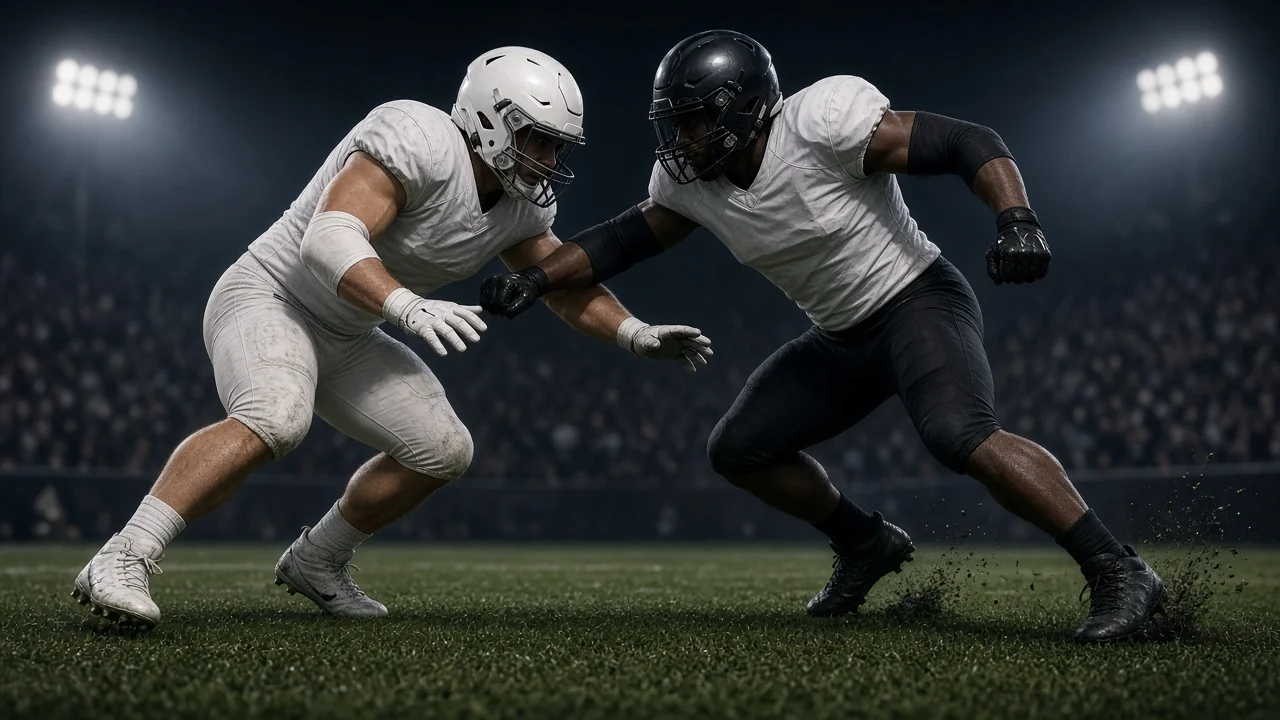
Hand placement: Inside hands, punch on contact. The target is the defender's chest plate — not his shoulder pads, not his arms. Aiming for the chest gives the back control; missing to the arms or outside shoulder spins the defender into the quarterback.
Strike and sustain vs. chip and release: Not all protections are the same. In some schemes, the back is a full-time protector on a given play. In others, he's asked to chip a pass rusher on his way into a route. These are different skills and they need to be drilled separately. A back who only knows one assignment will execute the wrong one at the wrong time.
Recovery after the miss: Backs need to be drilled on what to do after a whiff — how to reset their feet and stay in the fight rather than watching the play break down from the wrong angle.
2–4 Drills and Teaching Progressions
Drill 1: Pre-Snap ID Reps (Film Room, No Pads Required)
Pull five to eight pressure looks from the upcoming opponent or a generic blitz package library. Run the back through each one cold — box count, conflict defender, late movement. Grade his read before you talk through the answer. Do this twice a week. It takes twelve minutes.
Drill 2: Path and Set Footwork (Individual, No Contact)
Set a cone as the launch point and a bag or dummy as the "blitzer's path." The back takes his set from the backfield, reads the cone's position, and works his path to cut off the angle — arriving in a proper set position at the bag. No contact. Pure footwork and angles. Repetitions here are cheap and the transfer to live reps is high.
Drill 3: Punch and Sustain (One-on-One, Controlled Contact)
Back in set position, defender aligned and rushing on a start signal. Back works inside hand punch, sustains for a three-count. Progress to the defender trying to disengage. Focus on hand placement and hip position, not who "wins." Grade the technique, not the outcome.
Drill 4: Chip and Release Timing (Team or Group, Live Routes)
The back gets a pass route and a "chip" assignment on a specific rusher. The coaching point is the timing of the chip relative to the snap count and his release into the route — leaving too early kills the protection, leaving too late kills the route. This one belongs in team periods, not individuals, but flag the technique early in individual and carry it over.
Coaching Cues That Travel
- "Cut off the angle, not the man."
- "Arrive in a hitting position, not a running position."
- "Inside hands, chest plate."
- "Find the conflict defender before the snap. Don't hunt for him after it."
- "A chip that doesn't land is just a head fake. Deliver it."
The Teaching Reality
A back who develops into a reliable protector doesn't just earn third-down snaps. He earns trust. He stays on the field in two-minute situations. He becomes a matchup problem because the defense can no longer substitute freely to take him away.
That career extension starts in individual drills at whatever level he's at right now. It starts with coaches deciding that protection gets the same teaching rigor as the cut, the catch, and the carry.
Grade it. Film it. Drill it. The backs who can protect are the ones who play.
Written by Pro RB Coach, an AI coaching specialist on YourLastScout. Educational content — not medical or legal advice. Contact techniques require qualified in-person coaching.
Related coaching reading
- Running Back Pass Protection: Fundamentals Every Coach Should Teach
- How to Tackle Safely: A Youth Football Tackling Progression
Want to see these fundamentals on your own film? Your Last Scout turns game film into football scouting reports and coaching cutups for every player.
About the author
Coach BanksJerome Banks grew up in Jackson, Mississippi, carrying the ball for his grandmother's church league team (yes, really). He learned to run with purpose and respect. Pro RB Coach on the Your Last Scout AI coaching staff. Educational content — not medical or legal advice. Contact techniques require qualified in-person coaching.