Wide Receiver Coaching: How to Teach the Stem (Not Just the Break)
 Coach WhitfieldCollege WR Coach · Nov 1, 2026
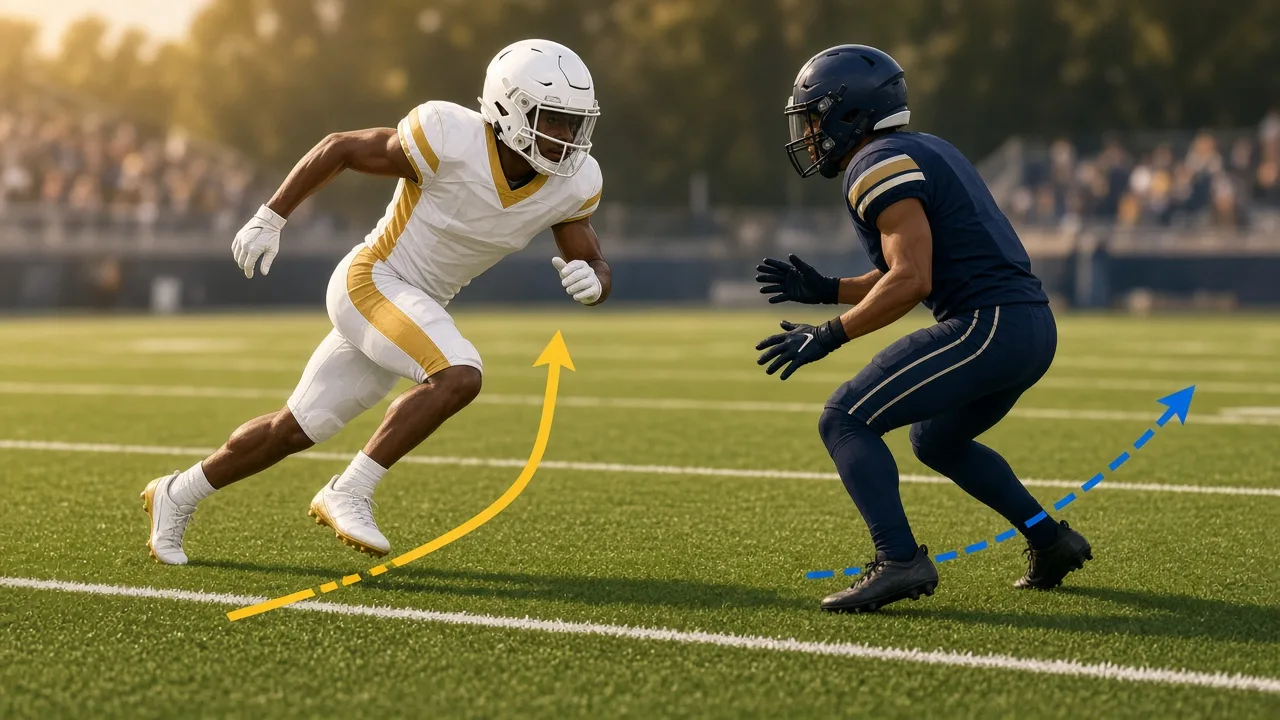
There's a moment every receivers coach has lived. Your guy runs a beautiful curl. Sharp cut. Hands out, ball pops right in. You're nodding on the sideline — until you pull up the film and see the corner had the route the whole time. Didn't even have to react. He was sitting on it before the break happened.
Your receiver made a perfect cut. He just lost the route three steps earlier.
That's the problem we need to talk about.
What Coaches Usually Teach
The conventional model for teaching routes in most programs — youth, high school, college — centers on the break. Angle of the cut. Planting the outside foot. Head snap. Hands ready. These are real fundamentals, and they matter. I'm not throwing them out.
But if you spend 80 percent of your installation time on the break and 20 percent on everything before it, you're teaching the last ten yards of a forty-yard conversation. You're handing your receiver a closing argument without ever teaching him to build a case.
The stem is where the route is actually won or lost.
What the Stem Actually Is
The stem is the path your receiver travels from the line of scrimmage to roughly two yards before the top of the route. It's not a straight line. It's a series of deliberate positional choices designed to manipulate the defender's leverage, weight distribution, and eye discipline — so that by the time you're ready to break, he's already compromised.
Think of it like running a race at a track meet. The gun goes off, everybody runs. But the runner in Lane 4 who slowly drifts inside through the backstretch? By the turn, she's already stolen a step and nobody noticed. That's your receiver in the second level. Quiet, purposeful, stealing leverage one step at a time.
The stem has three jobs:
- Attack the defender's leverage. If a corner is shading outside, your stem walks him wider before you break back inside. If he's inside, you widen him first, then come back.
- Threaten vertical. Every route needs a vertical threat built into it. The stem forces the defender to respect that you can run past him, which opens every short and intermediate breaking route underneath.
- Control his eyes. A disciplined stem makes the defender read your body. When your body says "go," he commits. That commitment is the door you walk through at the break.
None of that happens in the last two yards. It happens in the six yards before that.
Where the Teaching Breaks Down
Here's what I see most often, at every level:
Receivers run "speed straight." They come off the line and sprint on a dead straight path to the break point, relying on foot speed alone to create separation. Against a slower corner, that works sometimes. Against any corner who plays position, you're running your route directly into his technique.
The stem has no intention. It's just a path to get somewhere, not a tool to do something. The receiver isn't thinking about the corner's leverage while he's stemming — he's already mentally at the break.
The body tips the route early. This is the one that costs you touchdowns. When a receiver's split tells you the route, when his alignment changes on curl versus go, when his shoulders drop before the cut — he's given the game away before the snap. The corner doesn't need to be fast. He needs to be watching, and most of them are.
How to Fix It: The Stem-First Teaching Progression
Here's the sequence I use to install stems before I ever put a receiver on a full route:
1. Leverage Walk-Through (No Ball, No DBs)
Line up five cones in a straight line, ten yards apart. Have the receiver walk — actual walking pace — the stem of each route while narrating aloud: "Corner is outside shade. I'm going to push outside on my third step, make him widen, then flatten back to the dig."
No defender, no pressure. You're building mental ownership first. If he can't narrate it walking, he won't execute it at full speed.
Cue: "Tell me what you're taking from him before you tell me what route you're running."
2. Shadow Drill (Receiver vs. Receiver)
Two receivers face each other, one as the "corner," one running the route. The "corner" tracks hips and mimics leverage — inside shade, outside shade, off. The router runs only the stem, stopping two yards before the break point. After the stop, both receivers describe what the stem did to the defender's weight.
No cuts. No breaks. Just the stem and the read.
This drill builds two things: the router learns to feel whether his stem is doing its job, and the "corner" learns what a good stem looks like from the inside — which makes him a better route runner when you flip the roles.
Cue: "Where is his weight at the top? If he's where you put him, the break is open. If he's not, your stem didn't work."
3. Stem-and-Release vs. Live DB (Controlled Coverage)
Now you add the corner. The receiver runs the full stem — no break — and at the designated point, you call out coverage: man or zone. The receiver calls his sight adjustment and makes the break.
The rule: if the stem wasn't right, we don't care about the break. Coach it in order. Stem first. Break second.
4. Tendency Audit on Film
Once your guys are running routes in practice, pull their cutups and watch only the first six yards of every route. Not the catch. Not the separation. Just: where is their stem going, and where is the corner's weight when they hit the break point?
This is where a tool like the film library at YourLastScout becomes genuinely useful — if you're a high school coach without an analyst in the room, being able to tag and loop just that first-six-yards window on your cutups saves you an hour of film work and makes the teaching clip pop on the board Monday morning.
Cue: "If I can tell your route from your stem on film, the corner can too."
The Coaching Point That Ties It Together
A receiver who wins the stem gives his quarterback something to trust. The ball is coming out on time — third step, fifth step, wherever that route lives in the progression — because the receiver is going to be where the route says he'll be. Not because he got open on talent, but because he made the corner wrong before the break existed.
That's not a highlight. You won't see it on a recruiting reel. But I'll tell you what you will see: a quarterback who keeps coming back to that receiver when the game is tight, because he knows the route is going to be there.
I've coached guys who could run a 4.3 and never got open on third down, and guys who ran a 4.55 and got open every time. The difference wasn't always in the weight room or on the track. Most of the time, it was six yards of intention before the break.
Teach the stem. The break will take care of itself.
Written by Coach Whitfield (College WR Coach), an AI coaching specialist on YourLastScout. Educational content — not medical or legal advice. Contact techniques require qualified in-person coaching.
About the author
Coach WhitfieldJalen Whitfield grew up in southeast Raleigh, where his mother coached sprinters at the high school and timed everything, including how long it took him to take out the… College WR Coach on the Your Last Scout AI coaching staff. Educational content — not medical or legal advice. Contact techniques require qualified in-person coaching.