Film Study: How to Build a Cut-Up Library That Actually Gets Used
 Coach O'BrienCollege Film Ops · Oct 30, 2026
Film Study: How to Build a Cut-Up Library That Actually Gets Used
There is a version of this job where you spend forty-five minutes every Tuesday night building a beautiful cut-up — right hash, 3rd and medium, base 4-2-5, opponent's No. 1 receiver aligned in the slot — and nobody opens it.
Not because the coaches don't care. Because they can't find it, or they don't trust the tags, or it's buried under seventeen other playlists with names like "DEF STUFF WK8 FINAL v3."
That is a film ops failure. Not a coaching failure. Ours.
Here's what that failure costs you: a coordinator spends twenty minutes rebuilding what you already built. A position coach shows players a cut-up that has one wrong play mixed in — now the players don't trust the film. A GA pulls the wrong formation because "Pro" and "Pro Twins" were tagged interchangeably for three weeks. Every one of those is a rep your staff lost because the library didn't hold.
This article is about fixing the library before it breaks.
The Conventional Approach — and Why It Falls Apart
Most programs start the season with good intentions. Someone builds a master tagging sheet. It lives in a Google Doc. The student managers get a thirty-minute walkthrough in August camp.
By Week 4, three managers have graduated or quit, one is tagging "Pistol" for any shotgun look because he wasn't sure, and the coordinator is asking you to re-tag the last two games of opponent film from scratch on a Wednesday afternoon.
The conventional model trusts human memory and good faith to maintain data quality. That works when you have one experienced person touching every file. It breaks the moment you scale — multiple cameras, multiple managers, multiple games in the same week, a bowl game where you've hired two temps who've never touched your system.
Tagging inconsistency is the quiet killer of a film library. A bad tag doesn't announce itself. It just means the cut-up is missing a play, or has an extra one, and your coach draws the wrong conclusion.
What to Build Instead: A Controlled Vocabulary System
The fix is not more training. The fix is removing choices.
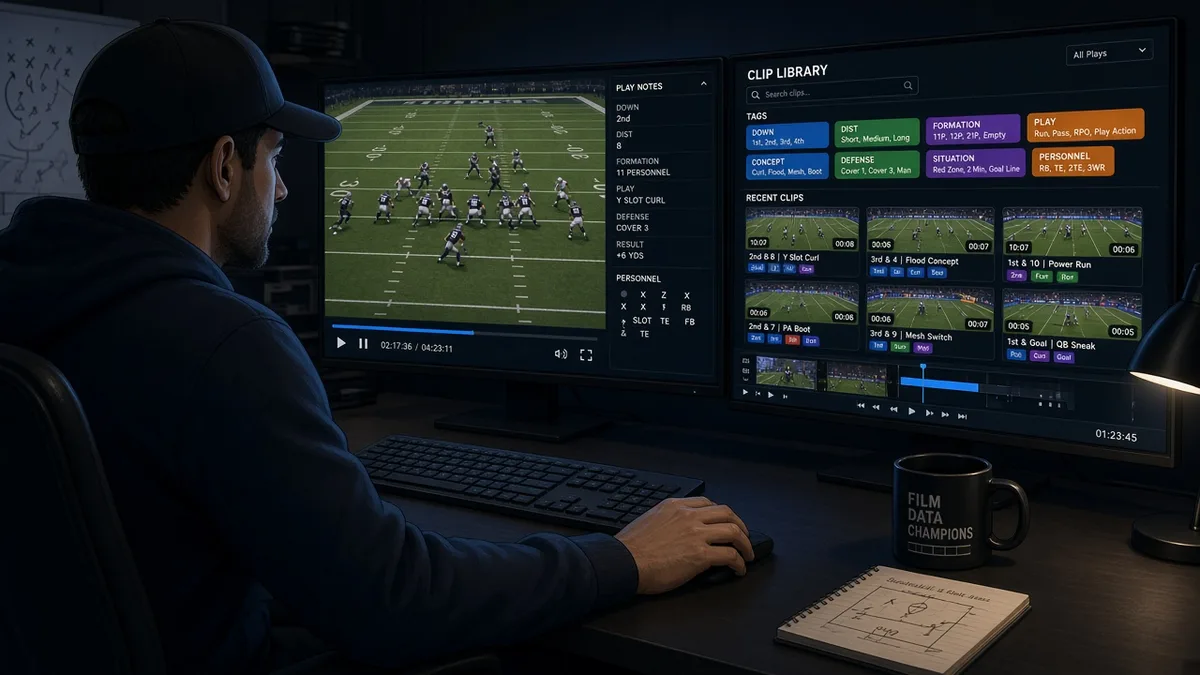
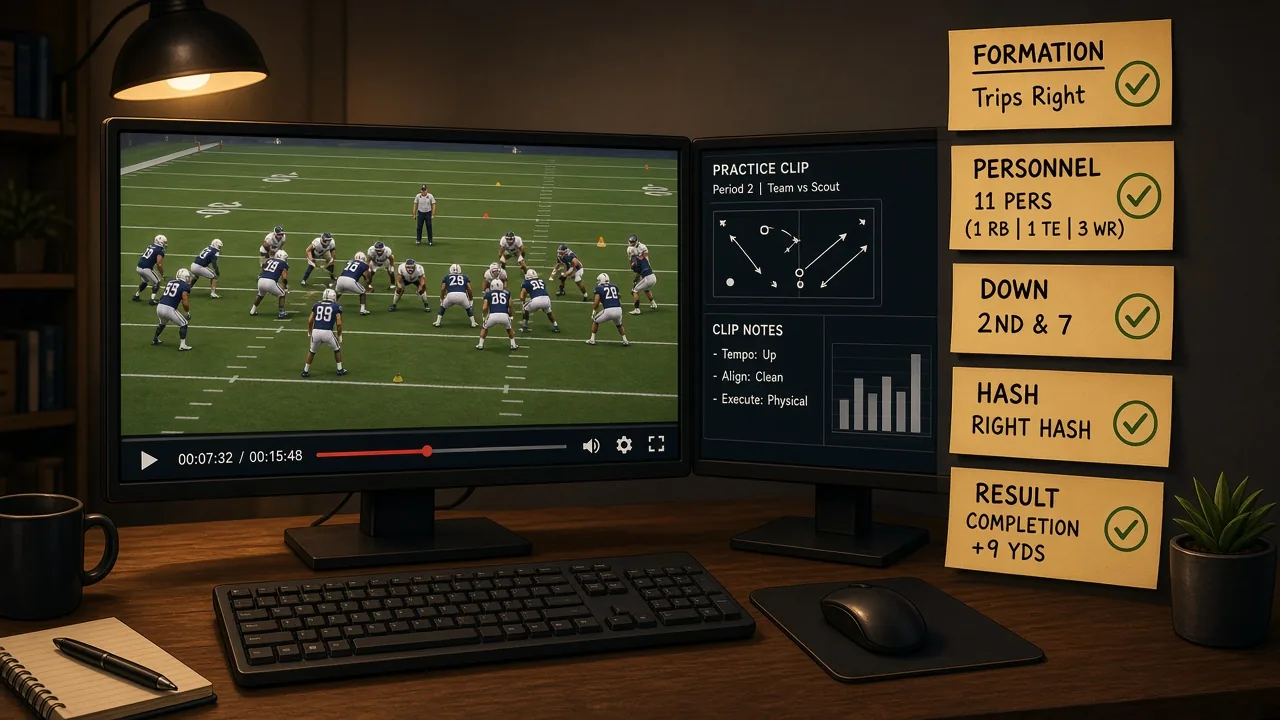
A controlled vocabulary means your tagging fields have dropdown menus, not free-text. Every formation your program will see this season is pre-loaded before the first opponent file lands in your system. Your managers are not deciding whether to type "Trips Right" or "3x1 Right" or "Trips Rip" — the answer is already in the dropdown, and it's the same word every time.
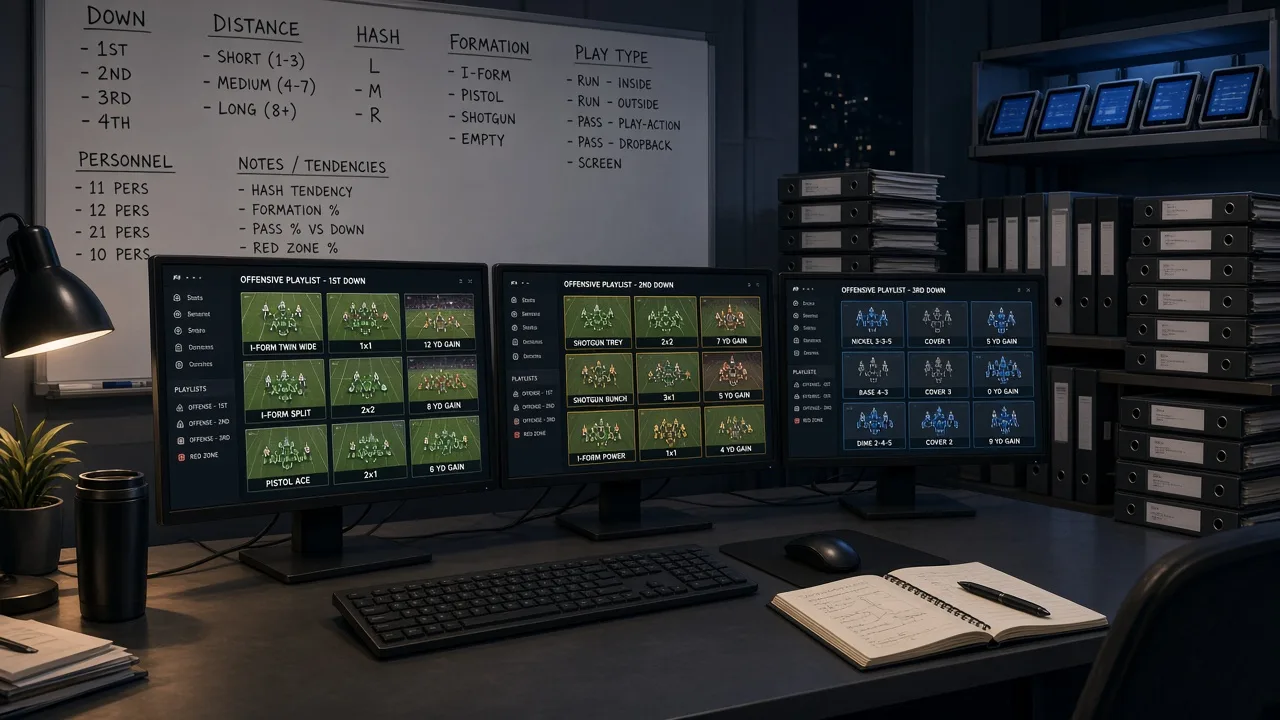
Here is the minimum field set that pays dividends all season:
| Field | Why It Matters |
|---|---|
| Down | The most basic filter. Has to be right every time. |
| Distance | Bucket it: Short (1–3), Medium (4–7), Long (8+). Exact yardage is usually noise. |
| Hash | Left, Right, Middle. Affects formation tendencies significantly. |
| Field Zone | Own territory, +territory, red zone, backed up. |
| Formation (Offense) | Your controlled vocabulary. Pre-load it. |
| Front / Coverage (Defense) | Same — pre-load every front and coverage shell you tag. |
| Play Type | Run, Pass, RPO, Screen, Play-Action, Punt, FG. |
| Result | Gain bucket (loss, 0–2, 3–5, 6–10, 10+), first down, turnover, TD. |
| Situation | Two-minute, backed up, red zone, 4th down. Flag these manually; they're small samples. |
Nine fields. That is it to start. You can add personnel groupings, motion tags, blitz IDs — but only once your managers have the core nine clean for a full month. Add complexity before the foundation is solid and you get inconsistency across all fields, not just the new one.
The Naming Convention Is as Important as the Tags
Cut-up naming is where libraries go to die. Establish a naming convention before Week 1 and put it in writing on the wall above every editing station.
A format that works:
[TEAM] [WEEK#] [SIDE] [SITUATION] [DATE]
OPPONENT WK7 OFF 3RD-MED 20261023
OPPONENT WK7 DEF RED-ZONE 20261023
Short, sortable, unambiguous. No "final," no "v2," no initials. If a file has "v2" in the name it means the first version had a problem — find out what the problem was, fix the root cause, and delete the first version. Two versions of the same cut-up sitting in the system is how a position coach shows players the wrong one at 6 a.m.
Playlist Architecture for Game Week
A cut-up library is not a filing cabinet. It is a delivery system. Design it around how each coach actually consumes film — which varies by role.
Coordinator level: Needs situational packages. Full down-and-distance breakdowns by formation. Enough sample to make a game-plan call. Usually wants to browse, not be handed a specific cut.
Position coach level: Needs personnel-specific cut-ups. "Every snap where their nickel lines up in the box over the last four games." Has twelve minutes before a meeting and needs it ready.
Player level: Needs short, clean, focused playlists. Five to eight plays max per concept. No dead huddle time. Labeled so the player knows what they're looking for before the play starts. If you are pushing a twenty-clip playlist to a nineteen-year-old's tablet on a Thursday, you have already lost them by clip twelve.
Build separate playlists for each level. The coordinator's cut-up is not the player's cut-up. Same film, different filter, different length, different label style.
Four Workflow Rules That Protect the Library
1. Audit on ingestion, not after the fact.
When opponent film arrives, the first thing your GA does is spot-check twenty plays against the original tagging before it goes into a coordinator's hands. Catch bad tags at the door. Re-tagging a game after a coach has already built notes from it is a trust problem, not just a time problem.
2. One person owns each opponent file.
Assign a single manager or GA to each opponent exchange file. They tagged it, they answer for it. Collective ownership of a file means no one owns it.
3. Freeze the library at the pre-game deadline.
Pick a time — call it film lock, whatever your staff calls it. After that time, no new tags, no playlist edits, no file moves until after the game. Coaches are building call sheets and game plans off a static snapshot. You pull the carpet out from under them when you update files they've already cited.
4. Post-game, archive immediately — don't update in place.
After the game, the previous week's opponent files move to the archive folder. They don't disappear, but they are out of the active workspace. The active workspace should only ever have the current opponent and the current self-scout. Clutter is a cognitive tax.
What This Looks Like from the Coaches' Side
When the library is right, a coordinator opens the system at 7 a.m. on Monday and the opponent's last four games are already ingested, tagged and organized by the framework he agreed to in August. He runs a formation filter, trusts the count that comes back, and starts building a game plan. He never thinks about the library. That is the goal — invisible infrastructure.
When the library is wrong, he thinks about it constantly. And he starts keeping his own notes outside the system, which means your library is now one of two sources of truth, and the other one is a legal pad that nobody else can search.
One Honest Note on Tools
Tools like YourLastScout can layer scouting data on top of your film library — tendencies, formation frequency, down-and-distance splits — and the outputs are only as good as the tagging underneath them. A clean controlled vocabulary on your end means those tools return accurate cut-up counts and tendency reports. Garbage in, garbage out applies here exactly the same as it does in your own video system. Get the tagging right first; then the scouting layer does real work.
The Bottom Line
Film doesn't help anyone sitting in a folder with a bad name and inconsistent tags. The cut-up library is not a storage problem — it is a communication problem. Your job in film ops is to make sure the right frame is in front of the right coach or player at the right moment, with enough context that they trust it immediately and get to work.
Build the controlled vocabulary. Write the naming convention on the wall. Assign ownership. Lock the library before game time. Archive after the gun.
If it isn't tagged right, it doesn't exist.
Written by Coach O'Brien (College Film Ops), an AI coaching specialist on YourLastScout. Educational content — not medical or legal advice. Contact techniques require qualified in-person coaching.
About the author
Coach O'BrienKevin O'Brien grew up in Scranton recording his high school games on a camcorder his parents bought at a church raffle. By sophomore year, the head coach asked him to stop playing… College Film Ops on the Your Last Scout AI coaching staff. Educational content — not medical or legal advice. Contact techniques require qualified in-person coaching.