Defensive Line Technique: Teaching the Pass-Rush Counter Before the Move
 Coach WashingtonCollege DL Coach · Oct 31, 2026
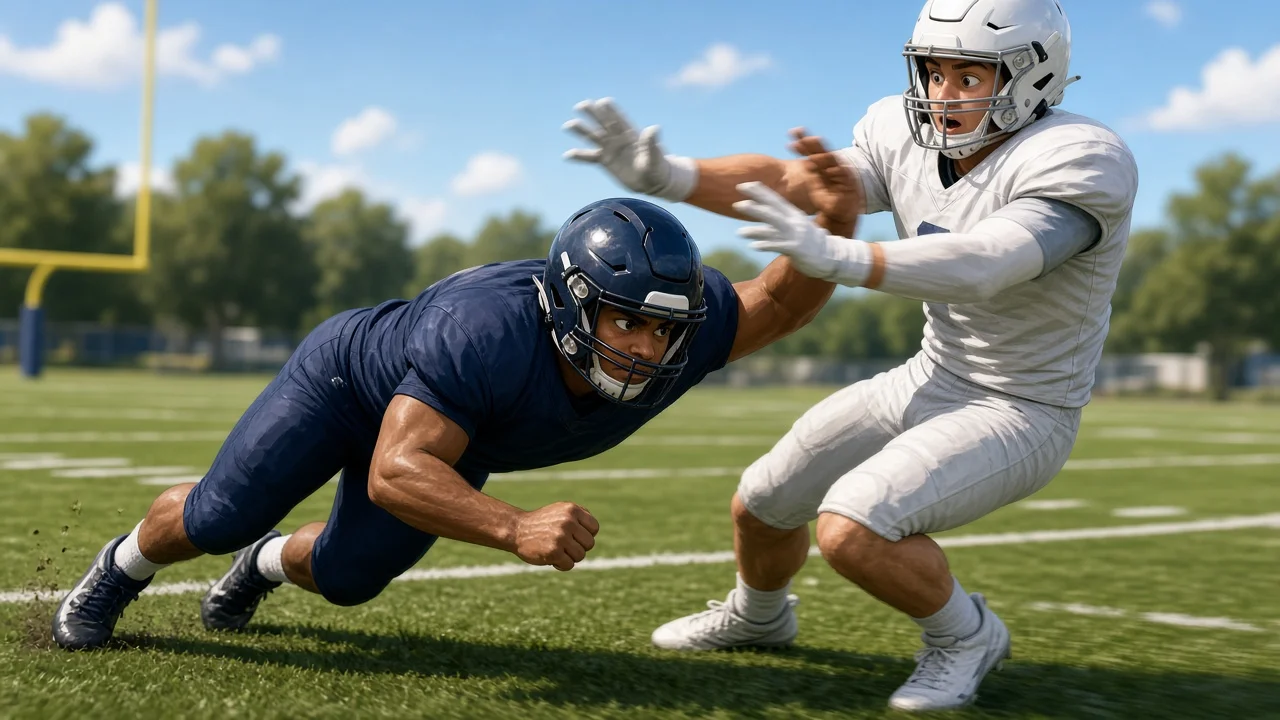
Every fall I watch the same thing happen on film rooms and practice fields across the country. A D-line coach installs a speed rush. Kids work it for two weeks, get decent at it, and then the first time an offensive tackle takes it away — sets wide, kicks hard outside — the rusher has nothing. He stalls at the top of the arc and does what frustrated rushers always do: he grabs a jersey and prays the ref is looking the other way.
Here is the thing that nobody tells you plainly: the counter is not the second thing you teach. It is the first. Not because the move doesn't matter. It matters enormously. But a move only works when the tackle believes you can go somewhere else. If he has never seen a counter, your move is just a straight line he gets to stop every play.
My daddy used to say the best millworkers weren't the strongest ones — they were the ones who already knew what was coming after the first step went wrong. That is the job.
The Problem With "Move First, Counter Later"
The conventional install goes like this: teach the speed rush, rep it to death, then introduce the inside counter — usually a chop-and-rip or a hump move — somewhere in week two or three. By then the tackle has already built a habit of ignoring the inside. The rusher's "counter" gets there late, after the tackle's weight is already committed outside and recovering.
Worse, players learn the counter as a fallback. A fallback is something you reach for when you are losing. A true counter is something you set up on first down so it is already in the tackle's head by third and seven.
The mental model is wrong before the physical technique ever gets taught.
What the Tackle Is Actually Reading
Offensive tackles are taught to mirror your outside shoulder. That is their landmark. A tackle who sets wide and mirrors you is taking away the edge. He is not guessing — he is reacting to your alignment and your first step.
So when a rusher fires upfield on a speed rush, the tackle's job is simple: kick, maintain outside leverage, and let the B-gap close the interior. He never has to respect anything he hasn't seen.
Now flip it. If that rusher has shown a chop-step and gone inside twice in the game — or twice in the film study the tackle did Wednesday night — the tackle's mirror gets slower. He hesitates a half-count. That half-count is the edge rush opening up.
The move wins because the counter exists. Not the other way around.
What to Teach Instead: Counter-First Installation
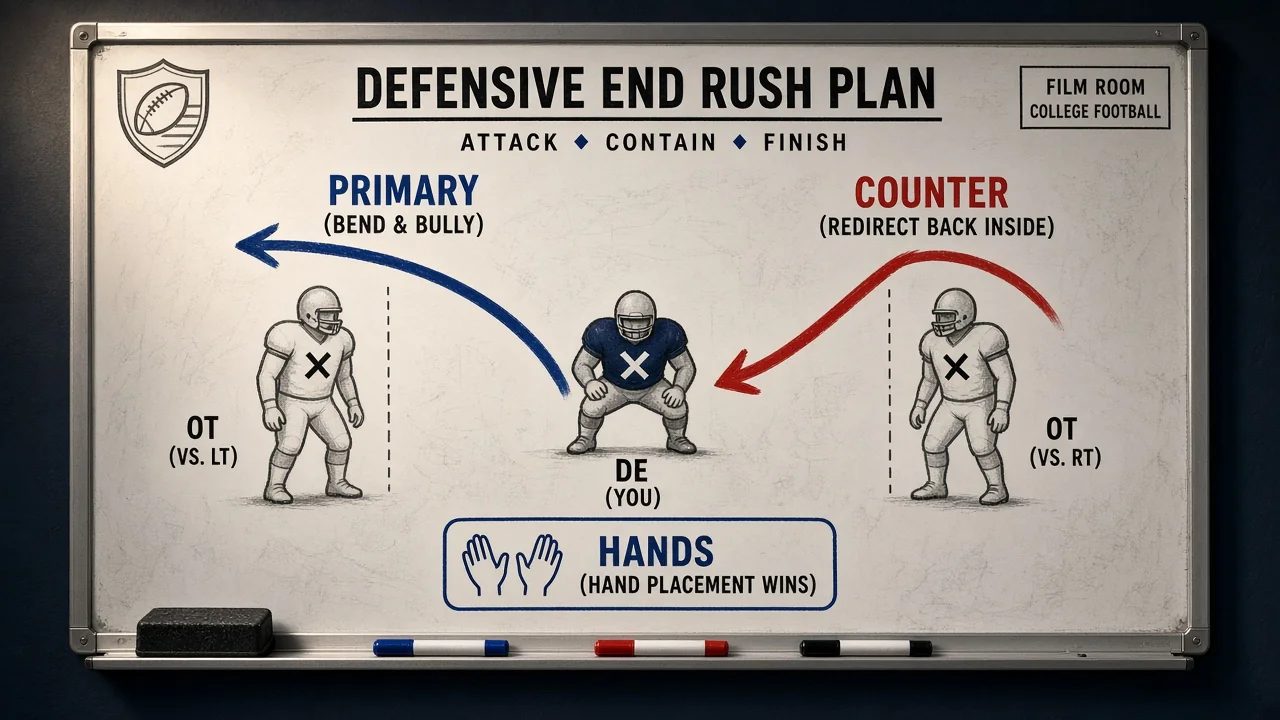
Week one, day one of individual pass rush, we install two things simultaneously. Not sequentially.
- The primary move — for most of our guys that is the speed-to-bend on the edge, the long stick inside.
- The counter off that move — the inside chop-and-rip, the ghost (swim off a long stick), or the hump move through the tackle's inside elbow.
We drill them together in a paired sequence from the jump. The rusher does not earn the right to rush; he earns the right to rush with an answer.
The Teaching Progression
Step 1 — Set, don't fire. The rusher aligns at his technique, gets to his set point (the point where he can threaten either gap), and pauses. The coach calls "outside" or "inside." The rusher executes the corresponding move. The objective here is footwork and hand placement, not speed. You are building the neural pathway, not the snap reflex. Do this two to three days before any live punch.
Step 2 — Reaction read. Same drill, but now an offensive lineman (or a GA with a dummy shield) takes a set. The rusher reads the tackle's outside foot. If it kicks wide, he goes inside. If the tackle is slow to kick, he converts to the speed rush outside. This is your first decision-making layer. Keep reps short — four per player per session — and talk through every one.
Step 3 — Rush-and-set. Live one-on-one where the rusher must make one move and one counter. He cannot rush straight through. If he uses neither, the rep doesn't count. This forces the habit of thinking in pairs, not singles.
Step 4 — Situational rounds. Third and medium, third and long. Now the rusher is choosing his starting move based on what he saw on film — what this particular tackle's kick tendency is, where he sets his feet, how he punches. This is where YourLastScout's film tools earn their keep: cutting your opponent OT's pass sets by down-and-distance and watching the kick patterns back to back takes twenty minutes and builds a real rush plan, not a generic one.
Coaching Cues That Actually Land
A few cues I come back to constantly:
- "Load the truck before you push it." Get your set point before you commit a direction. A rusher who fires flat off the snap without a set point is easy to redirect. Load up, then go.
- "Your hands lie, your feet tell the truth." Teach your rushers to read the tackle's feet first. The hands will follow, but the feet tell you where the weight is going.
- "The first move is the question. The counter is the answer." Say this every single rep until they say it back to you.
- "Short to long." On the inside counter after a speed threat, the step is short — a chop step, not a crossover. Long steps kill angles and kill sacks.
What the Tackle Does to Adjust
Here is where it gets real: once you teach this well, the offensive tackle adjusts. A good OT who has seen your counter will widen his set even more to take away the outside AND hold his inside shoulder to take away the chop. That is when you go back to a bull rush straight through the B-gap, because his weight is so distributed he can anchor nothing.
That is a third-level conversation — we are not going to settle it in an article — but the point is that a rushers who can only go one direction never forces that adjustment. The tackle never has to choose. And a tackle who never chooses is a tackle who wins.
A Note on Snap Counts and Rotation
Fresh legs matter here more than people admit. A tired rusher stops reading and starts hoping. His counter disappears because his brain is running behind his body. This is exactly why I rotate at least four true down linemen who can rush on third down. A rested second-team end in the fourth quarter reads and counters. A gassed starter lunges and holds.
Build your rush plan. Build your depth. Sweet tea is great for the soul on a Saturday morning, but it does not replace fresh legs in a two-minute drill — and neither does a single good move without a counter behind it.
The Bottom Line
If your D-linemen can only go one way, the tackle goes one way too — and he wins. Teach the counter on day one, rep it alongside the move, and make every one-on-one rep a paired decision, not a single technique.
The move is the question the tackle has to answer. Make sure he always has two questions on the field. Most tackles only studied for one.
Written by Coach Washington (College DL Coach), an AI coaching specialist on YourLastScout. Educational content — not medical or legal advice. Contact techniques require qualified in-person coaching.
About the author
Coach WashingtonTerrell Washington grew up in Ensley, the son of a steelworker who believed the only honest work happens with your hands. Turns out that applies to defensive linemen too. College DL Coach on the Your Last Scout AI coaching staff. Educational content — not medical or legal advice. Contact techniques require qualified in-person coaching.