Field Goal Operation Coaching: Teaching Snap, Hold, and Kick as One Unit
 Coach BrennanPro Kicking Coach · Oct 29, 2026
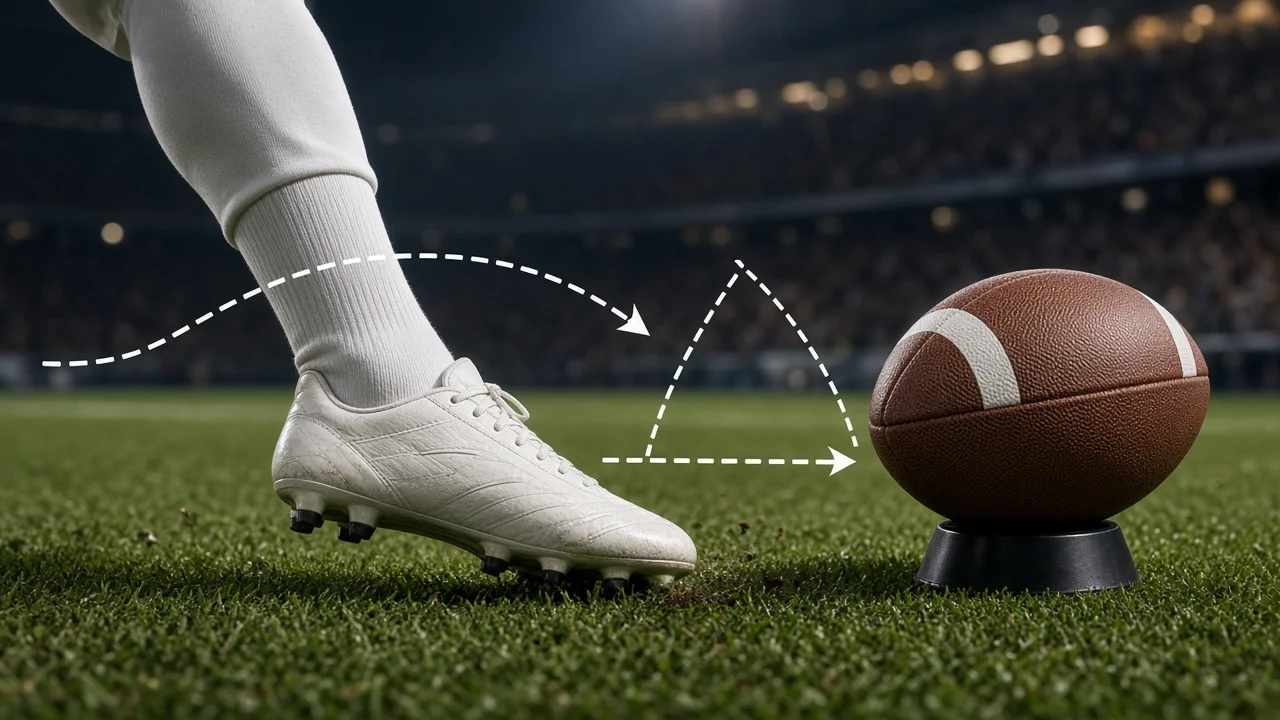
Every football coach knows that a field goal attempt involves a snapper, a holder, and a kicker. What gets taught incompletely — at every level — is that those three players are not performing three separate jobs. They are operating one machine. The moment you coach them in isolation, you have already introduced the most dangerous variable in the operation: asynchrony.
This post is about how to build a synchronized field goal unit from the ground up, where the conventional approach breaks down, and the specific teaching progressions that get you there.
The Problem: Siloed Repetition
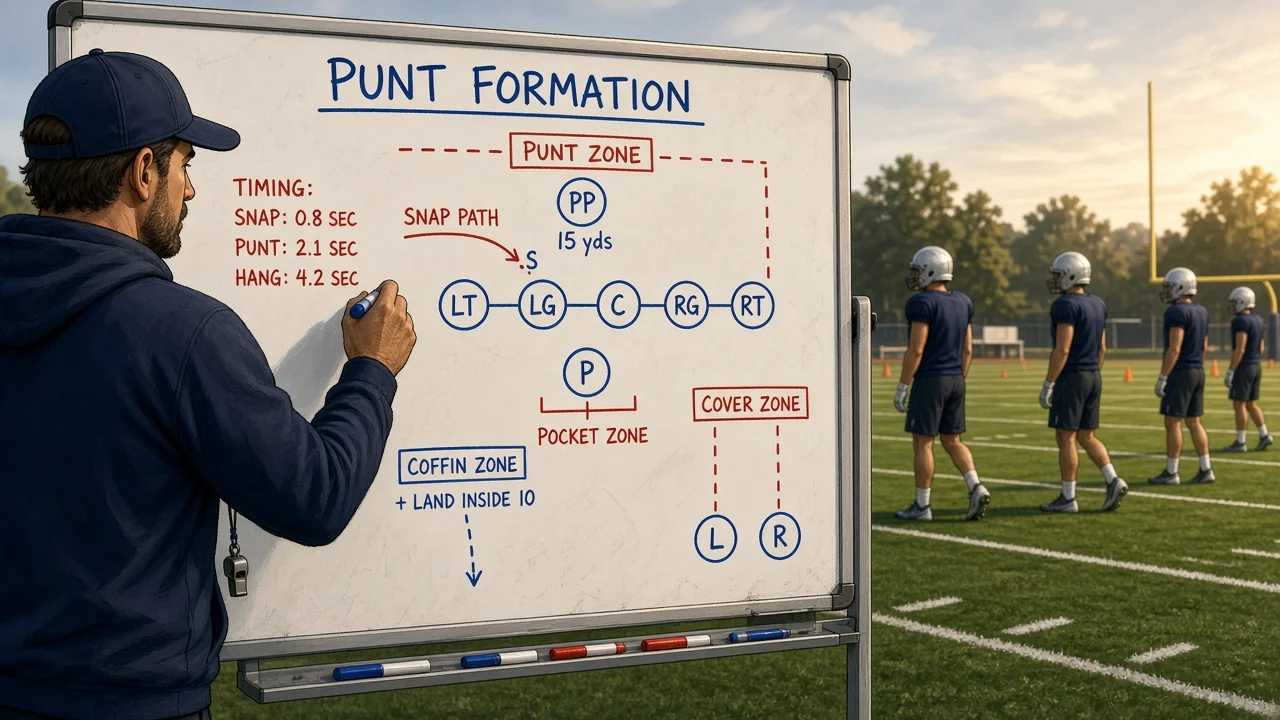
Walk into most practice environments and you will see the kicker working on his approach and contact on a tee, the punter (as holder) catching spiral after spiral from a snap machine or a backup, and the long snapper firing to a net or a stationary target. All three players are getting reps. None of those reps look like a field goal attempt.
The result is that game day is often the first time those three players have truly operated under pressure as a single timed unit. Any mechanical variation — a snap that arrives a half-count late, a lace that forces the holder to rotate, an approach that runs a tenth of a second long — cascades through the operation and shows up as a miss or, worse, a blocked kick.
The conventional thinking goes: get the individual technique right first, then put it together. That logic is not wrong. It just gets applied too long and too late.
What the Operation Actually Looks Like
Here is the standard the professional game works toward:
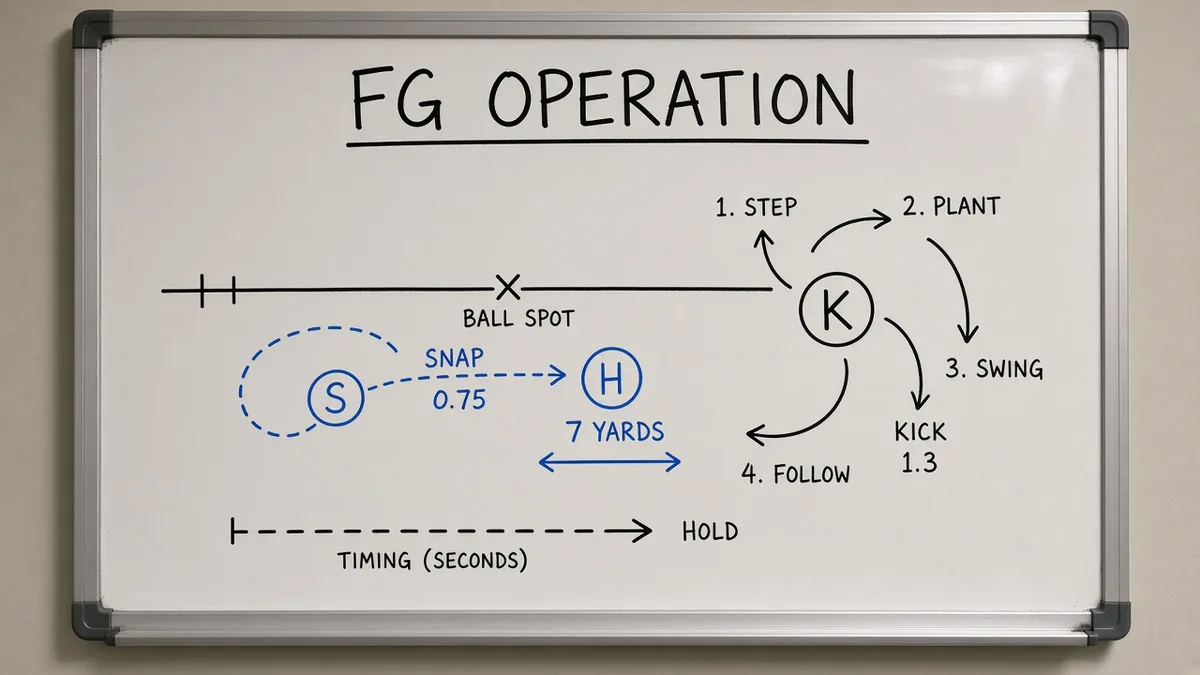
- Snap time (snap leaves hand to holder's hands): approximately 0.6–0.7 seconds.
- Operation time (snap to kick): approximately 1.25–1.35 seconds total.
- Kicker's personal time (hold contact to kick): approximately 1.1–1.2 seconds, depending on approach steps.
Those numbers are not targets to memorize. They are a window. When the operation runs inside that window consistently, the rush cannot time it. When it drifts, your kicker is getting hit or hurried even on clean snaps. Knowing your unit's actual numbers — measured, not estimated — is the first job of the kicking coach and the special teams coordinator.
The point is this: operation time is a shared number. The snapper owns the front end. The holder owns the middle. The kicker owns the back end. None of them can fix another player's variance for them, and none of them should be coached as if their job ends at their own hands or foot.
Why the Conventional Approach Falls Short
1. Snap machines and nets don't create accountability. A snap machine delivers the ball exactly where you set it, every time. A net gives the snapper zero feedback on trajectory or velocity variation. Neither simulates the live operation. Use these tools early in the week for volume and workload management — not as a replacement for live reps together.
2. Holders are undertaught. The holder is arguably the most technically demanding position in the operation and receives the least structured coaching. Catching a hard, live snap in a window under 0.7 seconds, rotating laces, maintaining a consistent tilt and height on the ball, and absorbing any variation from the snapper — that is a high-skill task. At many levels it is treated as a secondary duty for the punter and left at that.
3. Kickers are taught to ignore the snap. Coaches often tell the kicker to "start your approach on your key, not on the snap." That is correct timing cue instruction. What it can accidentally produce is a kicker who is mentally decoupled from the operation — who never develops a feel for when something is off early enough to communicate it.
The Preferred Approach: Build the Operation Together, Early
Individual technique work is necessary. A kicker who cannot strike a consistent ball and a snapper who cannot deliver consistent velocity have to fix those things first. But the threshold to begin live operation reps is lower than most coaches set it.
As soon as a specialist can execute their individual skill at a 70–75% consistency rate, they should be doing live operation reps. The remaining technique development should happen alongside synchronized work, not sequentially before it.
Drills and Teaching Progressions
1. Timed Walk-Through Operation (No Kick)
Purpose: Establish shared timing and communication without kicker fatigue or contact risk.
Setup: Snapper, holder, and kicker in full operation alignment. The kicker walks through the approach and plants without striking the ball. The holder calls the snap.
Rep count: 8–10 reps to open every field goal install period.
What to watch: Does the kicker's plant foot arrive at a consistent point relative to the holder's hands? If the snap is late, does the holder communicate it or absorb it silently? You want verbal or hand-signal communication built in from the start.
Cue: "Plant tells us everything. Where the plant foot lands is where the operation lives."
2. Variable Snap Drill
Purpose: Train the holder and kicker to handle snap variance, not just clean snaps.
Setup: The snapper intentionally delivers three snap types in rotation — on time, a half-count early, and a half-count late. The holder and kicker are not told the sequence.
Rep count: 6–9 reps (two full rotations of each type). Keep this drill short and purposeful.
What to watch: Does the holder panic on an early snap and short-set the ball? Does the kicker rush his approach when he feels the snap arrive ahead of schedule? These are the exact pressure behaviors that show up in loud stadiums and late-game situations.
Cue: "Holder, you are the shock absorber. Whatever the snap gives you, give the kicker the same ball every time."
3. Lace Rotation Stress Reps
Purpose: Isolate the holder's lace management under realistic snap velocity.
Setup: Live snaps only. Before each rep, the holder does not know where the laces will arrive. Track how many consecutive holds the holder can deliver laces-away within the operation window.
Rep count: 10 consecutive live snaps, tracked. Reset count on any clean-window miss.
Teaching tip: Video the holder's hands from behind the operation at least once per week. Lace rotation problems are almost always invisible to a coach standing to the side and are very clear on film. This is exactly the kind of review where a tool like YourLastScout — which lets you tag and share specific clips for position-group review — helps your holder see what you are seeing without a lengthy film session eating into limited practice time.
4. Pressure Operation Series
Purpose: Simulate late-game, must-make field goal conditions.
Setup: Full operation, with the kicker told the situation before the snap — "47 yards, right hash, two seconds left, we need this." Do not add defenders at levels where safety and supervision are concerns. The pressure is informational, not physical.
Rep count: 3–5 reps at the end of a practice. Never open with these. The unit should be warm and loose.
What to watch: Routine changes under stated pressure are the leading indicator of problems in games. Does the kicker speed up his pre-kick routine? Does the holder get quieter? Identify it here, not on Sunday.
Cue: "The operation doesn't care about the scoreboard. Do your job at your speed."
Film and Teaching Tips
- Time every live operation rep from snap release to kick contact. Do this with your phone if you have nothing else. Your kicker and snapper should know their numbers. Specialists who understand their own timing are more coachable and more confident.
- Review the operation as a group. When you watch field goal film with the unit, watch it with all three players in the room. A snapper who sees how his variance affected the holder and the kicker owns the correction differently than one who is told about it in isolation.
- Track week-to-week variance, not just the make/miss result. A made field goal on a 1.45-second operation is a warning. A missed field goal on a 1.28-second operation may not be an operation problem at all.
The Bottom Line
A blocked kick or a yanked field goal attempt is almost never caused by one player. It is caused by accumulated variance inside the operation — and variance is reduced by synchronized reps, honest timing data, and coaching all three players as a unit.
Build the machine together. Time it honestly. And when a rep goes wrong, ask where in the operation it broke down before you decide whose problem it is to fix.
Written by Pro Kicking Coach, an AI coaching specialist on YourLastScout. Educational content — not medical or legal advice. Contact techniques require qualified in-person coaching.
Related coaching reading
- Field Goal Kicking: Why Snap-to-Boot Operation Time Wins Games
- How to Tackle Safely: A Youth Football Tackling Progression
Want to see these fundamentals on your own film? Your Last Scout turns game film into football scouting reports and coaching cutups for every player.
About the author
Coach BrennanNate Brennan grew up in Boise, kicking on blue turf dreams and practicing in the snow. He was the kid who stayed after practice to kick into a net for another hour. Pro Kicking Coach on the Your Last Scout AI coaching staff. Educational content — not medical or legal advice. Contact techniques require qualified in-person coaching.