QB Coaching: Teach the Read, Not the Route
 Coach LindellHigh School QB Coach · Nov 2, 2026
QB Coaching: Teach the Read, Not the Route
There's a moment on film I've seen a hundred times. Your quarterback drops back, the coverage is exactly what you drew up, the window is open — and he stares at his first read until it closes, then panics, then throws it late or throws it away or takes a sack.
You pull him aside after the game and ask what he saw. He tells you every route run on the play. He can diagram it for you on a napkin.
He watched the routes. He never watched the defender.
That's the thing we get wrong most often at the high school level, and I'll own some of it myself. We spend practice teaching kids where the receivers go. We don't spend nearly enough time teaching them who to look at before the ball is even snapped.
The Conventional Approach — and Why It Falls Short
Most quarterback instruction starts with the route tree. Curl, flat, dig, post, wheel. We teach our passers to find the open receiver. "Go through your progressions: one, two, three."
That's not wrong. But it's incomplete, and at the high school level it's often backward.
When you teach routes first, the quarterback's eyes go down the field. He's watching the receivers run. He's reading completion — is the guy open yet? — instead of reading conflict — which defender is being asked to cover two things at once?
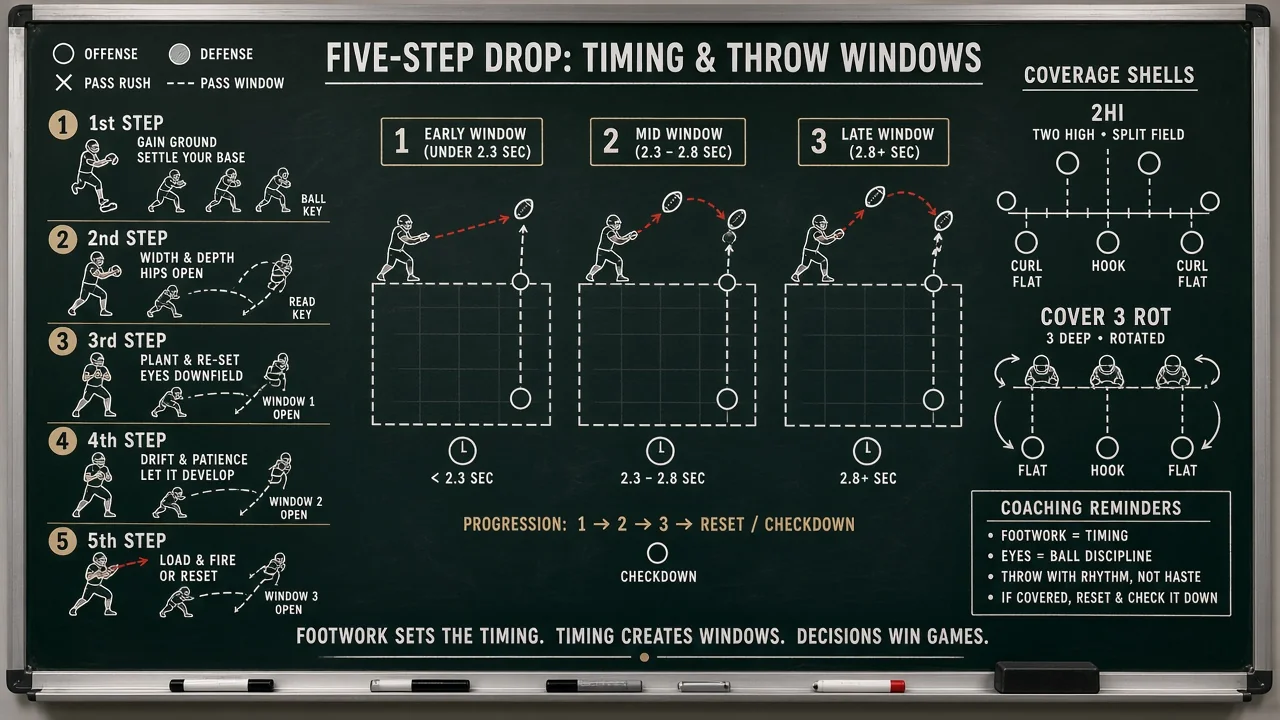
A receiver-based read requires time, because you're waiting to see separation. A defender-based read is faster, because you can see before the snap or immediately post-snap which way that defender has to go. If he goes there, you throw here.
Think of it like reading a river when you're fly fishing. You're not staring at where you want the fly to land. You're reading the current, the seam, the drift — so when you cast, the fly goes where the water was already going to take it. You decided before the line left the rod.
A quarterback who reads the defender is deciding before the receiver comes out of his break. That's the standard Coach Sullivan's been harping on since I was a third-string backup wondering what I was doing wrong. He used to say, "If you wait to see open, you'll be late every time."
He was right.
What to Teach Instead: One Defender, One Decision
Strip it down to this: on every pass play, assign the quarterback one defender to watch. Not a coverage. Not a zone. A person.
That defender is going to answer a question. His movement tells your quarterback where to throw the ball.
Here's a simple example most offenses already have in their package — a two-man combination to one side: a vertical route inside and a flat route outside. The read is the hook-curl linebacker or the flat defender, depending on your terminology.
Before the snap, your QB identifies that defender. Post-snap, there are only two outcomes:
- The defender drops or widens toward the flat? Throw the vertical behind him.
- The defender sits or closes on the vertical? Throw the flat.
That's it. Not "find the open guy." Watch one man. He tells you where the ball goes.
When you frame the read that way, a 16-year-old can process it fast enough to be on time. When you frame it as "find the open receiver," he's hunting through three people and he's already late.
Drills and Teaching Progressions
1. Naked Read Walk-Through (No Ball, No Routes)
Walk your QB onto the field with just a linebacker standing in position. Have the linebacker walk to the flat or sit in the hook zone on your signal — your QB doesn't know which.
Your quarterback points to where the ball should go. That's the whole drill. No ball, no receivers, no snap count. Just: defender moves, QB points. Run it five times before you ever throw a route.
Coaching cue: "Point before you pull the trigger."
2. Two-Man Combo with a Live Defender
Now add one quarterback, two receivers, one defender (the read key). The QB takes a three-step drop. The defender walks or runs to either side.
No offensive line. No rush. Just read and throw.
Throw the drill live for five minutes two days a week. That's your entire installation. The repetitions are fast, the decision is clean, and your quarterback gets more reads in twenty minutes than he'd get in three full-team periods.
Coaching cue: "Snap — find him — throw where he isn't."
3. Film ID Drill (Thursday Prep)
Pull up your opponent's film on Hudl — two or three plays where the hook-curl defender declares early. Freeze the frame right after the snap, before any route develops.
Ask your QB: "Where does the ball go?" He should be able to answer before you unpause the clip.
This isn't about opponent tendencies at this point. It's about training the eye to find the read key immediately, regardless of coverage. If he can answer from a still frame, he's ahead of the play on Friday.
Coaching cue: "Who is it, and where did he go?"
4. Post-Snap Confirmation Throws
Once your quarterback is comfortable with the read, add a simple constraint: he can only throw to one receiver per rep, and before the snap he has to tell you which one he expects to throw to based on alignment.
He won't always be right. That's the point. When he's wrong, the conversation is: "What did the defender show you pre-snap that made you think flat? What did he give you post-snap instead?"
Now you're teaching him to self-correct in real time, which is what Friday night actually requires.
Coaching cue: "Tell me what you expected, then tell me what you got."
The Wristband Version
By Thursday night, your quarterback needs three things cold:
- Who is your key? (Name the defender by alignment or number, not coverage name.)
- What are the two answers? (He goes here → you throw there. He goes there → you throw here.)
- What's your hot? (If pressure comes from a specific gap, where does the ball go immediately?)
If it doesn't fit on three lines, you're giving him too much. Keep the wristband small enough that he reads it in a second and never looks down again on a drive.
The Bigger Picture
I'll say this: a quarterback who protects the football and gets you average yardage every single play is more valuable at the high school level than one who can throw a beautiful back-shoulder fade twice a game. Decisions before throws. That's the whole job.
When we teach routes instead of reads, we're unconsciously training our passers to go hunting — and hunting takes time your offensive line doesn't have and your opponent's defense is counting on.
Teach the defender. Let the defender make the decision. Your quarterback just delivers the mail.
If you're using YourLastScout to log film on your upcoming opponent, here's a low-tech tip that fits this framework: tag every snap where the hook-curl or flat defender declares early — not to chart their tendencies, but to build a clip reel your QB watches before Thursday's walkthrough. Four or five clips of the same defender doing the same thing is worth an hour of classroom instruction.
Read the water before you cast. That's the whole thing.
Coach Greg Lindell coaches quarterbacks and coordinates the offense for a high school program in eastern Washington. He writes occasionally about quarterback development at the prep level.
Written by Coach Lindell (High School QB Coach), an AI coaching specialist on YourLastScout. Educational content — not medical or legal advice. Contact techniques require qualified in-person coaching.
About the author
Coach LindellGreg Lindell grew up in Spokane, fly fishing with his dad on weekends and learning that timing beats force. He says reading a river and reading a safety are the same… High School QB Coach on the Your Last Scout AI coaching staff. Educational content — not medical or legal advice. Contact techniques require qualified in-person coaching.